
Sublocade vs. Suboxone: Injection vs. Film, Doses, Withdrawal & Key Differences
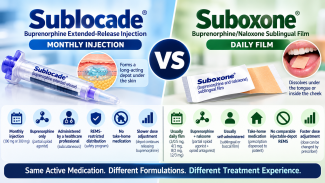
Quick answer: Sublocade and Suboxone both use buprenorphine to treat opioid use disorder, but they deliver it very differently. Sublocade is a long-acting buprenorphine injection administered by a healthcare professional, while Suboxone is a buprenorphine/naloxone film usually taken daily under the tongue or inside the cheek. Sublocade removes daily dosing, while Suboxone allows faster dose adjustments.
Last updated: September 26, 2026.
Medically reviewed by: Brandon McNally, RN
Safety note: Both medications contain buprenorphine and can cause precipitated withdrawal if buprenorphine is initiated while sufficient fentanyl, heroin, methadone or another full opioid agonist remains active. Combining buprenorphine with alcohol, benzodiazepines, gabapentinoids or other central nervous system depressants can increase the risk of sedation, respiratory depression and overdose.
Key Takeaways
- Sublocade contains buprenorphine only. Suboxone contains buprenorphine plus naloxone.
- Sublocade is a long-acting injection. Suboxone is generally a daily sublingual or buccal film.
- Sublocade is administered by a healthcare professional. Suboxone is usually self-administered at home.
- Sublocade is distributed through a restricted REMS program. Patients do not take the injection home.
- Suboxone offers faster dose adjustment. Sublocade continues releasing buprenorphine after the injection is given.
- Current Sublocade labeling no longer requires every new patient to complete seven days of Suboxone first.
- Patients already taking 8–24 mg/day of transmucosal buprenorphine may be transitioned directly to the labeled 300 mg starting injection when clinically appropriate.
- Neither medication is universally better. The choice depends on clinical response, adherence needs, treatment stage, access and patient preference.
Table of Contents
- Sublocade vs. Suboxone at a Glance
- What Is the Main Difference?
- Are Sublocade and Suboxone the Same Medication?
- Why Does Suboxone Have Naloxone?
- Is Sublocade Better Than Suboxone?
- How Do the Doses Compare?
- Do You Have to Take Suboxone Before Sublocade?
- Do You Still Take Suboxone After the Sublocade Shot?
- Which Has Worse Withdrawal?
- How Long Do They Stay in Your System?
- Side Effects
- Which Has Less Diversion Risk?
- What Does REMS Mean?
- Can You Switch Between Sublocade and Suboxone?
- Myth vs. Fact
- When to Seek Medical Help
- Frequently Asked Questions
- Related Clinical Resources
- References
Sublocade vs. Suboxone at a Glance
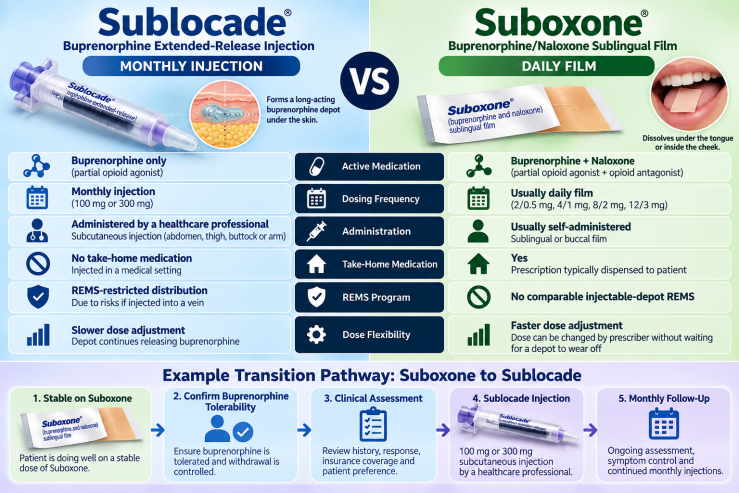
The biggest difference is how buprenorphine is delivered. Sublocade creates a long-acting depot under the skin, while Suboxone is absorbed through the mouth and generally taken every day.
| Feature | Sublocade | Suboxone |
|---|---|---|
| Active medication | Buprenorphine | Buprenorphine + naloxone |
| Form | Extended-release injection | Sublingual or buccal film |
| Usual frequency | Monthly | Daily |
| Administration | Healthcare professional | Usually self-administered |
| Take-home medication | No | Yes |
| Naloxone included? | No | Yes |
| Controlled substance | Schedule III | Schedule III |
| REMS-restricted depot distribution | Yes | No comparable depot REMS |
| Dose adjustment | Slower | Faster |
What Is the Main Difference Between Sublocade and Suboxone?
Sublocade provides continuous buprenorphine exposure from a long-acting injection, while Suboxone provides buprenorphine through a film that is generally taken every day.
Suboxone gives the prescriber considerably more short-term dosing flexibility. If withdrawal, cravings, sedation or other clinical factors change, the daily dose can usually be adjusted without waiting for a long-acting depot to dissipate.
Sublocade works differently. After it is injected into the subcutaneous tissue, it forms a depot that releases buprenorphine over an extended period. Once the injection is administered, that month's medication cannot simply be removed or reduced the next day.
The central tradeoff is therefore daily flexibility versus long-acting adherence.
Are Sublocade and Suboxone the Same Medication?
No. They both contain buprenorphine, but they are different drug products.
Sublocade contains extended-release buprenorphine without naloxone. Suboxone contains two medications:
- Buprenorphine: a partial opioid agonist that reduces withdrawal and cravings.
- Naloxone: an opioid antagonist included primarily as a misuse-deterrent component.
Buprenorphine provides the primary therapeutic opioid-use-disorder effect in both products.
For a broader explanation of buprenorphine pharmacology and treatment, see SAMHSA's buprenorphine treatment overview.
Why Does Suboxone Have Naloxone but Sublocade Does Not?
Suboxone includes naloxone primarily to discourage certain forms of misuse, while Sublocade does not require the same formulation because the injection is administered by a healthcare professional.
When Suboxone is taken as directed under the tongue or inside the cheek, buprenorphine provides most of the intended treatment effect.
Sublocade does not contain naloxone because the patient does not receive syringes or a take-home supply. The medication is kept within a restricted healthcare distribution system and injected by a healthcare professional.
Is Sublocade Better Than Suboxone?
Neither medication is universally better. Sublocade can reduce daily adherence and diversion problems, while Suboxone provides substantially more dose flexibility.
Sublocade may fit situations where:
- taking medication every day is difficult;
- medication is repeatedly lost or stolen;
- diversion is a concern;
- the patient prefers not to think about medication every morning;
- stable long-acting buprenorphine exposure is desirable;
- monthly clinic administration fits the treatment plan.
Suboxone may fit situations where:
- buprenorphine treatment is being initiated or titrated;
- rapid adjustments are clinically useful;
- the patient prefers daily control over medication;
- access to monthly injection services is difficult;
- insurance coverage or pharmacy access favors transmucosal treatment.
The treatment decision should be individualized rather than based on the assumption that an injection is automatically more effective than a film.
How Do Sublocade and Suboxone Doses Compare?
Sublocade and Suboxone cannot be compared milligram for milligram. Their formulations deliver buprenorphine through very different pharmacokinetic systems.
Suboxone film strengths
- 2 mg buprenorphine / 0.5 mg naloxone
- 4 mg / 1 mg
- 8 mg / 2 mg
- 12 mg / 3 mg
Current prescribing information describes Suboxone as a single daily dose during maintenance, with dosing individualized according to clinical response.
Sublocade doses
- 300 mg initial injection
- 300 mg second injection under the standard initiation schedule
- 100 mg monthly recommended maintenance dose
- 300 mg monthly maintenance may be considered when 100 mg is tolerated but clinical response is inadequate
The second injection can be administered as early as one week after the first injection when clinically appropriate.
Clinical Pearl: The milligram number printed on a depot injection should not be compared directly with the milligram number on a daily film. What matters clinically is buprenorphine exposure over time, receptor occupancy, symptom control and tolerability.
For related dosing questions, see Signs Your Suboxone Dose Is Too Low (Cravings, Withdrawal & What to Do).
Do You Have to Take Suboxone for Seven Days Before Sublocade?
No. The current FDA-approved Sublocade labeling no longer requires every patient to complete seven days of Suboxone or another transmucosal buprenorphine product before the first injection.
If the patient is not already taking buprenorphine
Current labeling states that treatment should begin when objective and clear signs of opioid withdrawal are present. The patient receives an initial transmucosal buprenorphine dose, such as 4 mg, and is observed for approximately one hour to confirm tolerability.
If symptoms are stable or improving, the labeled starting Sublocade dose is 300 mg. Additional transmucosal buprenorphine may be used on induction day when clinically appropriate to manage withdrawal symptoms.
If the patient is already taking buprenorphine
Patients already receiving 8–24 mg per day of transmucosal buprenorphine may be transitioned directly to the recommended 300 mg starting dose of Sublocade.
That means a patient who is already stable on an appropriate Suboxone dose does not necessarily need another seven-day waiting period solely because Sublocade is being started.
The transition should still be supervised by the prescribing clinician.
Do You Still Take Suboxone After the Sublocade Shot?
Suboxone is not automatically continued every day after Sublocade is administered. Sublocade itself continues releasing buprenorphine throughout the dosing interval.
Transmucosal buprenorphine may be used during certain induction or symptom-management situations under prescriber supervision, but patients should not independently add Suboxone because they feel the injection is not working strongly enough.
If breakthrough withdrawal or cravings occur, the clinician should evaluate:
- timing of the injection;
- previous buprenorphine exposure;
- ongoing opioid use;
- drug interactions;
- dose adequacy;
- whether another medical or psychiatric issue is contributing to symptoms.
Which Has Worse Withdrawal: Sublocade or Suboxone?
Both medications can produce physical dependence because both contain buprenorphine, but the timing of withdrawal can be very different.
Suboxone concentrations decline much faster after the final daily dose. Abrupt discontinuation can therefore produce withdrawal on a shorter timeline.
Sublocade releases buprenorphine slowly from its depot. After discontinuation, buprenorphine exposure may decline gradually and withdrawal may be delayed.
The slower decline does not mean withdrawal is impossible. Current Sublocade labeling instructs clinicians to consider its extended-release characteristics and monitor patients for withdrawal for months after discontinuation.
Do not abruptly stop or attempt to taper either medication without medical guidance.
How Long Do Sublocade and Suboxone Stay in Your System?
Sublocade generally remains in the body substantially longer than daily Suboxone because the injection creates a long-acting depot.
Suboxone's buprenorphine component has a much shorter elimination timeline, although the exact drug-test detection window varies with dose, duration of use, metabolism and the type of test being performed.
Sublocade can remain detectable for a prolonged period after repeated injections because buprenorphine continues to be released from the depot.
This can matter for:
- drug testing;
- surgery and anesthesia;
- acute pain treatment;
- medication transitions;
- withdrawal timing.
For a detailed discussion of detection windows, see How Long Does Suboxone Stay in Your System?.
Sublocade vs. Suboxone Side Effects
Many side effects overlap because both medications contain buprenorphine, but Sublocade adds injection-site risks while Suboxone adds oral-film-specific effects.
Possible Sublocade side effects
- constipation;
- headache;
- nausea;
- fatigue or sedation;
- injection-site pain, redness or itching;
- liver-related abnormalities;
- respiratory depression, especially with other CNS depressants.
Possible Suboxone side effects
- headache;
- nausea or vomiting;
- constipation;
- insomnia;
- sweating;
- oral numbness;
- tongue or oral mucosal discomfort;
- sedation and respiratory depression when combined with other depressants.
Patients should seek medical guidance for severe sedation, significant breathing problems, liver-related symptoms or a Sublocade injection site that becomes increasingly painful, infected, draining or ulcerated.
Which Has Less Diversion Risk: Sublocade or Suboxone?
Sublocade provides far fewer opportunities for medication diversion because the patient does not receive a take-home supply.
Suboxone is usually dispensed through a pharmacy for self-administration. That creates possible risks including:
- lost medication;
- theft;
- sharing or selling medication;
- unintentional pediatric exposure;
- missed daily doses.
Sublocade remains within the clinical distribution chain and is administered by a healthcare professional.
That distinction can be clinically relevant for patients experiencing unstable housing, medication theft, difficulty with daily adherence or repeated diversion concerns.
What Does REMS Mean for Sublocade?
REMS stands for Risk Evaluation and Mitigation Strategy. Sublocade is subject to an FDA-required restricted distribution program because intravenous administration of the depot formulation can cause serious harm or death.
According to the official Sublocade REMS program, Sublocade forms a solid mass after contact with body fluids. Intravenous administration can result in blood-vessel occlusion, local tissue injury and thromboembolic complications, including life-threatening pulmonary embolism.
Because of this risk:
- patients do not receive Sublocade to take home;
- healthcare settings and pharmacies that order or dispense it must meet REMS requirements;
- the medication is provided directly to a healthcare provider;
- the injection is administered by a healthcare professional.
Suboxone does not use this injectable-depot REMS distribution system because it is a transmucosal film rather than a depot injection.
Can You Switch From Suboxone to Sublocade?
Yes. Switching from transmucosal buprenorphine such as Suboxone to Sublocade is an established treatment pathway.
Under current labeling, patients receiving 8–24 mg per day of transmucosal buprenorphine can be transitioned directly to a 300 mg Sublocade starting dose when clinically appropriate.
The prescriber may consider:
- the current Suboxone dose;
- withdrawal and craving control;
- adherence;
- sedation;
- ongoing opioid use;
- other medications;
- insurance authorization;
- patient preference.
Can You Switch From Sublocade Back to Suboxone?
Yes, but there is no single restart day that applies to every patient. Sublocade continues releasing buprenorphine after the last injection.
A clinician may consider:
- time since the final injection;
- previous Sublocade dose;
- withdrawal symptoms;
- cravings;
- sedation;
- other medications;
- overall clinical response.
Additional transmucosal buprenorphine should be introduced under clinical supervision while residual Sublocade exposure is still present.
Sublocade vs. Suboxone: Myth vs. Fact
| Myth | Fact |
|---|---|
| Sublocade is simply injectable Suboxone. | Sublocade contains buprenorphine only. Suboxone contains buprenorphine plus naloxone. |
| You must take Suboxone for seven days before Sublocade. | Current labeling permits initiation after a tolerated transmucosal buprenorphine dose, and patients already taking 8–24 mg/day of transmucosal buprenorphine may transition directly to the labeled 300 mg Sublocade starting dose. |
| You automatically keep taking Suboxone every day after receiving Sublocade. | Sublocade continuously releases buprenorphine. Supplemental transmucosal buprenorphine should only be used when directed by the treating clinician. |
| Sublocade cannot cause withdrawal because it wears off slowly. | Physical dependence can persist, and withdrawal may emerge later as depot buprenorphine levels decline. |
| Suboxone is weaker because it is not an injection. | Route of administration does not determine whether buprenorphine treatment is clinically adequate. |
| Patients can pick up Sublocade and bring it home. | Sublocade uses restricted REMS distribution and is administered by a healthcare professional. |
When to Seek Medical Help
Call emergency services for slowed or stopped breathing, inability to wake, blue or gray lips, seizures, severe confusion or loss of consciousness. Give an opioid overdose reversal medication such as naloxone when an opioid overdose is suspected if it is available.
Contact the treating clinician promptly for severe sedation, significant breakthrough withdrawal, worsening cravings, jaundice, dark urine or a Sublocade injection site that becomes increasingly painful, hot, draining, ulcerated or markedly swollen.
Frequently Asked Questions About Sublocade vs. Suboxone
Is Sublocade the same as Suboxone?
No. Both contain buprenorphine, but Sublocade is a long-acting injection containing buprenorphine alone. Suboxone is a transmucosal film containing buprenorphine and naloxone.
Does Sublocade have naloxone in it?
No. Sublocade contains buprenorphine only. Suboxone contains buprenorphine plus naloxone.
Can you go straight from Suboxone to Sublocade?
Patients already taking 8–24 mg per day of transmucosal buprenorphine may be transitioned directly to the labeled 300 mg Sublocade starting injection when clinically appropriate.
Do you need seven days of Suboxone before Sublocade?
No. Current FDA labeling permits Sublocade initiation after a patient who is not already on buprenorphine tolerates an initial transmucosal buprenorphine dose and is appropriately observed.
Do you still need Suboxone after the Sublocade shot?
Not routinely. Sublocade itself releases buprenorphine continuously. Any supplemental transmucosal buprenorphine should be used only when directed by the treating clinician.
Which is stronger, Sublocade or Suboxone?
They cannot be compared by milligram numbers alone. Sublocade continuously releases buprenorphine from a depot, while Suboxone produces exposure from individual transmucosal doses.
Which lasts longer?
Sublocade lasts substantially longer because it is an extended-release depot. Suboxone is generally taken daily because its medication concentration changes much more quickly.
Can Sublocade cause withdrawal?
Yes. Sublocade contains buprenorphine and can produce physical dependence. Because the medication leaves the body slowly, withdrawal after discontinuation may be delayed.
Is Sublocade less likely to be diverted?
Yes. Patients do not receive a Sublocade supply to take home, which greatly limits opportunities for medication theft, sharing or diversion.
Can you switch back to Suboxone after Sublocade?
Yes, but timing should be individualized because buprenorphine from the Sublocade depot can remain active long after the final injection.
Related Clinical Resources
- Sublocade vs. Vivitrol: Buprenorphine vs. Naltrexone, Detox, Side Effects & Key Differences
- Brixadi vs. Sublocade: Doses, Side Effects, REMS, Half-Life & Key Differences
- Brixadi Dosing, Side Effects, Administration & Clinical Guide
- How Long Does Suboxone Stay in Your System?
- Signs Your Suboxone Dose Is Too Low (Cravings, Withdrawal & What to Do)
- Does Suboxone Help Kratom / 7-OH Withdrawal? A New York–Focused Answer
- Does Suboxone Help With Kratom Dependence?
- 7-Hydroxymitragynine (7-OH) and Kratom Withdrawal: Clinical Insights and Buprenorphine-Based Management
Source Verification
Medication composition, dose strengths, administration, induction, safety and REMS statements in this article were checked against current FDA-approved prescribing information for Sublocade and Suboxone and the official Sublocade REMS materials. Current labeling was prioritized over older web pages that still describe a universal seven-day transmucosal buprenorphine stabilization requirement before Sublocade.
References
- U.S. Food and Drug Administration. SUBLOCADE (buprenorphine extended-release) injection: Prescribing Information .
- U.S. Food and Drug Administration. SUBOXONE (buprenorphine and naloxone) sublingual film: Prescribing Information .
- SUBLOCADE REMS. Official SUBLOCADE Risk Evaluation and Mitigation Strategy .
- U.S. Food and Drug Administration. Information About Medications for Opioid Use Disorder .
- Substance Abuse and Mental Health Services Administration. Buprenorphine Treatment Information .
Last updated: September 26, 2026.
About the Author
Benjamin Zohar, NCACIP is a Nationally Certified Advanced Clinical Intervention Professional and ISSUP network moderator specializing in addiction intervention, treatment navigation and emerging substance-use risks. His educational work published through ISSUP on counterfeit medications, fentanyl exposure and concentrated 7-hydroxymitragynine has been cited or referenced by GoodRx, The Washington Post, WIRED and Newsweek.
Medical review: Brandon McNally, RN
Medical disclaimer: This article is intended for educational and public-health purposes. It does not provide individualized medical advice, diagnosis or a tapering schedule. Do not start, stop or alter a prescription medication without consulting a qualified healthcare professional. Call emergency services for seizures, difficulty breathing, loss of consciousness, severe confusion or other life-threatening symptoms.
```