Patient Navigation Plus mHealth Incentives for Linkage to OUD Care for Adults Who Also Use Methamphetamines A Pilot Randomized Clinical Trial
Abstract
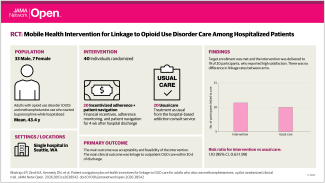
Importance Hospitalization is common among people with opioid use disorder (OUD) and is recognized as a reachable moment to start treatment. Methamphetamine use among people with OUD is associated with decreased linkage to postdischarge OUD care.
Objective To determine the feasibility, acceptability, and exploratory clinical outcomes of a pilot randomized clinical trial (RCT) of an adherence-focused mobile health (mHealth) intervention aiming to increase linkage to and retention in outpatient buprenorphine services for patients hospitalized with OUD and methamphetamine use.
Design, Setting, and Participants This single-site, 2-arm pilot RCT was conducted from January 3, 2024, to April 14, 2025, at a single-site, large urban safety net hospital in Seattle, Washington. Patients 18 years or older were eligible if they had initiated buprenorphine for OUD while in the hospital and had used methamphetamine within the past 30 days. Participants were randomized to the mHealth Incentivized Adherence Plus Patient Navigation (MIAPP) intervention or to treatment as usual (TAU).
Intervention The MIAPP intervention combined financial incentives via mHealth-based adherence monitoring with a patient navigator (PN) during the first 30 days after discharge.
Main Outcomes and Measures Feasibility was assessed by meeting the target enrollment of 40 participants and intervention delivery. Acceptability was measured by patient satisfaction ratings on a scale from 0 to 10, with 0 indicating not at all satisfied and 10 indicating extremely satisfied. The main pilot clinical outcome was linkage to outpatient OUD care within 30 days of hospital discharge, defined as medications for OUD being prescribed or dispensed. Other outcomes included retention in buprenorphine treatment and hospital readmissions at 90 days; past 30-day methamphetamine use was measured at the 30-day follow-up visit.
Results The target enrollment of 40 participants (mean [SD] age, 43.4 [12.6] years) was met. Most participants (33 [82.5%]) were male. The intervention was allocated to 20 participants and delivered to 19 (95.0%); 20 participants received TAU. Participants reported being highly satisfied with the PN, with a mean (SD) patient satisfaction rating of 9.9 (0.3). Linkage to OUD care at 30 days occurred in 11 participants (55.0%) in the intervention arm compared with 10 (50.0%) in the TAU arm (risk ratio, 1.10; 95% CI, 0.61-1.99).
Conclusions and Relevance In this pilot RCT of the MIAPP intervention, study procedures were feasible and acceptable. While no difference in linkage rates was noted in this pilot study, larger studies are needed to determine intervention effectiveness.
Trial Registration ClinicalTrials.gov Identifier: NCT06027814