The Road After Prison: Care, Recovery and Safer Communities with Michael Chaple Pt.4
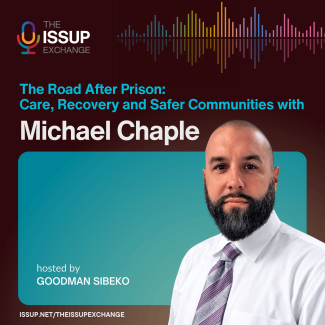
In this fourth and final episode of The Road After Prison: Care, Recovery and Safer Communities, Professor Goodman Sibeko is joined by Michael Chaple to explore how re-entry success can be measured beyond recidivism. Michael discusses the importance of treatment engagement, health and wellbeing, stable housing, employment, financial security, and social reintegration in understanding how people rebuild their lives after incarceration.
They also look at how successful reintegration can contribute to safer communities, the potential of technology in correctional treatment and re-entry, and what policymakers and practitioners can do now to strengthen support and remove barriers to successful re-entry.
Featured Voices
Host – A/Prof. Goodman Sibeko
ISSUP Global Scientific Advisor.
Head of Addiction Psychiatry, University of Cape Town.
LinkedIn: goodmansibeko
Twitter/X: @profgsibeko
Guest – Michael Chaple
Michael Chaple is an internationally recognised expert in correctional behavioural health, implementation science and justice-health systems integration. His work has focused on strengthening substance use and mental health services in correctional settings and improving continuity of care as people return to the community. Learn More>>
Time Stamps
Professor Goodman Sibeko (00:00)
Hello again and welcome to the fourth and final episode of The Road After Prison, Care Recovery, and Safer Communities with Michael Chapel. Across this series, we've followed the journey from treatment and custody across vulnerable transition after release and into the systems and partnerships that can really sustain that recovery. We're now going to look at success, how it should be defined and measured, what communities and justice systems gain when continuity of care improves.
And what developments may shape correctional treatment and re-entry over the next decade? Michael, welcome back. Thank you for coming back.
Michael Chaple (00:34)
Thank you for having me back.
Professor Goodman Sibeko (00:36)
Reentry success has traditionally been judged through recidivism Why is that measure important and why is it insufficient on its own?
Michael Chaple (00:44)
I would argue very strongly that measuring recidivism is not sufficient alone to evaluate re-entry programming and what you're doing. a complete view requires looking at personal success and well-being alongside measures of recidivism, whether that be rearrest, reconviction, reincarceration, however you want to define it. It's understandable that recidivism has been a major focus of the criminal legal system as the implied goal.
Would be to ensure that all those in custody do not re-offend. Yet this approach fails to track critical factors that contribute to the prevention of recidivism. This is not to argue that measuring recidivism isn't valuable, but it offers a limited view of the complexities faced by those re-enter in communities from incarceration. And if that's all we measure, we really don't have the ability to understand and adjust our approach to reentry accordingly, where we could see successes, we could see the successes we can build on, and we can see the struggles that we need to or are failing to address.
Professor Goodman Sibeko (01:42)
And so keeping that in mind, which outcomes then should a modern reentry system be prioritizing alongside the justice outcomes which, you know, are actually important to our communities as well?
Michael Chaple (01:53)
Yes, there there's a lot of ways we can go with this, but I I have a a report that I often reference when I talk about this because this is a conversation that's happening a lot, thankfully, that we need to expand beyond the measure of recidivism. There's a report titled Beyond Recidivism Redefining Measures to Understand Reentry Success. It's issued by the Council of State Governments, which provides a really valuable blueprint for expanding to a broader set of measures.
That redefines successful entry re-entry. So just to give you a taste of some of this, they track as one component what they term as recidivism progression, which refers to the pattern or trajectory of an individual's repeated involvement in the system and how it evolves over time. So you're talking about community supervision violations and revocations, time to re-event, severity of reoffense, and frequency of reoffense, right? So you can see that you're getting more nuanced.
This allows agencies to differentiate between individuals who return to prison on a violation of supervision conditions or commit minor infrequent offenses from those with more serious, persistent patterns, right? So it's no longer dichotomous and saying you were f reoffended or you didn't, you recidivated or you didn't. There's a lot more we need to understand within that when it comes to those patterns. So that's just one piece of it. But also talking about employment and financial stability.
Right. And beyond just again, dichotomously, are you employed or are you not? But do you have gainful, stable employment, income adequacy, educational opportunities for career advancement, the degree of financial independence? Then there's housing security, right? Again, nuanced in terms of type of housing, housing status, duration of housing, duration of housing instability, rent burden. How much do you spend on rent as a percentage of your income?
Time to stable housing, right? Again, nuance it, health and well-being, right? As another measure, mental health service utilization, substance use utilization, insurance enrollment, health service utilization, and then measures of social reintegration. So we can go way deeper to really understand and then to see how that impacts is ultimately outcomes of recidivism. And then we have a better understanding of maybe where we need to go from here.
Professor Goodman Sibeko (04:03)
Of course, for success we have to have some measure of you know, how well we're doing. And I think one can conceive of ways to measure some of these structural considerations that you've spoken to. How would you say engagement and continuity in substance use and mental health treatment specifically can be measured?
Michael Chaple (04:20)
so engagement, I mean, certainly we can talk about whether or not people take referrals. We can talk about you know, retention in care has been a a big measure over time, right? Retention in care often contributes to positive treatment outcomes. we could talk about engagement of care, which in care, which is different than in retention and care, right? Retention and care is more about time in care. Engagement talks a little bit more about your level of investment.
In care during the time that you spend in care. And so there's a lot of things we can do around treatment, but it's really critical to know whether an individual is re receiving treatment. Their health directly impacts their ability to do pretty much everything else they're expected to do in re-entry, such as secure employment, secure and maintain housing, maintain relationships, process trauma, avoid reoffending, so on and so forth. So
I think we do have to be pretty diligent about understanding the degree to which they are engaged with treatment.
Professor Goodman Sibeko (05:18)
What about the individual's idea of progress and of success, you know. how can services effectively incorporate the person's own definition of progress, but without losing rigor and accountability that is so important for outcome measurement?
Michael Chaple (05:34)
Yeah, I mean, from a treatment perspective, sort of measurement aside, I mean, a person's own perception of progress is really the only thing that should matter. I mean, we have gotten into over time historically, when we think about, for example, treatment planning, right? Especially in a system of care that has long been abstinence based, you're gonna come into treatment and drug-free is the goal, right? That's what that's what the goal is gonna be. That's what we're gonna talk about.
You being drug tree, we're gonna urine test you, we're gonna do all this other stuff. The reality is, is that maybe that particular person is motivated more to be in treatment because they wanna regain custody of their child, or they wanna, you know, they wanna stay out of the legal system or whatever the case may be. And so we have to do a much better job in letting people set their own priorities in treatment and understanding that abstinence is not.
The sole goal. Will they get there eventually if they want to? Sure. But I think that, you know, when we think about treatment and we think about even measures, right? This is why engagement and retention and all these other measures we talked about is important, similar to the way that recidivism, yes, no, is a dichotomous measure, isn't as important in treatment as completed, didn't complete, abstinent, not abstinent.
Right, those sorts of things are just entirely too restrictive a view of what success not only looks like to the individual, but should look like to us as a as a system of care.
Professor Goodman Sibeko (07:04)
That's great. Michael, so if if we then step from another lens and look at justice and basically community outcomes, how in in your view should systems distinguish between rearrest, reconviction, return to prison when interpreting these outcomes?
Michael Chaple (07:21)
Yeah, I mean, you know, that's like sort of like the age-old conversation about how we operationalize recidivism, right? Like what does it really mean? it has varied greatly from technical violations under community supervisions, right? You didn't follow the terms of parole, you were violated and you were sent to jail for three months, to re-arrest for a new offense, to reconviction, and ultimately re-commitment, right? If you were convicted and it necessitated a a period of institutionalization.
Looking back at that report that introduced the concept of recidivism progression, which offers a more nuanced understanding of behavioral change and assistance patterns, this approach allows agencies again to differentiate individuals who are engaged in less and more severe behavior, right? There's there's a degree of that. you know, also keeping in mind that simply looking at recidivism rates overlooks critical aspects of reintegration.
That directly impact well-being, such as whether people have stable housing, access to care, employment, and so forth. So I think, you know, within the discussion about recidivism, right, there is like a a level of rigor, right? Being rearrested doesn't necessarily mean you were convicted or or or you were recommitted, right? And then as you go up that ladder, right, you get more definitive in terms of your outcomes. But I think that we need to sort of include that, you would never not look at that as a as a in in the legal system, right? I mean, that's the ultimate outcome. But I think it's critically important that we that we move away from that to the extent possible to understand the drivers because those are the things that we can impact. Right. It's like the difference between static and dynamic risk factors when we think about just if if age is a risk factor, right? As people get older, they're less likely to offend. We can't address that through interventions. It's just a fact. Right. But we can address substance use. We can address mental health. We can address employment. We can address education. Right. Stick to the things that we can actually affect and measure those and understand those and how they contribute to the challenge.
Professor Goodman Sibeko (09:21)
Michael, we've spoken about ownership. We've spoken about the potential for an individual to contribute meaningfully to society given the opportunity to integrate and rehabilitate meaningfully. How how do we sell this to the justice community? How does successful reintegration contribute to community safety? And what benefits can justice and health systems really start to expect? When continuity of care is seen to improve.
Michael Chaple (09:50)
Yeah, so I mean successful reintegration builds safer communities in so many ways. And ideally, it would lower repeat offense rates, right? Like people aren't going to come out of the institution and commit new crimes. It f and when they're doing that, it helps to fill critical workforce needs, right? You get people jobs, get them back into the community, contributing to the community, right? Paying taxes as everybody likes to talk about.
And then that helps to stabilize families, which then helps to stabilize communities. I mean, we're talking about helping to break the cycle of rearrest and reincarceration. Addressing the root causes of crime through, for example, the provision of treatment helps to prevent future offending. So as stable housing removes the desperation often brought about by homelessness. Meaningful employment provides individuals with purpose and income. Family reunion. And other pro-social networks build bonds and offer support that creates actually a personal stake in the community. And so when all of this happens, the likelihood of reoffending is reduced and the community is a safer place.
Professor Goodman Sibeko (10:53)
That create that belonging, create that sense of we're in this together. so really looking forward to the next decade, which innovations or shifts in your mind would most likely shape the way correctional treatment and reentry evolve over the next decade? What should happen?
Michael Chaple (11:10)
Interesting question. So, in full disclosure, I am I am not an early adopter. The guy still has the iPhone, you know, 14 or whatever it is.
Professor Goodman Sibeko (11:19)
No, I'm ending this podcast. Carry on.
Michael Chaple (11:21)
But yeah, certainly when it comes to my field, I think I'm a little bit more in tune. besides I think what would be an enhanced focus on rehabilitation, like we've I've talked about how important that is, and we are starting to see a lot of movement where we've had sheriffs and jails and prisons come forward, whether it be with medication or treatment, there's definitely momentum gaining there and and and that should be credit where credit's due.
But besides that sort of enhanced focus on rehabilitation, there certainly has been some movement to integrate technology into the provision of treatment and re-entry support. And I think there's probably much greater potential than I understand being sort of technologically illiterate in some ways. But we're talking about, you know, the use of virtual reality platforms that have been used to provide cognitive behavioral therapies, which I've seen both in and out of facilities. You know, so it's really like virtual counseling, but it uses VR platforms with avatars and things that make it more interesting for folks to engage in services, speaking a little bit to the to the newer generations. It can be accessed by individuals while incarcerated. We've done stuff like this before, and which also reduces the burden on correctional systems because they don't have the expertise around treatment to deliver this stuff themselves.
Re-entry programs, I've seen this very frequently, have made use of tablets and kiosks to provide continuous and on-demand access to re-entry services, whether it be specific interventions or just general re-entry supports where people are having conversations to assess needs and things like that. Telehealth models can be more widely implemented to promote remote access to specialized care, right? We've done stuff like that as well. We've done computer-based treatment in prisons.
And then you know, advancements in data analytics can contribute to the implementation of predictive risk assessments, re-entry mapping, digital case management, and other things that really help to streamline communication between corrections personnel, treatment facilities, and returning citizens. So you're gonna start to see obviously some of these things impact the re-entry sphere, especially with the amount of communication that needs to be bridged, not only within the facility to the community, but once you get out in the community.
Professor Goodman Sibeko (13:31)
Do you have any sense, Michael, about the extent of trust or non trust of telehealth by folks involved in the criminal justice system?
Michael Chaple (13:38)
I specifically to the legal system, no, but I can say that and and I'm sure I could find it real quickly. But I know that we had a lot of experience during COVID when it came to just treatment in general, meaning individuals providing treatment. And I think prior to COVID, it's I can say especially here in New York State, there was a lot of resistance to the use of telehealth for remote counseling. And part of it was because
The infrastructure wasn't in place, reimbursement wasn't possible, so folks aren't going to do it. But really the main driver was the perception amongst providers, clinicians, that clients aren't going to like it. You know, there's not, they're not going to be able to build a therapeutic rapport. There's concerns around privacy, all those sorts of things. And what we learned during COVID in the treatment sphere, not necessarily specific to the legal system, was that staff and clients loved it.
It worked. I mean, there were challenges. I'm not gonna say there weren't challenges, but it was way better received than it was ever anticipated that it would be received. And so I would imagine the same would be true, you know, especially in the legal system where they would appreciate access to services. I mean, this is a way to bring, you know, when you talk about like, yes, remote access is great, but it's even more complicated to bring people behind prison walls to provide counseling.
So if you can do it remotely, it's got even more added advantages than in the typical community setting. So I wouldn't anticipate it to be a barrier once it happened. There may be people that perceive it to be a barrier though, and that's always been the problem.
Professor Goodman Sibeko (15:09)
I look forward to hearing what the ISSUP community has to say about that. So please do share your comments and your thoughts about that. You know, Michael, as we hit towards the end, earlier on you spoke about the importance of systems mapping as a starting point. Is there any other closing nuggets that you could share with policymakers and practitioners who want to start strengthening their systems now?
Michael Chaple (15:31)
Yeah, I think there are a lot of options that can be considered and you know developmentally appropriate options as well. first we have to provide focus on providing more holistic support. We really have to think broadly, comprehensively. All the different challenges that we've discussed here today. Right. There's too many things that have been neglected. Think broadly, think comprehensively. Even if you end up not being able to address anything, make sure it's all on the table.
Early planning is critical. We've talked about that already. Let's not wait until a month before, a week before, and then do, you know, ten percent of the job. Right? Like we need to get it done quickly. not enough correctional, you know, not enough institutions get on this early. Very few do. And so I think we really need to get ahead of that. also there's a lot of work that needs to be done to remove systemic barriers to re-entry.
If we think about it from a policy perspective, housing barriers like blanket bans on public housing, ban the box policies around employment, things like that. There are too many systemic barriers, some of which might require some legislation to remove, but think about where you are and what could be done. there needs to be a greater re- investment and re-entry program. I mean, we need more money, we need more dollars to get more services.
I think that there's a sufficient knowledge about what needs to be done. I think it needs to be facilitated though. And I also would say it's, you know, like into our previous conversation, a greater investment in peer support across the continuum. Really look at the potential roles of peers and the and the contributions they can make, and they can make them in a variety of ways depending on how your program is structured, would be incredibly valuable to any re-entry effort.
Professor Goodman Sibeko (17:11)
Michael, if listeners take one central message from everything we've spoken about over the past four episodes, what would you hope that it'll be?
Michael Chaple (17:19)
I mean, we need to do more. We need to do more. I mean, if we kind of recap quickly everything that's been said in this podcast, everything we've been doing hasn't been working. We've been incarcerating people at a record rate, releasing them without any services, with extremely high recidivism rates, and a phenomenal opportunity to provide treatment behind the walls that we essentially have barely done.
And then re-entry planning being largely inadequate, almost as if, like, well, they're done with their period of incarceration, they're not our problem anymore. Well, if we don't do anything, they are in fact going to be our problem quickly again. And so it just seems, and keeping also in mind that many of these individuals are incarcerated for drug offenses, you know, as we think about that, as we think about all the people we know who struggle.
There's a lot of opportunities, a lot of the stigma that exists against violent offenders who don't deserve better or whatever it is. That's not most of the people that we're talking about, whatever it is that you may feel in that realm. So we need to do more. I mean, we just haven't done anywhere near enough. And a lot of it has to do with various stakeholders, including the correction system, stepping up and accepting the fact that this is part of our responsibility.
This is the way it's evolved, and it is part of our responsibility, and what we're doing is not working.
Professor Goodman Sibeko (18:36)
So our conversation really has shown that successful re-entry begins before release and continues through coordinated person-centered support in the community. Treatment does matter, but so do housing, employment, relationship, social connection, and the ability of all these systems to work together. It's also shown that success can't be understood through just rearrest or return to prison alone. The fuller picture really needs to include sustained engagement with care, recovery and well-being, practical stability, restored relationships and safer communities.
For practitioners and policymakers, the invitation is quite practical. Start planning early, build with those warm handovers, map and connect existing resources, protect continuity of medication and behavioral health care. And, of course, importantly, measure the outcomes that matter to people, services, communities and individuals. Michael, thank you so much for spending this time with us, your expertise, your analysis, your practical guidance. It's been a hoot.
Michael Chaple (19:36)
Thank you for having me. I really appreciate the opportunity to get my perspective out there.
Professor Goodman Sibeko (19:40)
Thank you. And thank you so much to Kwadwo, our producer behind the scenes. From all of us at ISSUP, thank you for listening. We hope these conversations support your work to advance ethical, evidence-informed, and person-centered approaches to treatment, recovery support, reintegration, and community safety worldwide. Take care till the next podcast.
Thank you for spending this time with us. We hope you enjoy that as much as we do. Be sure to hop on over to our website, isop.net, where you'll find information on how to sign up for free membership. Take care and catch you on the next one.
About the ISSUP Exchange
The ISSUP Exchange podcast series explores the evolution of responses to the challenges of substance use—from research and training to ethics, quality standards and evidence-based practice. We connect the dots so you can see the big picture.
Explore more episodes and join the ISSUP podcast community here>>>
About ISSUP
ISSUP is a global network that unites, connects, and shares knowledge across the substance use prevention, treatment, and recovery support workforce. Our mission is to make our members’ work as effective as possible—by providing access to training, resources, and a vibrant professional community.