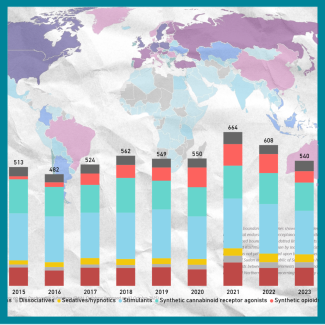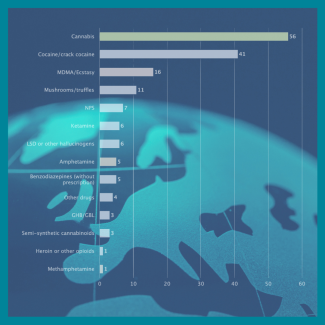
Systematically collected information used to understand patterns of substance use, substance use disorders, treatment needs, and drug market dynamics. This may include epidemiological data, service utilisation records, treatment outcomes, law enforcement intelligence, and public health surveillance. Data helps identify emerging trends, assess the effectiveness of prevention and treatment programmes, monitor trafficking and market activity, and guide evidence-informed policy and decision-making. Reliable data systems are essential for improving responses to substance use and ensuring that interventions are targeted, effective, and responsive to population needs.

Data
Problematic Pornography Use as a Predictor of Depressive and Apathetic Symptoms in Slovak Young Adults
INTRODUCTION: Problematic pornography use (PPU) has been increasingly recognized as a relevant factor in mental health research, mainly in relation to depression and apathy. Its association with apathy, reflecting diminished motivation and...
Online Gambling In Europe: Prevalence, Risk and Regulatory Challenges In The Digital Era
INTRODUCTION: Digital transformation and market liberalisation have intensified the growth of online gambling and related risks, underscoring the need for targeted research, regulation, and prevention. This study synthesises evidence on the...
Online time of Slovak and Czech adults and its relation to Big Five
INTRODUCTION: In the present article, we focused on the relationship between time spent online and factors of Big Five in the population of adults. We assume that there exist the specifics of time spent online in the relation to age, sex...
UN Toolkit on Synthetic Drugs
The UN Toolkit on Synthetic Drugs is a practical online resource coordinated by UNODC that brings together tools, guidance, and operational resources from across the UN system to support responses to the global synthetic drug problem...
New UNODC Toolkit Module on Security Document Examination: Launching event
UNODC has launched a new Security Document Examination module within the UN Toolkit on Synthetic Drugs to help law enforcement, border control, and forensic professionals detect and respond to document fraud linked to synthetic drug trafficking.
NEW Security Document Examination module in the UN Toolkit on Synthetic Drugs
UNODC has launched a new Security Document Examination module within the UN Toolkit on Synthetic Drugs, developed in collaboration with the UNODC Laboratory and Scientific Services. The module aims to help law enforcement, border control...
UNODC Current NPS Threats
The UNODC Early Warning Advisory highlights a continued global expansion of new psychoactive substances (NPS), with nearly 1,400 substances reported worldwide. In 2024 alone, a record number of substances were identified, including over 100...
Stimulant Use and Related Harms in Canada: Recent Trends
This report highlights a growing concern around stimulant use and related harms in Canada, particularly involving cocaine and methamphetamine. Data from multiple national sources show that stimulant-related deaths have significantly...
Instrument for Pre-accession Assistance (IPA) data sheets
The European Union Drugs Agency has released updated data sheets providing a clear and comparable overview of drug-related indicators across six Western Balkan partners under the Instrument for Pre-accession Assistance (IPA). These include...
EU controls nine drug precursors following first EUDA assessments
The European Commission has introduced new controls on nine high-risk chemical precursors used in illicit drug production under Delegated Regulation (EU) 2026/314. Most of these substances are linked to synthetic cathinones, while one is...