Supply & Market Disruption

Supply and market disruption refers to coordinated strategies aimed at reducing the production, trafficking, distribution, and availability of illicit substances. These strategies often involve law enforcement, regulatory controls, border management, and financial investigations designed to disrupt drug trafficking networks and weaken illicit drug markets. By targeting supply chains and market dynamics, these efforts aim to reduce the availability of drugs, increase the risks and costs associated with illegal production and distribution, and contribute to broader efforts to reduce substance-related harms. Effective supply and market disruption typically operates alongside public health, prevention, treatment, and recovery responses as part of a comprehensive approach to substance use. 
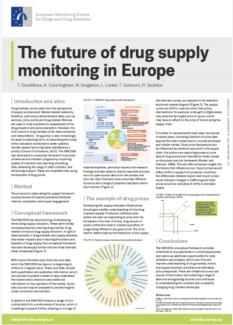
The Future Of Drug Supply Monitoring In Europe (Poster)

Leaflet, Infographic, Fact sheet, Poster
 - 
his EMCDDA paper explores how better data can help us understand and respond to Europe’s illicit drug markets. Traditional indicators like seizures, prices, purity, and offences provide only part of the picture, so the agency is expanding...

Drug Supply Reduction: An Overview Of EU Policies And Measures

Scientific article
 - 
This EMCDDA paper introduces the European Union’s approach to drug supply reduction, explaining how policies, structures, and actions are designed to disrupt drug markets and limit the availability of illicit substances. It highlights the...

Public Expenditure On Supply Reduction Policies

Report
 - 
This report takes an important step towards understanding how European countries fund efforts to tackle illicit drugs. By examining public spending on supply reduction measures, it highlights how resources are allocated, the gaps in...

Council of the European Union (2007), Fourth EU‑Africa Summit

Report
 - 
On 2–3 April 2014, African and European leaders met in Brussels for the Fourth EU–Africa Summit under the theme “Investing in People, Prosperity and Peace.” The meeting reaffirmed the strong partnership between the two continents, built on...
Council of the European Union (2007), Fourth EU‑Africa Summit logo

Substance Control Ecosystem

Guide
Psychoactive substances are regulated under three key United Nations conventions, agreed by Member States to safeguard public health and prevent illegal drug production: 1961 Single Convention on Narcotic Drugs – focused on substances such...
Substance Control Ecosystem - Page photo

UN Toolkit on Synthetic Drugs

Toolkit
 - 
The 2024 Feedback Survey gathered valuable insights from users of the UN Toolkit on Synthetic Drugs. Running from January to December 2024, it assessed user experiences, explored how Toolkit resources are applied, and identified areas for...
UN Toolkit on Synthetic Drugs photo