

From Practice to Publication: Sharing Your Work in the Substance Use Field
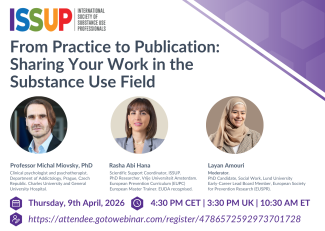
ISSUP Global presents a webinar titled, "From Practice to Publication: Sharing Your Work in the Substance Use Field."
Date: Thursday, 9th April 2026
Time: 4:30 PM CET | 3:30 PM UK | 10:30 AM ET
This webinar aims to support substance use professionals, researchers, practitioners, and early-career professionals in understanding how to publish their work in the field of substance use research. It will combine journal-specific guidance with practical advice on transforming prevention, treatment, and research work into publishable scientific papers. Programme Outline:
- Journal Presentation (≈20 minutes) – Addictology Team - Michal Miovsky
- Introduction to the Addictology journal
- Scope, thematic priorities, and target audience
- Submission process and editorial expectations
- Guidance for prospective authors and tips for successful submission
- Practical Publishing Guidance (≈20 minutes) – ISSUP Contribution - Rasha Abi Hana
Supporting professionals who may be new to publishing in peer-reviewed substance use research journals.
Key elements:
- Overview of scientific manuscript structure for peer-reviewed journals
- Understanding journal expectations, originality, and submission standards
- Common writing challenges and strategies to address them
- Practical guidance for first-time and practitioner authors preparing scientific papers
- Orientation to ISSUP activities and considerations for members aiming to publish their work in Addictology Journal
3. Questions & Discussion (≈10 minutes)
- Open Q&A with participants
- Clarifications about publishing, submissions, and professional perspectives in the field
Intended audience:
- ISSUP NCs and ISSUP members and broader substance use networks.
- Substance use prevention and treatment professionals.
- Researchers and academics in the substance use field.
- Early-career professionals interested in publishing
Learning outcomes:
By the end of the webinar, participants will be able to:
-
Develop a clearer understanding of publication pathways within substance use research.
-
Strengthen confidence in preparing and submitting scientific manuscripts.
-
Enhance awareness of how practice-based evidence can be translated into scholarly contributions.
-
Increase knowledge of available professional development, training, and publication support resources.
Presenter:
Michal Miovsky, PhD
Charles University and General University Hospital, 1st Faculty of Medicine,
Department of Addictology, Prague, Czech Republic
Michal Miovský is a clinical psychologist and psychotherapist. A graduate of a single-major academic programme in psychology at the Faculty of Arts of Masaryk University, Brno, and a postgraduate programme at the Faculty of Arts of Palacky University, Olomouc, he qualified as a senior lecturer (“docent”) in clinical psychology at Palacky University in 2005 and was appointed as professor in the same field at Charles University in 2012. In 2005 he was appointed as the head of the Centre for Addictology at the Department of Psychiatry of the 1st Medical Faculty, Charles University, Prague. In January 2012 he became the head of the Department of Addictology, an independent institution created by the merger of the Centre for Addictology and the Addiction Treatment Unit of the General University Hospital (“U Apolináře”). Since 2008 he has held the office of the Vice-dean for non-medical study programmes at the 1st Faculty of Medicine, Charles University, Prague. From 2016 to 2018 he was the president of the International Society of Addiction Journal Editors (ISAJE). In 2016 he became a founding member of the International Consortium of Universities for Drug Demand Reduction (ICUDDR) and in 2017 he was elected the first ever president of this international organisation following its incorporation. In 2021 he become member of board of directors of International Society of Substance Use Professionals (ISSUP). He is a permanent member of the Scientific Board of Charles University and was (2018 – 2022) a member of the Scientific Board of the Czech Health Minister. For more information and publications visit: http://www.adiktologie.cz/cz/users/detail/11/Michal-Miovsky.
Rasha Abi Hana
Rasha Abi Hana is the Scientific Support Coordinator at ISSUP Global and a capacity-building and prevention specialist with experience in evidence-based prevention, workforce development, and training across the Middle East and internationally. She is a certified European Prevention Curriculum (EUPC) European Master Trainer recognised by the European Union Drugs Agency (EUDA) and has supported EUPC implementation and training in Arabic- and French-speaking countries.
Rasha is currently finalising her PhD at Vrije Universiteit Amsterdam, where her research focuses on scaling up mental health services, stigma reduction, quality rights in mental health and substance use care, and digital mental health cost-effectiveness. She holds a Diploma in Mental Health Policy and Services from NOVA Medical School (Lisbon Institute of Global Mental Health).
She also serves as a consultant with The George Washington University, supports prevention initiatives with UN agencies, and is a member of the editorial board of the International Journal of Addictology. Previously, she worked with Lebanon’s Ministry of Public Health, coordinating community mental health services and substance use treatment programmes.
Moderator:
Layan Amouri
Layan Amouri is a PhD candidate in Social Work at Lund University, where her research focuses on migration, belonging, and preventive psychosocial practice. She examines the experiences of newly arrived and immigrant youth, with particular attention to how participation and relationships within migration‑related organizations forms their identity and influence their wellbeing and sense of belonging in both their local communities and society at large.
Before beginning her doctoral studies, she worked at Örebro University in both the Psychology and Social Work departments. There, she contributed to the PIA Project, which supports the wellbeing and adjustment of migrant youth and their families, and was involved in the GLOMISCO research group on studying globalization, migration, and social cohesion. She also serves as the Early‑Career Lead Board Member of the European Society for Prevention Research (EUSPR), where she supports emerging scholars and promotes strengths‑based and inclusive approaches within prevention science.
References:
-
Strunk, W., & White, E.B. (2000). The elements of style. (4th ed.) London: Allyn and Bacon. Still one of the best and shortest writing guides, easily read and absorbed. Those learning English find its clarity and brevity helpful.
-
Rogers, S.M. (2007). Mastering scientific and medical writing: A self-help guide. N.Y.: Springer. A compact guide with exercises as solved problems; good for overcoming specific writing handicaps.
-
Gustavii, B. (2003). How to write and illustrate a scientific paper. Cambridge, UK: The Cambridge Press. Oriented to the biological and medical sciences, it’s the clearest and most succinct work that I found among all such works at our local university. A marvel of clarity and utility. Full of relevant URLs for up-to-date information.
-
Huth, E.J. (1990). How to write and publish papers in the medical sciences. (2nd ed.) London: Williams and Wilkins. This compact work offers practical advice on how to make decisions about what to write and what to leave out; both novice and experienced researchers can benefit. A highly readable source.
Webinars and online events delivered and hosted by the International Society of Substance Use Professionals (ISSUP) are provided for informational purposes only. They are educational in nature and do not constitute medical advice, diagnosis or treatment.