Suicide is not the solution
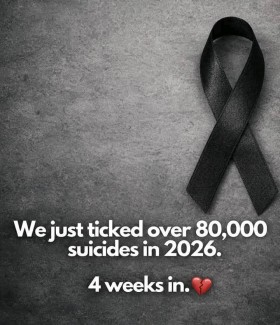
SUICIDE IS NOT THE SOLUTION
There are moments when numbers stop being informative and start being evasive.
They give us scale, but they shield us from closeness.
More than 80,000 people have died by suicide worldwide and 2026 isn’t even a month old.
We repeat the figure as if magnitude can protect us from intimacy. As if sheer volume can stop us from imagining a single face, a single morning routine, a single unfinished sentence. But suicide is not a statistics problem. It is a human one. Every number once had a life that was still unfolding still arguing with itself, still hoping quietly, still negotiating another day.
Three days ago, someone who used to be my neighbor ended his life.
What unsettles me most is not that he is gone, but that until the moment he wasn’t nothing appeared extraordinary. There were no warning sirens. No public collapse. No visible catastrophe. Just the quiet continuation of a man who had learned how to carry too much without letting it spill.
This is how many suicides live before they die: invisibly.
If he were still here today, life would not suddenly be perfect. That fantasy comforts us, but it isn’t honest. He would still be tired. Still wrestling with thoughts that looped too long at night. Still frustrated by problems that didn’t resolve neatly. But he would also still be here participating in the ordinary friction of living. Being misunderstood. Being needed. Being momentarily relieved by small, forgettable things.
And that matters more than we realize.
Right now, if he were alive, people would still be experiencing him in fragments. Someone would be irritated by his silence. Someone else would find it grounding. A colleague would disagree with him. A neighbor would nod in passing. None of them would recognize these moments as lifesaving—but psychologically, they often are.
Belonging is rarely dramatic.
It is mundane.
And mundanity is stabilizing.
Psychology helps explain what morality struggles to articulate. Under prolonged distress, the mind narrows. Cognitive constriction takes hold. The future compresses into a single conclusion: nothing will change. Pain becomes authoritative. It convinces the brain that permanence is mercy and escape is logic.
But pain is not objective truth it is a state.
And states, by definition, shift.
This is what suicide interrupts not suffering, but possibility.
Not pain, but the chance for pain to transform, soften, or be shared.
If he were still alive, something would already be different. Not everything. But enough. A conversation. A delay. A distraction. Another day that cracked the illusion of finality. Another moment that quietly contradicted the mind’s most dangerous lie: this is forever.
Instead, the pain has migrated.
It now lives in the people left behind in children who will grow up with unanswered questions, in parents who will interrogate their memories for signs, in friends who will wonder which moment mattered most. Suicide does not eliminate suffering; it redistributes it, often to those least prepared to carry it.
This is where leadership at work and at home must be confronted.
We have built cultures that reward emotional suppression and call it professionalism. We praise endurance while pathologizing vulnerability. We ask people to perform while bleeding internally, and then we express surprise when they disappear.
This is not resilience.
It is maladaptive endurance.
And it costs lives.
At work, we measure outputs and ignore interiors.
At home, we normalize isolation and call it independence.
In both spaces, we mistake silence for stability.
But psychologically, silence is often not peace it is a learned survival strategy. A signal that the mind has decided it is safer not to speak than to risk being misunderstood, minimized, or burdensome.
If he were still alive today, he would still be inconvenient at times. Still complicated. Still unfinished.
And that is precisely the point.
Life is not valuable because it is polished or productive. It is valuable because it is relational. Because presence matters even when it is messy, slow, or hard to interpret. Especially then.
If you are struggling, hear this not as sentiment but as science:
Your thoughts are not facts. They are symptoms of distress. They can change. They do change particularly when interrupted by connection. The nervous system regulates in the presence of safety. Despair loosens its grip when it is witnessed.
And if you lead people in organizations, families, or communities understand this clearly:
Checking in is not kindness. It is prevention.
Asking deeper questions is not inefficiency. It is responsibility.
Creating space for truth is not weakness. It is leadership.
Because sometimes the difference between life and death is not a grand intervention but a moment that reminds someone they still belong in the ongoing, imperfect work of being human.