Search
Mindfulness-Based Relapse Prevention: why make relapse prevention more mindful?
Traditionally, relapse prevention for addictive disorders has been based on cognitive-behavioural therapy (CBT). The development of mindfulness-based relapse prevention (MBRP) by the University of Washington, which integrates core aspects...
Cocaine intermediates: base paste or "paco"
Summary
Drug abuse has become a serious problem worldwide. In recent years, the consumption of cocaine base paste (paco) has increased by more than 200% in our country. Despite the fact that paco is an intermediate product in obtaining...
The impact of the COVID lockdown on alcohol consumption in the Netherlands
The lockdowns that have been introduced around the world in response to the COVID-19 pandemic have dramatically influenced health behaviours.
This research, published in Drug and Alcohol Dependence explores the impact of lockdown on...
Patient and provider perspectives on self-administered electronic substance use and mental health screening in HIV primary care
Abstract
Background
Substance use disorders, depression and anxiety disproportionately affect people with HIV (PWH) and lead to increased morbidity and mortality. Routine screening can help address these problems but is underutilized...
The impact and long-term effects of childhood trauma
This article discusses early childhood trauma and the negative long-term consequences that can cause life-long medical and psychological difficulties.
The article defines trauma and complex trauma and then describes the ways in which...
Introducing compassion focused therapy
Compassion focused therapy (CFT) is based on the evolutionary, functional analysis of basic social motivational systems (e.g., to exist within groups and care for kin) and emotional systems (e.g., to respond to threats, seek out contentment...
Adverse childhood experiences and related outcomes among adults experiencing homelessness
People who are homeless experience significant physical, mental and social challenges that are linked with poor health and functioning. Rates of substance use issues, mental health difficulties, injury and chronic disease are significantly...
Variations in risks from smoking between high-income, middle-income, and low-income countries
Tobacco use is a major risk factor for cardiovascular and respiratory diseases, over 20 different types or subtypes of cancer, and many other health conditions 1.
In this study, the researchers explored the variation in risk from current...
Alcohol-attributable burden of cancer in Argentina
Abstract
Introduction
Alcohol consumption is a risk factor for several types of cancer. Alcohol consumption levels in Argentina are among the highest in the world, and malignant neoplasms are the second cause of death in the country...
Take-Home Naloxone and the Prevention of Deaths from Heroin Overdose
Naloxone is a drug that can reverse the effects of opioid drugs like heroin, methadone, opium, codeine, morphine and buprenorphine, and is an important aid in preventing drug-related deaths.
Overdose deaths are often witnessed and can be...
Evidence-based principles for effective drug demand reduction: applying theory to practice
New Trends in Education and Training Programs in Addictions at the Higher Education and University Levels
BACKGROUND
A broad range of professionals, training opportunities, and regional differences exist in the addiction study field worldwide. This educational variety poses a challenge in proposing a precise classification of study programs at...
The Master’s in Drug Dependence at the University of Barcelona: Historical Perspective and Future Challenges
BACKGROUND
The two-year, multidisciplinary Master’s in Drug Dependence (MDD) at the University of Barcelona was created in 1986, after some years of offering shorter seminars. It was a response to the heroin crisis of the 80s and 90s and...
Implementing and Evaluating the UPC to Promote Capacity Building among Drug Demand Reduction Practitioners in Nigeria: Lessons Learned and Future Directions
BACKGROUND
There has been a growing need to improve the knowledge and skills of addiction practitioners worldwide. The development of the Universal Prevention Curriculum (UPC) is one effort to address these needs. This paper is the first...
Developing Curriculum for the Training of Non-Specialist in Addiction Studies in Nigerian Universities: The Journey of Nigerian ICUDDR Team
BACKGROUND
This article describes the need to develop a workforce to address the public health burden of drug use in Nigeria. Central to workforce development is the development and implementation of a substance use curriculum.
AIMS
The...
Supporting Emergency Remote Teaching Due to Coronavirus Pandemic: Problem Solving Group at ICUDDR
BACKGROUND
The COVID-19 pandemic has been challenging for all and has had a particular effect on university-level educators. Although the use of technologies in education is recognised as critical in developing transversal skills and...
Training Needs Assessment of Specialists Who Provide Care to People with Substance Use Disorders in Ukraine
BACKGROUND
In Ukraine, substance use disorders (SUDs) and rates of HIV infection are growing, the number of specialists does not meet country’s addiction treatment demands, and the quality of the care is often insufficient and does not...
Maintaining the Provision for Professional Development in the COVID Era: Three Practical Examples
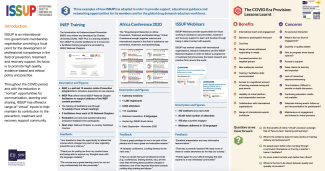
ISSUP participated in the European Society of Prevention Research (EUSPR) 2021 Conference which took place online from the 29th of September to the 1st of October by presenting an oral poster that focussed on three practical examples of...
Consequences of Lockdown and the COVID-19 Pandemic for a Selected Sport – Comparative Study
BACKGROUND
In December 2019, severe viral pneumonia caused by the new beta coronavirus appeared in China. It spread rapidly around the world and affected it greatly. In order to stop the global COVID-19 pandemic, the world was forced to...
Share the Knowledge: ISSUP members can post in the Knowledge Share – Sign in or become a member