

Search
 Populations
Distinct groups of people within a society who share certain characteristics such as age, gender, geographic location, socioeconomic status, cultural background, or exposure to particular risk factors that may influence patterns of substance use, vulnerability to substance use disorders, and access to services. In the context of substance use systems, identifying and understanding different populations helps guide the design of prevention, treatment, recovery, and policy responses that are appropriate, equitable, and responsive to specific needs. Examples may include youth, women, people experiencing homelessness, individuals in the criminal justice system, or communities affected by specific social or economic conditions.


UNODC supports a Quality Assurance Training for Drug Use Disorder Treatment Services in Senegal
The UNODC Regional Office for West and Central Africa (ROSEN) and the Prevention, Treatment and Rehabilitation Section in Vienna (PTRS), organized from June 14th to June 18th, an online Quality Assurance training, benefitting 16 drug...

Mental Health of Youth and Substance Use: Self-harm and Suicide in Young
ISSUP Ukraine are pleased to present the First Webinar in their Three-Part Series on 'Mental Health of Youth and Substance'. The First Webinar will centre specifically on Self-Harm and Suicide in Young.
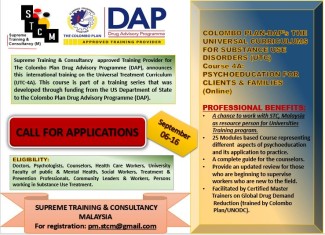
Online Training on UTC 4A
Psychoeducation for Clients & Families.
Organized by Supreme Training & Consultancy Malaysia.
For registration, please email pm [dot] stcm [at] gmail [dot] com
President Biden issues proclamation for overdose awareness week
President Biden issued the first ever Presidential Proclamation recognizing August 29, 2021 – September 4, 2021 as Overdose Awareness Week – a time to honor the lives lost to the overdose epidemic and recommit to both preventing overdoses...
Attitudes towards consumption, sensation seeking and alcohol consumption. Model of partial mediation in Ecuadorian adolescents
Objective: To determine the mediated effect of sensation-seeking on the relationship between attitudes to alcohol consumption and consumption in a sample of adolescents from Ecuador. Method: Descriptive predictive and mediation study with...
Monitoring and evaluation for community based prevention systems
Monitoring and evaluation (M&E) are essential in strengthening Community-Based Prevention Implementation Systems, through this process organizations collect and analyze data, and determine if the Substance use prevention- intervention (EBIs...
Substance Use in Women Deprived of Liberty: A General Approach and Recent Evidence
ISSUP Argentina held a webinar presenting a general initial framework and evidence on the characterization and approach of problematic substance use in the population of women deprived of liberty.
The webinar took place on Tuesday, October...
WHO-UNODC “Stop Overdose Safely (S-O-S)” initiative
Overdose is the leading cause of avoidable death among people who inject drugs.
The ‘Stop Overdose Safely’ is a joint initiative from UNODC and the World Health Organization (WHO) to address opioid overdose and provide life-saving...
Community-based prevention implementation system in Uganda
Uganda is one of the countries in East Africa with an outdated policy on substance use and abuse. The World Health Organization highlights Uganda as a country with hazardous drinking patterns due to the high prevalence of alcohol...
Factors influencing engagement and utilization of opium tincture-assisted treatment for opioid use disorder: A qualitative study in Tehran, Iran
Abstract
Introduction
In response to a high burden of opioid use disorder (OUD), Iran established a network of opioid agonist treatment (OAT) centers beginning in 2002. To increase treatment diversity, particularly for patients who use...
Opium tincture-assisted treatment for opioid use disorder: A systematic review
Abstract
Background: Some countries have used opioid agonist medications other than methadone and buprenorphine as a strategy to increase treatment diversity. In Iran and other countries where opium use is common and culturally tolerated...
Codependency can prevent you from being independent
Family members with substance use disorders can prevent others in the family from happily living their own lives.
When we first start protecting someone else's feelings, we often realize that we were trying to protect our own feelings.
Be...

Changes in alcohol consumption patterns based on gender during COVID-19 confinement in Spain
Abstract
The goal of this study was to analyze the prevalence and pattern of alcohol consumption (frequency of consumption, average daily consumption, and risky consumption) before and during confinement due to the coronavirus disease...

Listen First- What the Experts are Saying
'Listen First' is an initiative to increase support for the prevention of drug use that is based on science and is thus an effective investment in the well-being of children and youth, their families and their communities.
Listen First...
Prevention Science Journal, Volume 22, issue 6, August 2021
Special Issue: Optimizing the Implementation and Effectiveness of Preventive Interventions through Motivational Interviewing

Drug-related Deaths in Scotland in 2020
In 2020,1339 drug-related deaths were registered in Scotland.
This is a 5% increase compared to figures from 2019.
Other key findings show:
- The number of drug-related deaths has increased substantially over the last 20 years – there...
Risk and protective factors for mental health problems in patients with substance use disorder
Abstract
The present study aimed to assess the predictive association of self-esteem and perceived social support (family, friends & significant others) with mental wellbeing in patients with substance use disorder (SUD). Sample of the...
ISSUP UK Launch Event
We are pleased to announce that the ISSUP UK Chapter launch took place Thursday, 23rd. September at 2pm (GMT). The launch will be followed by a webinar on the topic of ‘Substance Use and Families’.
Does Cancer Risk Increase With Alcohol Consumption?
A study published on July 13 by the scientific journal The Lancet Oncology attributed more than 4% of all new cancer cases in 2020 to alcohol consumption.
Cancer – what is it?
Cancer is a term that encompasses more than 100 different...

Gender disparities in opioid treatment progress in methadone versus counselling
The high dropout rate (75%) in opioid use disorder (OUD) treatment among women and racial/ethnic minorities in the United States necessitates a better knowledge of the factors that contribute to treatment success. While therapy and...