

Search
Pharmacological Interventions
The use of medication to manage withdrawal symptoms, reduce cravings, or treat co-occurring mental health disorders e.g., methadone, buprenorphine, naltrexone.

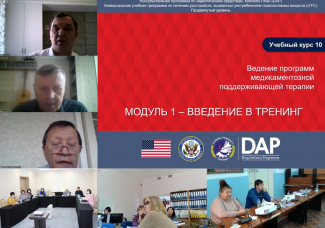
National trainer teams from Central Asia level up in the Universal Treatment Curriculum for Substance Use Disorders with support from UNODC
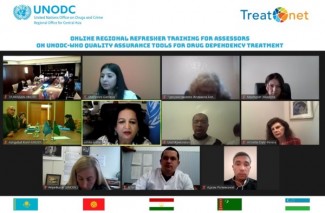
Online regional training for trainers (ToT) on Course 10 “Managing Medication-Assisted Treatment Programs” (30 November – 3 December 2020) of the Advanced Level of the Universal Treatment Curriculum for Substance Use Disorders (UTC training...
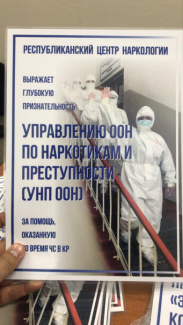
UNODC and partners support the Republican Narcotics Center in the fight against COVID-19 in Kyrgyzstan
Although COVID-19 usually occurs easily and most people recover quickly, coronavirus can cause very serious complications for certain categories of people, including the elderly and people with weakened immune systems or chronic diseases...
UNODC Continues to Support Capacity Building of National Trainer Teams Within the Advanced Level of the Universal Treatment Curriculum for Substance Use Disorders
A Regional three-day training for trainers (ToT) on Course 9 “Advanced Pharmacology and Substance Use Disorders” of the Advanced Level of the Universal Treatment Curriculum for Substance Use Disorders (UTC training package) was launched via...
Training of Trainers on UPC Course 2, Physiology and Pharmacology for Prevention Specialists
A 4 days virtual training on Universal Prevention Curriculum Course 2, “Physiology and Pharmacology for Prevention Specialists” from 02 to 05 November 2020 kicked off today by UNODC to add into pool of national master trainers on substance...
UNODC supports Central Asian countries in piloting quality assurance mechanisms/tools for drug use disorder treatment
Background
In 2019, four Central Asian countries – Kazakhstan, Kyrgyzstan, Tajikistan and Uzbekistan – piloted the implementation of UNODC's quality assurance mechanisms/tools for the treatment of drug use disorders.
The event was held...
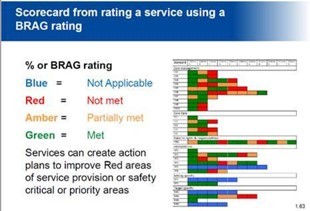
UNODC Supports Central Asian Countries in Piloting Drug Use Disorder Treatment Services Quality Assurance Mechanisms/Tools
Background
Four Central Asia countries piloted the UNODC Quality Assurance (QA) mechanisms in 2019 with training and technical assistance provided by UNODC in 2018-2019. The countries involved were Tajikistan, Kazakhstan, Uzbekistan and...
International Consensus Statement for the Screening, Diagnosis, and Treatment of Adolescents with Concurrent Attention-Deficit/Hyperactivity Disorder and Substance Use Disorder
This international consensus statement can be used by clinicians and patients together in a shared decision-making process to select the best interventions and to reach optimal outcomes in adolescent patients with concurrent ADHD and SUD.
Universal Prevention Curriculum (UPC) 2020 Programme Implementation in Pakistan
The United Nations Office on Drugs and Crime (UNODC) in collaboration with the Ministry of Narcotics Control (MNC) and support from Bureau of International Narcotics and Law Enforcement Affairs of the U.S. Department of State (INL) is in...
The Universal Treatment Curriculum (UTC) Advanced Series
The Advanced Level UTC series is a set of courses, which offers a specialised training provision that aims to provide an in-depth continuing education with the latest information and skills-based activities to further enhance the capacity...
Universal Treatment Curriculum (UTC) Basic Level Series
The Basic Level UTC series consists of eight courses that cover the broad spectrum of treatment for substance use disorders. The content and methodology of the UTC training series are designed to ensure that addiction practitioners develop...
Universal Prevention Curriculum (UPC) Coordinators Series
The UPC Coordinators Series provides a 288-hour training programme for prevention coordinators, managers, and students/trainees whose role includes, or will include coordination and supervision of the implementation of prevention...
WHO Management of Alcohol Withdrawal
Alcohol withdrawal can be uncomfortable and occasionally life threatening. Pharmacological management of alcohol withdrawal is an essential component of alcohol dependence. Benzodiazepines (BZDs), nonsedating anticonvulsants and...
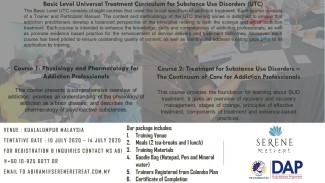
UTC / UPC Workshop for Addiction Professionals
Basic Level Universal Treatment Curriculum for Substance Use Disorders (UTC)
The Basic Level UTC consists of eight courses that cover the broad spectrum of addiction treatment. Each course consists of a Trainer and Participant Manual. The...
Inhibition of Cardiac Sodium Currents by Toluene Exposure
Abstract
Toluene is an industrial solvent widely used as a drug of abuse, which can produce sudden sniffing death due to cardiac arrhythmias. In this paper, we tested the hypothesis that toluene inhibits cardiac sodium channels in Xenopus...
Training on the Universal Curriculum for Substance Use - Implementers Series (UPC1), Core Course for Afghanistan Cohort 2
Colombo, Sri Lanka 18-26 January 2020
By Rogers Kasirye
The workshop started on 18th January organized by Colombo/ INL for the support in undertaking the training programme for Afghanistan entitled Training on the Universal Curriculum...
Changes in Smoker Characteristics in England
Smoking in England has decreased over the last decade. It is vital to monitor the trends and examine the factors that may be influencing the downward curve, so as to maintain the pattern and make predictions about future smoking rates.
A...

Lisbon Addictions: Presentations & Posters
Following their 2019 conference, the Lisbon Addictions team have gathered posters and information about the presentations from the event.
The co-producers have built coherent packages of topical strands, sessions and guided poster tours.
...
The Emerging Role of Toxic Adulterants in Street Drugs in the US Illicit Opioid Crisis
This article introduces the emergence of adulterant cutting agents in street drugs in the United States and considers the synergistic effects that is compounding the opioids crisis in the U.S. The article outlines the role of the Colombo...
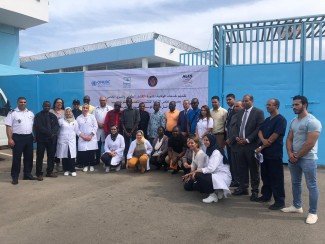
Experts from Côte d'Ivoire Attend a Study Tour in Morocco
From 6 to 12 October 2019, as part of the UNODC - PTRS / GLOK32 activities to guide the introduction of assisted pharmacological treatment of opioid dependence, 10 representatives, policy makers and treatment experts, and 2 psychiatrists...
Review of Toluene Actions: Clinical Evidence, Animal Studies, and Molecular Targets
Abstract
It has long been known that individuals will engage in voluntary inhalation of volatile solvents for their rewarding effects. However, research into the neurobiology of these agents has lagged behind that of more commonly misused...