
Evidence-based psychosocial interventions in substance use disorders: implications for professional practice.
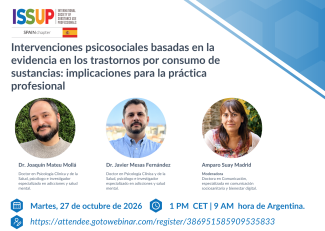
ISSUP Spain cordially invites you to participate in its webinar on Evidence-Based Psychosocial Interventions in Substance Use Disorders: Implications for Professional Practice.
Date: October 27, 2026
Time: 1 PM CET | 9 AM Argentina time.
Register for the webinar
Substance use disorders are a major public health problem that requires comprehensive, evidence-based interventions adapted to the needs of each person. This webinar aims to provide an up-to-date view of the main psychosocial interventions used in the approach to addictions and their application in professional practice.
Throughout the session, the interventions with the greatest scientific support will be reviewed, including Cognitive-Behavioral Therapy, Motivational Interviewing, Contingency Management, family interventions, and new digital intervention modalities. Likewise, the available evidence on which strategies are most effective depending on the type of substance, the characteristics of the population, and the different care contexts will be analyzed.
The webinar will also address current and future challenges in the field of addictions, paying particular attention to the personalization of interventions, recovery models and the need to move towards person- and relationship-centered approaches to care, which promote active participation, shared decision-making and the strengthening of support networks.
The session will combine the presentation of scientific evidence with practical examples and a final space for debate and exchange with participants, providing recommendations applicable to the clinical, social and community practice of professionals working in prevention, treatment and recovery of substance use disorders.
Topics that will be addressed during the webinar:
- Current situation and need for psychosocial interventions
- Magnitude of the problem.
- Why are psychosocial interventions essential?
- Main evidence-based psychosocial interventions
- Cognitive-Behavioral Therapy.
- Motivational interviewing.
- Contingency Management.
- Family and digital interventions.
- From evidence to professional practice
- What works, for whom, and in what contexts?
- Practical recommendations for professionals.
- Future challenges: recovery and person- and relationship-centered care.
- Personalization of interventions.
- Recovery.
- Person- and relationship-centered care.
Discussion and questions
Target audience:
This webinar is aimed at professionals and students in the field of addiction and mental health, including psychologists, social workers, doctors, nurses, occupational therapists, social educators, harm prevention and reduction professionals, service managers and other health and social health professionals interested in intervention with people with substance use disorders.
The session will also be of interest to researchers, teachers, and those responsible for programs and public policies who wish to update their knowledge on evidence-based psychosocial interventions and their application in clinical, social, and community practice.
The content of the webinar will be especially useful for those professionals interested in promoting recovery-oriented and relationship-centered models of care in the field of addictions.
Learning outcomes:
By the end of this webinar, participants will be able to:
-
To identify the main evidence-based psychosocial interventions used in the treatment of substance use disorders.
-
To analyze the effectiveness of different intervention strategies depending on the type of substance, the characteristics of the population, and the context of care.
-
Recognize the main current trends and future challenges in the approach to addictions, including the personalization of interventions, recovery models and digital interventions.
-
Apply evidence-based recommendations for the planning and implementation of interventions in clinical, social, and community contexts.
-
Reflect on the importance of promoting care models focused on the person and relationships, favoring active participation, shared decision-making and the strengthening of support networks in recovery processes.
-
Integrate a multidisciplinary and recovery-oriented perspective into professional practice with people with substance use disorders
References:
-
American Psychiatric Association. (2018). Practice Guideline for the Pharmacological Treatment of Patients With Alcohol Use Disorder. American Psychiatric Association Publishing.
-
Carroll, K. M., & Kiluk, B. D. (2017). Cognitive behavioral interventions for alcohol and drug use disorders: Through the stage model and back again. Psychology of Addictive Behaviors, 31(8), 847–861. https://doi.org/10.1037/adb0000311
-
Magill, M., & Ray, L. A. (2009). Cognitive-behavioral treatment with adult alcohol and illicit drug users: A meta-analysis of randomized controlled trials. Journal of Studies on Alcohol and Drugs, 70(4), 516–527. https://doi.org/10.15288/jsad.2009.70.516
-
Miller, W. R., & Rollnick, S. (2013). Motivational Interviewing: Helping People Change (3rd ed.). Guilford Press.
-
National Institute on Drug Abuse (NIDA). (2020). Principles of Drug Addiction Treatment: A Research-Based Guide (Third Edition). National Institutes of Health.
-
Substance Abuse and Mental Health Services Administration (SAMHSA). (2020). Treatment Improvement Protocol (TIP) Series 35: Enhancing Motivation for Change in Substance Use Disorder Treatment. U.S. Department of Health and Human Services.
-
UNODC & WHO. (2020). International Standards for the Treatment of Drug Use Disorders. United Nations Office on Drugs and Crime & World Health Organization.
-
Volkow, N. D., Koob, G. F., & McLellan, A. T. (2016). Neurobiologic advances from the brain disease model of addiction. New England Journal of Medicine, 374(4), 363–371. https://doi.org/10.1056/NEJMra1511480
-
Kelly, J. F., Bergman, B. G., Hoeppner, B. B., Vilsaint, C. L., & White, W. L. (2017). Prevalence and pathways of recovery from drug and alcohol problems in the United States population. Drug and Alcohol Dependence, 181, 162–169. https://doi.org/10.1016/j.drugalcdep.2017.09.028
-
Leamy, M., Bird, V., Le Boutillier, C., Williams, J., & Slade, M. (2011). Conceptual framework for personal recovery in mental health: Systematic review and narrative synthesis. British Journal of Psychiatry, 199(6), 445–452. https://doi.org/10.1192/bjp.bp.110.083733
-
World Health Organization. (2016). Framework on Integrated, People-Centred Health Services. World Health Organization.
Presenters:
Dr. Joaquín Mateu Mollá
Dr. Joaquín Mateu-Mollá is a psychologist and researcher specialized in the field of addictions and mental health. His research activity has focused on the study of substance use disorders, being the main author of several international scientific publications, including systematic reviews on pharmacological treatment and psychosocial interventions in substance use disorders, published in journals of international impact. His work is aimed at identifying evidence-based interventions and improving clinical practice in the field of addictions
Dr. Javier Mesas Fernández
Dr. Javier Mesas-Fernández is a PhD in Psychology, a social worker and researcher in the field of mental health and addictions. His professional and academic career has focused on psychosocial intervention, health social work and recovery-oriented and person-centered models of care. He is co-author of international publications on psychosocial interventions in substance use disorders and actively participates in research projects related to the efficacy of therapeutic interventions and the implementation of comprehensive and evidence-based care models in the field of addictions.
Both speakers combine research and applied experience in the field of addictions, with a special interest in the transfer of scientific knowledge to professional practice and in the development of comprehensive, evidence-based and recovery-oriented care models.
Moderator:
Amparo Suay Madrid
PhD in Communication specialising in social and health information. Currently, she is the director of the Bachelor's Degree in Communication at the International University of Valencia (VIU), where she has been teaching since 2017. Her research activity focuses on the field of communication, health and digital well-being. She is the principal investigator of the COSABID Research Group (Communication, Health and Wellbeing in the Digital Age) and a member of the Health and Psycho-Social Adjustment Research Group (GI-SAPS).
She has an extensive professional career in corporate communication and journalism. She is currently responsible for Communication at the Health and Community Foundation (FSC), and has outstanding experience in the media, especially in the radio field.
He directs the radio program No hay edad en las ondas, broadcast on Ràdio Manises for the Xarxa d'Emissores Municipals Valencianes (XEMV), and co-directs the podcast Versamente, available on iVoox, together with doctors Víctor José Villanueva Blasco, Joaquín Mateu Mollá and María José García Rubio, also VIU teachers and researchers.
Webinars and online events presented and hosted by the International Society of Substance Use Professionals (ISSUP) are provided for informational purposes only. They are educational in nature and do not constitute medical advice, diagnosis, or treatment.