
Adderall Shortage Timeline: 2022–2026 Explained
Medical Review: Brandon McNally, RN | Published: November 27 2025 | Last Updated: July 17, 2026
Quick answer: The Adderall shortage began on October 12, 2022, when the FDA confirmed nationwide supply problems after manufacturing delays at Teva, the largest U.S. producer. Surging ADHD diagnoses, strict DEA production quotas, and cascading manufacturer backorders extended it for more than three years — making it the longest-running stimulant shortage in modern U.S. history. Conditions began improving after the DEA raised production quotas 25% in October 2025, though supply remained inconsistent into 2026.
Key Takeaways
- The FDA formally announced the Adderall shortage on October 12, 2022, citing intermittent manufacturing delays at Teva Pharmaceutical Industries.
- The shortage spread from one manufacturer to nearly all producers of amphetamine mixed salts, affecting immediate-release and extended-release forms across dosage strengths.
- Three forces sustained it: manufacturing disruptions, record demand from rising ADHD diagnoses, and DEA aggregate production quotas that capped how much amphetamine could legally be made.
- In October 2025, the DEA raised the d-amphetamine production quota from 21.2 million to 26.5 million grams — a 25% increase — the first major quota adjustment of the shortage, with further increases finalized in January 2026.
- The CDC issued a Health Advisory in June 2024 warning that disrupted stimulant access could push patients toward unsafe alternatives, including counterfeit pills.
- Patients who abruptly lost access commonly experienced fatigue, low mood, appetite changes, and concentration problems — stimulant discontinuation effects, not addiction.
Table of Contents
- When It Started
- Shortage Timeline
- Why It Happened
- The 2025 Turning Point
- Impact on Patients
- Counterfeit Pill Risk
- Is the Shortage Over?
- When to Seek Help
- FAQ
When Did the Adderall Shortage Start?
The shortage officially began on October 12, 2022, when the U.S. Food and Drug Administration posted a shortage notice for the immediate-release formulation of amphetamine mixed salts — the generic name for Adderall. The trigger was ongoing intermittent manufacturing delays at Teva, then the largest U.S. manufacturer. Other companies continued producing, but the FDA confirmed their combined output could not meet national demand.
What looked at first like one company's production problem became a structural, multi-year supply failure — one that outlasted every previous stimulant shortage on record.
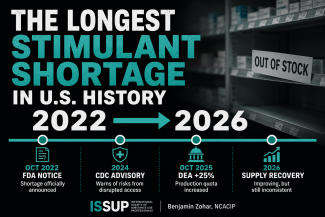
Adderall Shortage Timeline: 2022–2026
| Date | Event | Why It Mattered |
|---|---|---|
| Oct 12, 2022 | FDA announces the Adderall IR shortage after Teva manufacturing delays | Official start of the shortage |
| 2023 | Shortage spreads across generic manufacturers and to extended-release forms; strengths become intermittently unavailable for months | One-company problem becomes an industry-wide failure |
| Jun 2024 | CDC issues a Health Advisory on disrupted stimulant access | Federal recognition that the shortage itself created patient-safety risks |
| 2024–2025 | Congressional hearings on stimulant access; demand keeps rising; the 2025 ADHD stimulant shortage peaks with widespread backorders across amphetamine products | Peak disruption period; "adderall shortage 2025" becomes a national story |
| Oct 2025 | DEA raises the d-amphetamine aggregate production quota from 21.2M to 26.5M grams (+25%) | First significant quota adjustment of the entire shortage |
| Jan 2026 | DEA finalizes additional quota increases | Policy shift from rationing toward supply expansion |
| Mid-2026 | Supply improves but remains inconsistent; multiple manufacturers still report backorders, especially on XR 15 mg, 25 mg, and 30 mg; FDA's original notice remains live | Improvement without resolution — see current status below |
Why the Adderall Shortage Happened
Manufacturing Disruption
Teva's packaging and production delays in 2022 removed the market's largest supplier at exactly the wrong moment. Because amphetamine products run on tight, quota-limited production schedules, other manufacturers could not simply scale up to absorb the gap.
Record Demand
ADHD diagnoses and stimulant prescriptions rose sharply after 2020, driven partly by expanded telehealth prescribing. Supply plans built on pre-2020 demand assumptions were outdated before the first delay hit.
DEA Production Quotas
Amphetamine is a Schedule II controlled substance, and the DEA sets an annual ceiling — the aggregate production quota — on how much can be manufactured nationally. Through 2023 and 2024, that ceiling stayed essentially flat while demand climbed, which meant manufacturers were legally prevented from producing their way out of the shortage. This is the structural feature that separated the Adderall shortage from ordinary supply problems: the fix required regulatory action, not just factory capacity.
Clinical pearl: When a patient on a stable stimulant regimen suddenly reports irritability, fatigue, low mood, or "the medication stopped working," ask about pharmacy access before adjusting the diagnosis or the dose. During the shortage years, apparent treatment failure was often an unfilled prescription — and abrupt discontinuation symptoms were routinely mistaken for relapse, depression, or misuse.
The 2025 Turning Point: Quota Increases and Policy Response
The 2025 ADHD stimulant shortage marked both the low point of availability and the beginning of the policy response. In October 2025, the DEA raised the d-amphetamine aggregate production quota by 25% — from 21.2 million to 26.5 million grams — the first meaningful quota increase since the shortage began. Additional increases were finalized in January 2026.
Quota increases take months to translate into pharmacy stock: manufacturers must allocate quota, produce, package, and distribute. That lag is why supply in 2026 improved gradually rather than snapping back — and why patients continued to encounter backorders on specific strengths, particularly higher-dose extended-release capsules, well after the policy changed.
What the Shortage Changed for Patients
Four years of unreliable access changed patient behavior in ways clinicians still see:
- Medication switching: Many patients moved to Vyvanse (lisdexamfetamine), methylphenidate products, or non-stimulants — sometimes by choice, often because it was all the pharmacy had. Generic Vyvanse's arrival expanded that path, though it too experienced shortages.
- Pharmacy shopping and rationing: Patients learned to call multiple pharmacies, refill on the earliest legal day, and split or skip doses to stretch supply — a quiet form of under-treatment.
- Discontinuation symptoms mistaken for something worse: Abrupt loss of access produced fatigue, increased appetite, depressed mood, sleep disturbance, and concentration problems. These are recognized stimulant discontinuation effects — not evidence of addiction — but they drove real distress and, in some cases, unsafe self-treatment.
Counterfeit Pill Risk: The Shortage's Most Dangerous Side Effect
The CDC's June 2024 advisory named the risk directly: when legitimate supply fails, some patients turn to pills from friends, online sellers, or street sources. Counterfeit pills pressed to look like Adderall have repeatedly been found to contain methamphetamine or fentanyl. Any "Adderall" not dispensed by a licensed pharmacy should be treated as potentially counterfeit and potentially lethal. This remains the shortage's most important safety legacy: it converted a supply-chain problem into an overdose-risk pathway for otherwise low-risk patients.
Is the Shortage Over?
As of mid-2026: improving, not over. Multiple manufacturers still report backorders, the FDA's October 2022 notice remains live, and availability varies week to week by strength and pharmacy. For the continuously updated answer — current manufacturer status, which strengths are hardest to find, and what patients can do this month — see Is Adderall Still in Shortage in 2026?, which tracks the live situation this timeline article deliberately does not.
When to Seek Help
Shortage-driven disruption is a medical issue worth professional support. Contact a prescriber promptly if a fill gap is approaching rather than after it arrives; ask about equivalent formulations or temporary alternatives rather than adjusting doses independently. If shortage stress has led to using non-prescribed stimulants, escalating doses, or pills from any source other than a pharmacy, that warrants an honest conversation with a clinician — including a substance-use evaluation where use has moved beyond the prescription. Families navigating stimulant-related concerns can consult How Long Does Adderall Last? IR vs XR Duration, Effects & Timeline for duration and wear-off guidance, and the Long Island Rehab guide to the Vyvanse shortage for the parallel lisdexamfetamine situation.
Frequently Asked Questions
When did the Adderall shortage start?
October 12, 2022, when the FDA posted a shortage notice for immediate-release amphetamine mixed salts after manufacturing delays at Teva, then the largest U.S. producer.
Why did the Adderall shortage last so long?
Three overlapping causes: manufacturing disruptions, record demand from rising ADHD diagnoses, and DEA production quotas that legally capped national amphetamine output. Until quotas rose in late 2025, manufacturers could not produce enough to close the gap.
What caused the 2025 Adderall shortage?
The 2025 shortage was the continuation and peak of the disruption that began in 2022 — flat production quotas meeting record demand — before the DEA's October 2025 quota increase (+25%) began the recovery.
How long has the Adderall shortage lasted?
More than three and a half years as of mid-2026 — from October 2022 onward — making it the longest-running stimulant shortage in modern U.S. history.
Did the DEA increase Adderall production?
Yes. In October 2025 the DEA raised the d-amphetamine aggregate production quota from 21.2 million to 26.5 million grams, a 25% increase, and finalized further increases in January 2026.
Which Adderall strengths were hardest to find?
Higher-dose extended-release capsules — particularly XR 15 mg, 25 mg, and 30 mg — remained on backorder from several generic manufacturers into 2026, while some lower strengths recovered sooner.
Is it dangerous to stop Adderall suddenly because of the shortage?
Abrupt discontinuation commonly causes fatigue, low mood, increased appetite, sleep disturbance, and concentration problems. These are recognized discontinuation effects, not addiction — but they are a clinical concern, and patients should contact their prescriber before any gap rather than after.
Is buying Adderall online during a shortage safe?
No. Pills sold outside licensed pharmacies are frequently counterfeit and have been found to contain methamphetamine or fentanyl. No shortage justifies taking a pill from an unverified source.
Related Guides
- Is Adderall Still in Shortage in 2026? — the continuously updated current-status companion to this timeline.
- How Long Does Adderall Last? Dose, IR vs. XR, and Common Questions — duration, half-life, and formulation guidance.
- Zenzedi — the dextroamphetamine alternative many patients encountered during the shortage. (Verify live node title for exact anchor.)
- ADHD Medication Shortage — the broader stimulant-class shortage picture. (Verify live node title for exact anchor.)
References and Sources
- U.S. Food and Drug Administration. "FDA Announces Shortage of Adderall." October 12, 2022. fda.gov
- U.S. Drug Enforcement Administration. Aggregate Production Quota adjustments for d-amphetamine, October 2025 and January 2026. dea.gov / Federal Register
- Centers for Disease Control and Prevention. Health Advisory: Disrupted Access to Prescription Stimulant Medications. June 2024. cdc.gov
- American Society of Health-System Pharmacists. Drug Shortage Database: Amphetamine Mixed Salts (IR and ER). ashp.org
- U.S. Drug Enforcement Administration. Counterfeit pill public-safety alerts ("One Pill Can Kill"). dea.gov
About the Author
Benjamin Zohar, NCACIP is a Nationally Certified Advanced Clinical Intervention Professional, ISSUP New York Network Moderator, NAADAC Professional Member, and CCAPP Individual Member. He specializes in intervention planning, addiction treatment navigation, and evidence-based recovery resources throughout New York State. Benjamin has authored numerous educational publications covering stimulant medication access, ADHD medication shortages, 7-hydroxymitragynine (7-OH), withdrawal management, intervention strategies, and addiction treatment systems. His work focuses on translating emerging scientific research and regulatory developments into practical guidance for clinicians, families, and addiction professionals.
Medical Reviewer: Brandon McNally, RN, provides clinical accuracy review for all published content.
Editorial Support: Ezra Zohar, M.S. Ed.
This article is intended for educational and informational purposes for addiction professionals and the general public. It does not constitute medical advice. Patients should not start, stop, or adjust stimulant medication without consulting their prescriber. If someone may be experiencing an overdose, call 911 immediately.