
Comprehensive Drug Screening in Intervention: The Case for 22-Panel Testing in New York's Hudson Valley
Author: Benjamin Zohar, NCACIP – Nationally Certified Advanced Clinical Intervention Professional, ISSUP Network Moderator
Publication: International Society of Substance Use Professionals (ISSUP) – Integrated Recovery & Intervention Education Network (IRIEN)
Date: February 2026
This article is intended for education and professional development and does not replace individualized medical, psychiatric, or clinical consultation.
Introduction
For families navigating substance use crises in New York's Hudson Valley, the gap between suspicion and confirmation is often where momentum is lost. A parent notices behavioral changes. A spouse finds paraphernalia. An employer observes declining performance. Yet without a clear, clinical confirmation of what substances are involved, families struggle to take the next step — and treatment providers cannot develop an appropriate plan of care.
Comprehensive drug testing is one of the most underutilized tools in early intervention. A standard 5-panel screening, commonly used by employers, detects only five substances. It misses fentanyl, buprenorphine, kratom metabolites, synthetic cannabinoids, and many of the drugs now driving overdose deaths across New York State.
The Case for 22-Panel Screening
According to the CDC's National Center for Health Statistics, synthetic opioids — primarily illicitly manufactured fentanyl — accounted for over 73,000 overdose deaths in the United States in 2023. New York State continues to report record-high fentanyl involvement in fatal and non-fatal overdoses, particularly in the Hudson Valley, Long Island, and New York City metropolitan regions.
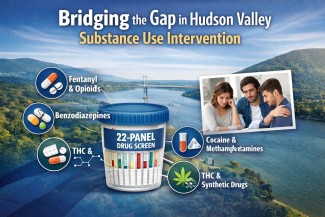
A 22-panel CLIA-waived urine drug test provides a significantly broader clinical picture. These panels detect substances across multiple drug classes simultaneously, including:
- Fentanyl and synthetic opioid analogs
- Oxycodone, hydrocodone, and prescription opioids
- Benzodiazepines (alprazolam, diazepam, clonazepam)
- Buprenorphine (Suboxone) and methadone
- Amphetamines and methamphetamine
- Barbiturates
- Cocaine and crack cocaine metabolites
- THC (marijuana)
- Tricyclic antidepressants
- MDMA (ecstasy)
- Phencyclidine (PCP)
This breadth of detection is particularly important in polysubstance use cases — which SAMHSA data now indicates represent the majority of substance use disorder presentations in treatment settings nationwide.
Clinical Application in Intervention and Treatment Placement
At Hudson Valley Addiction Treatment Center (HVATC), comprehensive screening is integrated into the intake and assessment process to inform individualized treatment planning. When an interventionist or family coach initiates a structured intervention, having objective laboratory data significantly strengthens the clinical rationale for a specific level of care — whether that is medical detoxification, residential treatment, partial hospitalization, or intensive outpatient programming.
For families in the Hudson Valley, this is especially critical. The region has experienced a surge in fentanyl-related emergencies, yet access to rapid, comprehensive testing remains limited outside of emergency departments and established treatment programs. Removing the barrier of cost — by providing free 22-panel drug tests — can accelerate the timeline from crisis recognition to treatment entry.
As noted in previous ISSUP publications on evidence-based intervention practices, the window of willingness for an individual in crisis is often narrow. Any delay — whether caused by cost, access, or logistical barriers — reduces the likelihood of successful treatment engagement. Free, accessible drug testing serves as a clinical bridge between family concern and professional assessment.
Implications for Prevention and Treatment Professionals
Substance use professionals, including interventionists, case managers, social workers, and family therapists, should consider integrating comprehensive drug testing into their standard workflow. Key recommendations include:
- Use 22-panel or broader screens rather than standard 5-panel tests, particularly when fentanyl or polysubstance use is suspected.
- Ensure testing is CLIA-waived and FDA-cleared for point-of-care use, allowing rapid results without laboratory delays.
- Provide testing at no cost when possible, as financial barriers can delay intervention during critical windows.
- Use test results to inform — not replace — clinical assessment. Comprehensive screening supports, but does not substitute for, a thorough biopsychosocial evaluation.
- Document and communicate results to treatment providers to ensure continuity of care from intervention through admission.
Accessing Free Testing in New York
Hudson Valley Addiction Treatment Center and its affiliated treatment navigation services — including Long Island Addiction Treatment Resources, Every1 Center, and Intervention NY — provide free 22-panel drug tests to New York State residents. Testing is available and can be ordered online at no cost for the test itself ($4.99 shipping per item).
For families in crisis, early identification of substances is not just a clinical best practice — it can be a life-saving first step.
About the Author
Benjamin Zohar, NCACIP, is a Nationally Certified Advanced Clinical Intervention Professional and ISSUP Network Moderator. He is the founder of Intervention NY and directs treatment navigation services across New York State, including Hudson Valley Addiction Treatment Center, Long Island Addiction Treatment Resources, and Every1 Center. His work focuses on evidence-based intervention, family coaching, and bridging the gap between crisis and care.
References
- CDC National Center for Health Statistics – Provisional Drug Overdose Death Counts (2023–2024)
- SAMHSA – National Survey on Drug Use and Health (NSDUH), 2023
- DEA – National Drug Threat Assessment, 2024
- FDA – CLIA-Waived Test Guidance for Point-of-Care Drug Screening
- ISSUP – Evidence-Based Intervention Standards and Practice Guidelines