
Safety Starts Early: Drug Use Prevention and Violence Prevention as Public Security Investments
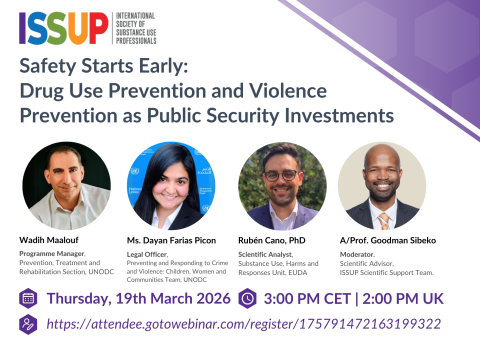
ISSUP Global presents a webinar on Safety Starts Early: Drug Use Prevention and Violence Prevention as Public Security Investments.
Date: Thursday, 19th March 2026
Time: 3:00 PM CET | 2:00 PM UK
This webinar explores how science-based prevention focused on children and adolescents is a strategic investment in public safety and security. Drawing on the International Standards on Drug Use Prevention, EUPC and evidence on Ending Violence Against Children, the session highlights how strengthening protective factors and reducing risk factors across developmental stages can prevent drug use, reduce exposure to violence, and limit vulnerabilities that criminal groups exploit for recruitment and profit.
The panellists will present to audience how early, evidence-informed interventions implemented in families, schools, and communities contribute to safer societies by reducing future involvement in crime and violence. The webinar will also underscore the importance of aligning prevention policies and programmes with internationally recognised standards to maximise impact, sustainability, and long-term security outcomes.
Intended audience:
- Prevention and drug demand reduction professionals
- Public health and behavioural health practitioners
- Policymakers, government officials, and community safety stakeholders
- Child protection and social development professionals
- Researchers, students, and International Society of Substance Use Professionals members across prevention, treatment, and recovery
Learning outcomes:
By the end of the webinar, participants will be able to:
-
Frame prevention as a dual investment in public health and public safety.
-
Summarise key evidence on economic and social returns.
-
Recognise intersections between prevention, violence prevention, and child vulnerability.
-
Identify mechanisms for translating prevention research into policy and practice.
-
Advocate for cross-sectoral prevention systems within national contexts.
Presenter:
Wadih Maalouf
Programme Manager, Prevention, Treatment and Rehabilitation Section,United Nations Office on Drugs and Crime
Dr Wadih Maalouf is Chief of the Prevention, Treatment and Rehabilitation Section at UNODC. He leads global efforts to promote evidence-based prevention, treatment, and recovery systems aligned with international standards. With a background in public health and psychiatry, he supports Member States in strengthening drug demand reduction policies and integrating prevention within broader health, development, and public safety frameworks. His work emphasises prevention as a cornerstone of sustainable and resilient societies.
Ms. Dayan Farias Picon
Legal Officer, UNODC's End Violence against Children team in Vienna.
Ms. Dayan Farias Picon is a Legal Officer with UNODC's End Violence against Children team in Vienna. With over 13 years of international experience at the intersection of child rights and justice for and with children in crime prevention and criminal justice, she advises on legal and policy frameworks to prevent and respond to violence against children and to address the specific needs of children associated with armed and criminal groups, including terrorist groups. Her practice spans legislative reform, policy guidance and capacity‑building to strengthen child‑sensitive justice systems, advance evidence‑based prevention and support rehabilitation and reintegration.
She has served with the Office of the United Nations High Commissioner for Human Rights (OHCHR) in Geneva and with UNODC in Bogotá, Addis Ababa and Vienna. A qualified Colombian lawyer, Ms. Farias Picon holds an LL.M. in Transnational Law from King's College London and a Master's in Public Policy from the University of Erfurt.
Rubén Cano, PhD in Clinical Psychology and Neuroscience
Scientific Analyst at the Substance Use, Harms and Responses Unit of the European Union Drugs Agency (EUDA), where I contribute to advancing evidence-based policies and coordinate health and social responses to drug-related challenges.
My work primarily focuses on substance use prevention, and I have experience in other areas of the continuum of care, such as treatment, harm reduction, and the broader health and social consequences of drug use. I hold a PhD in Clinical Psychology and Neuroscience, with over 14 years’ experience working on various aspects of drugs, health psychology, health promotion, and disease prevention from both clinical and research perspectives. My work focusses on developing innovative, evidence-based, and data-driven approaches to improve health and well-being, while reducing the impact of addictive behaviours and non-communicable diseases.
I have authored and co-authored more than 50 peer-reviewed scientific publications on drug use, addictive behaviours, and their physical and mental health consequences. In addition to my research and policy work, I have extensive experience teaching in higher education and providing training for clinical and health professionals, fulfilling one of my greatest passions: sharing knowledge to inspire and empower others to promote better health and care practices. I am deeply committed to the values of the European Union Drugs Agency—scientific excellence, independence, collaboration, and transparency—in supporting Member States and neighbouring countries to design effective, people-centred, and balanced responses to substance use and its associated harms. My professional goal is to contribute to a healthier, more informed, and more resilient society through the integration of research, practice, and policy.
Moderator:
ISSUP Scientific Advisor
Associate Professor Ntokozo Goodman Sibeko is Scientific Advisor to ISSUP and an academic in Public Mental Health and Addiction Psychiatry at the University of Cape Town. His work focuses on prevention systems strengthening, workforce professionalisation, and evidence-informed drug policy. He has led multiple international capacity-building initiatives and contributes to global dialogues on integrating prevention, treatment, and public safety strategies.
References:
-
UNODC WHO International Standards on Drug Use Prevention International Standards on Drug Use Prevention
-
UNODC Strive Juvenile STRIVE Juvenile
-
UNODC End VAC End Violence Against Children
-
EUPC The European Prevention Curriculum (EUPC) | www.euda.europa.eu
Webinars and online events delivered and hosted by the International Society of Substance Use Professionals (ISSUP) are provided for informational purposes only. They are educational in nature and do not constitute medical advice, diagnosis or treatment.
- ISSUP members can join Networks to comment – Sign in or become a member