
Professional Interventionist in New York: Cost, Credentials & How to Choose
Written by Benjamin Zohar, NCACIP · Medically reviewed by Brandon McNally, RN, BSN
When a loved one is struggling with addiction in New York, families often reach a breaking point—repeated relapse, escalating health risks, legal or financial fallout, and a household organized entirely around the crisis. At that stage, many families begin searching for a professional interventionist in New York who can help move their loved one from denial into treatment safely and with dignity.
This guide explains what a professional interventionist does, how to choose a qualified one in New York State, what the process involves, and what families can expect in terms of credentials, approach, and cost. It is written for families and professionals seeking a clear, ethical, evidence-informed overview.
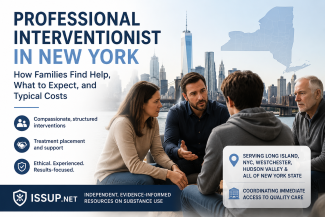
Professional intervention services are frequently requested throughout Long Island, including Nassau and Suffolk Counties, as well as Manhattan, Brooklyn, Queens, Westchester County, and the Hudson Valley. Demand for qualified, ethically grounded interventionists spans both the New York City metro area and the surrounding regions of New York State.
What a Professional Interventionist Does
A professional interventionist is a trained specialist who helps families guide a loved one toward accepting treatment for a substance use or co-occurring mental health disorder. Rather than relying on confrontation, skilled interventionists work to align the family, reduce conflict, and create a clear, compassionate path into care.
In New York State, qualified interventionists typically hold national credentials such as the NCACIP (Nationally Certified Advanced Clinical Intervention Professional) designation and maintain membership in professional bodies like NAADAC, The Association for Addiction Professionals. Their core role is to turn a chaotic, emotionally charged situation into a structured process with a defined outcome: immediate, appropriate placement in detox, residential, or outpatient care.
What the Intervention Process Involves
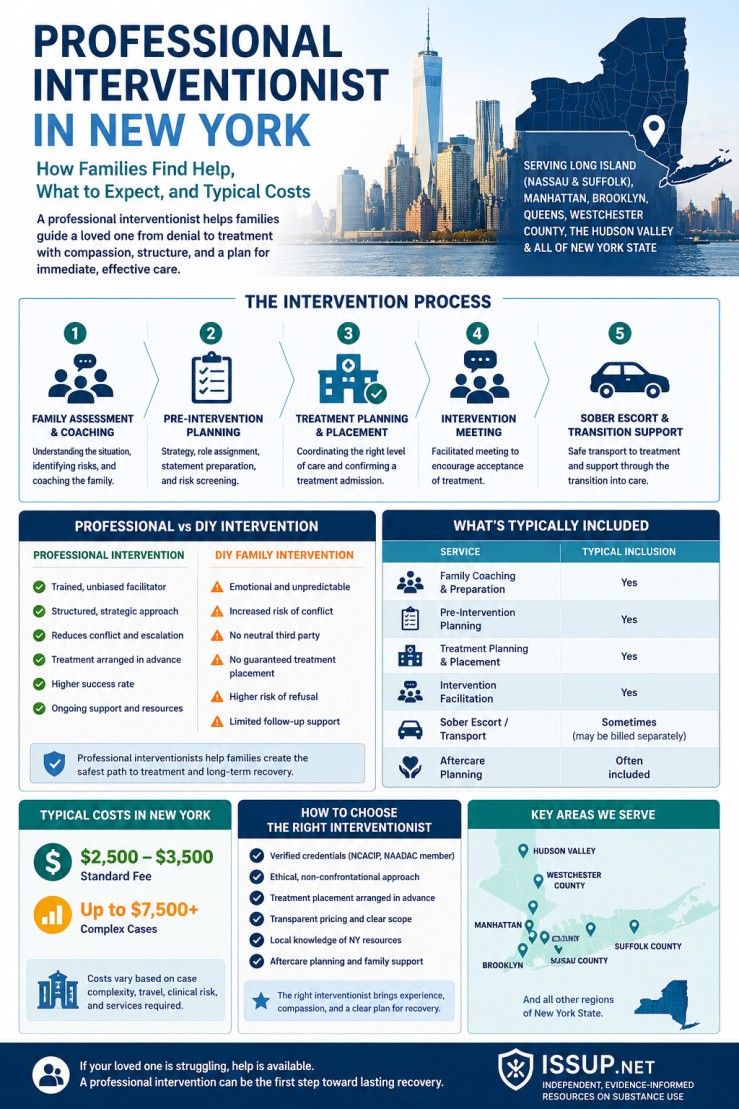
A professional intervention is best understood as a process, not a single meeting. Most interventionists working in New York structure their work around several stages:
1) Family Assessment and Coaching
The interventionist begins by understanding the loved one’s substance use history, current functioning, and any safety risks. Family members receive coaching on addiction, enabling behaviors, and how to set realistic, enforceable boundaries.
2) Pre-Intervention Planning
Before the intervention meeting, the family and interventionist hold one or more planning sessions to develop strategy, assign roles, prepare statements, and reduce the risk of escalation. Screening for withdrawal risk, mental health instability, or potential for conflict is part of this stage.
3) Treatment Planning and Placement Coordination
A defining feature of professional intervention work is arranging care in advance, so treatment is ready the moment the person agrees. This includes matching the right level of care (detox, residential, PHP/IOP, or outpatient), confirming bed availability, and planning the clinical handoff.
4) Facilitation of the Intervention Meeting
During the intervention itself, the professional manages structure and emotional intensity, keeps the family aligned, redirects denial or avoidance, and guides the conversation toward immediate treatment entry.
5) Sober Escorting and Transition Support
When there is a risk of last-minute refusal or relapse, some New York interventionists offer or coordinate sober escorting—accompanying the person safely to detox or treatment—to support a calm, structured transition into care.
The table below summarizes what is typically included in professional intervention services:
| Service | Typical Inclusion |
|---|---|
| Family Coaching & Preparation | Yes |
| Pre-Intervention Planning | Yes |
| Treatment Planning & Placement | Yes |
| Intervention Facilitation | Yes |
| Sober Escort / Transport | Sometimes (may be billed separately) |
| Aftercare Planning | Often included |
How to Choose a Professional Interventionist in New York
Not all interventionists are equally qualified, and families making a high-stakes decision under stress benefit from knowing what to look for. Key considerations include:
- Credentials: Look for recognized certification such as NCACIP, and professional membership (e.g., NAADAC). Verify that credentials are current.
- Ethical, non-confrontational approach: Evidence-informed interventionists prioritize family alignment, clarity, and compassion over shame or surprise-based confrontation.
- Placement coordination: A strong interventionist arranges vetted treatment options and confirms availability before the meeting, rather than leaving placement to chance.
- Transparent pricing: Reputable professionals provide clear, written pricing and scope of services up front.
- Local knowledge: Familiarity with New York and Long Island treatment resources, logistics, and travel considerations helps the process move quickly.
- Aftercare planning: The best outcomes come from interventionists who support the family and individual through the first phase of treatment and beyond.
Professional Intervention Resources in New York
Families in New York State and on Long Island have access to certified intervention professionals who specialize in family-centered, ethically grounded work. Intervention NY is one such resource, co-founded by certified interventionists including Christopher Veto, NCACIP, a Nationally Certified Advanced Clinical Intervention Professional and NAADAC member who focuses on structured, family-centered interventions for substance use and co-occurring mental health disorders across New York State and Long Island. Intervention NY is a member of NAADAC, The Association for Addiction Professionals.
For families seeking help identifying and coordinating appropriate care, Long Island Addiction Resources provides navigation and placement support connecting families with vetted treatment options.
Professional Interventionist vs. DIY Family Intervention
Some families consider staging an intervention on their own before seeking professional help. Understanding the difference can help families decide which approach fits their situation.
Family-Only (DIY) Intervention
In a family-led intervention, relatives organize and conduct the conversation themselves, usually without formal training. This approach has no professional fee and can work in lower-risk situations where the person is already somewhat open to help. However, it carries real risks: conversations can escalate into conflict, denial and manipulation can derail the effort, and—most commonly—families may succeed in getting a “yes” but have no treatment placement ready, losing momentum at the critical moment.
Professional Intervention
A professional interventionist brings structure, neutrality, and clinical judgment to a highly emotional situation. Advantages include screening for safety risks (withdrawal, violence, mental health instability), coaching the family to stay unified, managing escalation during the meeting, and—critically—coordinating vetted treatment placement in advance so care is ready the moment the person agrees. The trade-off is cost, but for families facing repeated relapse, co-occurring disorders, or prior failed attempts, professional guidance substantially improves the odds of safe, immediate treatment entry.
In short, a DIY intervention may suit simpler, lower-risk cases, while professional intervention is generally recommended when there is clinical complexity, safety concern, high family conflict, or a history of unsuccessful attempts.
What Does a Professional Interventionist Cost in New York?
In the New York metropolitan area, many interventionists use flat-fee pricing for local cases. As a general benchmark, professional intervention services in New York typically range from approximately $2,500–$3,500 for standard cases, with higher-complexity situations potentially reaching more when significant travel, clinical complexity, or extended support is required.
For a broader overview of intervention services, costs, inclusions, and planning considerations across the U.S., families may also review the full guide: How Much Does a Professional Interventionist Cost?
Families should always confirm pricing and scope of services in writing, including what is covered in the base fee and what circumstances result in additional charges.
When Should a Family Consider an Intervention?
Families often wait longer than they need to, hoping the situation will improve on its own. Signs that professional help may be warranted include:
- repeated relapse or failed attempts to cut back or quit
- escalating health, legal, or financial consequences
- denial that prevents the person from seeking help
- a household increasingly organized around managing the crisis
- co-occurring mental health concerns that complicate the situation
A professional interventionist can help even when previous family efforts have failed, because the structured process addresses the family system—not just the individual.
Common Situations That Lead Families to Seek an Interventionist
Families reach out to professional interventionists across a wide range of circumstances. Some of the most common include:
- Repeated relapse after treatment
- Alcohol use affecting employment or relationships
- Opioid, fentanyl, or prescription drug misuse
- Cocaine or stimulant addiction
- Co-occurring mental health disorders
- A loved one refusing treatment despite serious consequences
FAQs
What is a professional interventionist?
A professional interventionist is a trained, typically certified specialist who helps families guide a loved one into treatment for substance use or co-occurring mental health disorders. They coordinate family coaching, planning, treatment placement, and facilitation of the intervention itself.
How do I find a qualified interventionist in New York?
Look for recognized credentials such as NCACIP, professional membership like NAADAC, an ethical and non-confrontational approach, transparent written pricing, and the ability to coordinate vetted treatment placement in advance. Local knowledge of New York and Long Island resources is an added benefit.
Do interventionists travel throughout New York State?
Many professional interventionists work throughout Long Island (Nassau and Suffolk Counties), New York City, Westchester County, the Hudson Valley, and other regions of New York State. Travel requirements may affect scheduling and cost, particularly for locations outside the immediate metro area.
How much does a professional interventionist cost in New York?
In the New York metro area, intervention services typically range from approximately $2,500–$3,500 for standard local cases, with costs potentially higher for complex situations or those requiring significant travel. Always confirm pricing in writing.
Is an interventionist worth it?
For many families, a professional intervention provides structure, safety, and a clear path into care that families struggle to achieve on their own—particularly after repeated relapse or failed attempts. The value lies not only in the meeting itself but in the preparation, placement coordination, and transition support.
What happens if the person still refuses treatment?
A skilled interventionist prepares the family for multiple outcomes, including refusal. The process establishes clear, enforceable boundaries and consequences, keeps the door to treatment open, and often increases the likelihood of acceptance over time even if the first conversation does not result in immediate entry.
Conclusion
A professional interventionist in New York helps families move from crisis to coordinated care through a structured, compassionate, evidence-informed process. The most effective interventionists are credentialed, ethical, transparent about cost, and skilled at arranging vetted treatment placement in advance. For families facing a loved one’s substance use or co-occurring mental health disorder, professional guidance can be the difference between another failed attempt and a safe, successful entry into treatment.