Democratising Evidence with David Patton Pt. 4: The Future of Evidence
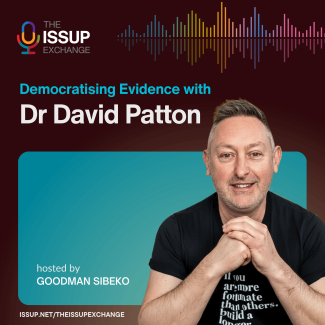
In this final episode, Professor Goodman Sibeko and Dr David Patton look ahead to the future of addiction science and explore what it would take for lived experience to become a recognised and embedded part of the global evidence base.
David reflects on the structural changes needed to create more inclusive approaches to knowledge production, challenging long-standing assumptions about evidence, academic excellence, and expertise. The conversation explores how institutions can embrace greater diversity, rethink research methods, and create meaningful partnerships that bring together different ways of knowing without reinforcing existing hierarchies.
The episode concludes with practical reflections for researchers, practitioners, and policymakers seeking to build more collaborative, equitable, and person-centred approaches to research, policy, and practice.
Featured Voices
Host – A/Prof. Goodman Sibeko
ISSUP Global Scientific Advisor.
Head of Addiction Psychiatry, University of Cape Town.
LinkedIn: goodmansibeko
Twitter/X: @profgsibeko
Guest – Dr David Patton
Dr David Patton is an Associate Professor in Criminology at the University of Derby whose work focuses on lived experience, participatory research, recovery, and social justice. He leads international initiatives that amplify lived experience voices, including Recovery Atlas and New Central Media, and has over 25 years of experience in higher education.
Time Stamps
Professor Goodman Sibeko (00:00)
Hello and welcome to this fourth and final episode of Democratizing Evidence. We're looking at lived experience and the future of addiction science with my good friend David Patton in this concluding conversation, we look ahead. We're going to explore how lived experience can become a recognized and embedded component on the global evidence base and what this means for the future of addiction science and practice. David, super happy to have you back.
And now that we have a better understanding of how lived experience can operationally contribute to the evidence base and to evidence generation and sharing in general, what would it look like for lived experience to go one step further and be fully integrated into the accepted standards for evidence?
Dr. David Patton (00:41)
fantastic question. I think that, you know, that would just really require a radical overhaul of what we currently understand to be knowledge production, way in which the whole publishing and academic industry has been set up. And we've got to acknowledge within all of this that, you know, the system is designed perfectly at producing exactly the outcomes that it was intending to produce. So, when we've seen that certain populations have been excluded for so long.
That's what it intended to do. So, it's not a quick and easy fix that when you're saying, you what would it look like? What would it take for lived experience to be truly integrated? You know, because when academia decides who counts, they're also deciding what counts. Yeah. And who, when they're deciding who's included, they're also deciding kind of what issues and how it can be expressed as well. So, it's not a simple thing of, know, can we patch work in? Lived experience knowledge, can it be kind of grafted in? I don't think it can. So, if we're going to be serious about the genuine integration of lived experience, it's going to require a kind of dismantling of the old system, the old ways of working and doing and building something entirely new. And I'm not sure we're at that point yet, if I'm being truly honest. So, I think that even though
In the last episode, I was saying, yes, I can see strides forward where lived experience is now influencing policy and funding and greater levels of co-production. Are we really there at the point globally or even within particular countries where lived experience is at the heart of the systems and is transforming the way things are done? I'm not sure we are and I don't mean to bring a damp onto the opening question.
But I do think we need to be truthful. It's not to say that we shouldn't try to get there, but I think, yeah, we need to radically overhaul what we currently see.
Professor Goodman Sibeko (02:28)
I think you know what we picked up during COVID is the public generally has a lower trust for evidence and the way social media is evolving, what information accessing looks like. It becomes even harder and harder to trust sources of evidence. So, the you know the battle the battle for science and evidence becomes much broader actually, doesn't it?
Dr. David Patton (02:48)
Yeah, and COVID was brilliant, wasn't it? Because for so long, these forms of knowledge production and these experts are touted on the news and in the media and they'll cite a statistic or the study says, and all of a sudden that becomes law, you know, and there's never any criticality to those messages, to the studies that are espoused. And you've just got to take it with the foods that are recommended, they're safe to eat, not safe to eat anymore, you know.
Yeah, it's just really, really good. I think that people began to be critical of the statistics, the stories, the narratives that are being espoused because that's exactly what we need to do if we're going to see change occur.
Professor Goodman Sibeko (03:26)
You were talking about academic performance and how, you know, the metrics for promotion and for measurement of excellence are really based on this old structure, you know, which, you know, you you've described as having been designed to be exclusionary to begin with. And so that in order for you to be recognized by your peers, you have to do things in this in this very old fashioned way.
What are your reflections about, you know, measurement of performance for academic needs to change. Does it need to become more anchored in social accountability, social responsiveness, social inclusion? What does that look like?
Dr. David Patton (03:58)
Yeah, I think we've got to broaden our understanding as to what is knowledge, what is data. I think kind of, Brene Brands says stories are just data with a soul. I'd probably go a further and see evidence without experience, there's no conscience. And so at the moment, a lot of knowledge and science is heralded as being this superior kind of almost like unquestionable form of knowledge. And I think for me, that's dangerous, but also the lack of ethical kind of conduct that's occurring in, as we spoke about in previous episodes is kind of really concerning. So we've really just got to challenge this notion that of hard evidence and hard data. And if knowledge can't be questioned, that doesn't sound like hard data to me, that sounds soft. And a lot of the methods and methodologies that we've spoken about in previous episodes is often labeled as soft knowledge and soft data, I would fundamentally disagree with that. And so we've got to expand the science, we've got to expand who's included, we've got to expand the methods and the metrics that we're using in the industry and acknowledging the limitations of the current forms of knowledge production and metrics. Yeah. Yeah.
Professor Goodman Sibeko (05:04)
I love the idea that we must challenge the notion of soft knowledge and soft data. And I, you know, you've given us a couple of really amazing nuggets here. And one is that the knowledge with no experience has no conscience. And then, you know, really about this reimagining what we mean by soft knowledge and soft data. In a so in by extension, I guess my next question is what can institutions do to begin to shift towards more inclusive models of knowledge, you know, wha what do our HREX need to do? What do our major national research bodies need to do and our regional bodies?
Dr. David Patton (05:37)
Yeah, I think we've got to diversify who is included. And that's both, and I'm not just talking about in terms of in the project or in terms of in research, but also who's employed. How diverse are your teams? Does everybody look like and sound like you? Do you have different voices, different genders, ethnicities, levels of educational attainment?
Does everybody agree with you? If there's no challenge and no diversity, then that's a red flag for me. I always want to live in a diverse community, whether that's at work or personally. love, even when you and I were in the UN very recently, I loved that week because you get to meet people from all over the world. And at those tables, there's so many different perspectives, so many different starting points, and you get to hear and learn. And so for me, you've got to come, the organizations need to begin to come with a humility that actually maybe there are other ways of doing things that we've not considered. Maybe the way that we've always done things is not the best way, regardless of how great you feel your track record has been as an organization. So how can you become humble? How can you become curious? And how can you diverse, know, the how-to's are really up to the organization. Yeah, but I think those would be some of the values I would suggest.
Professor Goodman Sibeko (06:52)
I think David, over the past three episodes we really went into some really fun discussion about, you know, how lived experience can be incorporated into design, into co-creation, and into strengthening systems by as a result.
What are the requirements in terms of training and workforce development? Like how what do we need to do on that side? you know, to sensitize, to create awareness, to actually operationalize the inclusion of communities?
Dr. David Patton (07:20)
Yeah, for me, kind of, believe decolonization is at the heart of it. And I think specifically in terms of knowledge production, I've just written a decolonizing research methods course, is just really about reconsidering the methods and the metrics as we've been speaking about and really allowing people to consider alternative. And as soon as you use the word alternative, it's hierarchical again, isn't it?
Different methods, non-traditional, again, they get you to use those. They always apply the hierarchical kind of framing to it, a diverse array of methods to knowledge production. And so you look at a whole range of tools. If you're a gardener, you wouldn't just use a lawnmower, yeah, because you need to use hedge trimmers and secateurs and the hose pipe and you accept that if I was only to have one tool in my toolbox, there's something wrong. And it's the same for knowledge production or if you're running an organization, if you're always relying on the same one or two tools to generate your knowledge, then your garden's suffering. The health of your plants and the life in your garden is suffering. And it could be so much more flourishing if you embraced and bought a range of additional tools and used them in different segments of your garden to cultivate new life.
Professor Goodman Sibeko (08:31)
That sounds great. And I think in sort of in terms of looking at policy and again taking it further from beyond just capacity building and how we reimagine our understanding and acceptance of alternative. Yes. Additional ways of collecting and assessing and sharing information is what role should going forward, lived experience play in shaping policy at both national, regional, global levels.
Dr. David Patton (09:00)
Yeah, it should really be at the heart because if we're saying we want to see change and it's really funny, isn't it? The system wants to see efficient, immediate results. And we know the true transformation takes time and it takes co-working and relationships with the communities. You can't just demand results overnight. And we operate in this short-termism of funding. So no sooner does an organisation gets some funding and then the funding's cut and so what they were building then kind of stops. So we've got to change all that. If lived experience is going to be at the heart of policy making and transformation, then we need long-term funding, long-term power sharing of people with lived experience. But I think as we were sharing previously, it's not about, because whenever you challenge power, the people with the power get edgy.
So it's not about toppling power, but sharing power. And how do we do that in a non-threatening way? And for me, it's about understanding that we all have a diverse perspective and a diverse role. So there's a beautiful video on YouTube. You might want to link to it. I can't remember the creator of it, but it's called Blobs and Squares. And so the people in policy and government to kind of call the squares. And it's like, they love to quantify things and measure things and control things. And the blobs are kind of, know, metaphor of people with lived experience and communities like that. come along and it talks about how these two people groups try to work together. And it's just brilliantly done. But I think the breakthrough comes when you embrace the fullness of what each party has got to bring to the table.
Why is that so difficult, Goodman? It's 2026. Why is it difficult for you and all of your gorgeousness and brilliance to show up as you and for me to do the same and go, we both bring something unique and we can work together to create something better than what you or I can do by ourselves. It's the same metaphor for lived experience and policy.
Professor Goodman Sibeko (10:53)
No, absolutely. And I think, you know, the my next question then becomes, over and above you and I as people who are conducting research and as people who are producing masters and PhD graduates, you know, I understand from our discussion what our responsibility might be going forward. What about the systems? How do systems move forward while avoiding tokenism and ensuring that there's genuine inclusion. Does it look like policy being rewritten? And if so, does it look like sort of some sort of lobbying happening for policymakers to more actively engage in in in rewriting policy for more meaningful inclusion? What does it look like?
Dr. David Patton (11:31)
Yeah, I'm going to give a sober answer. I'm not sure the systems are ready for that level of change. I really don't because again, it comes back to that radical overhaul, doesn't it? And so it means that the way we do things needs to change the job roles that we currently have maybe no longer needed the functions in people's livelihoods. So people will hide and defend and yeah, control that from ever occurring in the first place. So that's why I think this historical moment, I think the way we're going to see much more leverage is by the popping up and the uniting of all of these other tables of going, here's another way of doing things. I think that if you look globally, there are so many great players, yeah, so many great tables that have been established all over the globe.
The problem that we have, why we've not seen the measure of change that we would like to see is because A, we keep turning to central governments or to United Nations and other international, know, seemingly institutions of power to bring about change. But I think where you can get tables coming together and uniting and then finding allies within the system. So my personal view is that we need to create neuroplastic junctions, okay? So at the heart of the problem, I think you've got to use a metaphor left brain institutions, treatment services, housing, education, so on and so forth. They love measurement, control, observation, neutrality, all of the things we've spoken about. And then you've got this right brain thinking that's typical, and again, it's a metaphor. It's not a biological analogy here metaphor. The right brain, which is much more relational, authentic context and situational based forms of knowledge and ways of doing things and trying to come together. So you've got these parallel tracks operating. And what we try to do is go, okay, the left brain has got to incorporate the right brain. Well, it can't do it. It can't do it.
It's like oil and water to use a different metaphor. But I believe what we can do, if you think of it like a tube map, okay? Now I'm from England, so I'm gonna use the London tube map just for a moment. So you've got the Piccadilly line, which let this call it the blue line. And then you've got the Holloway line, okay? Which is we'll call it the green line. So the blue and green line. Now at certain points along the map, they're running in different directions, but at certain points they'll run parallel to each other. Now there, why can't we build a junction point, a tube station, where there's a coming together of approaches and perspectives and methods and metrics? So the traditional left brain institutions and services are never gonna become like right brain institutions and services and approaches and projects and vice versa. But what we can do is come together in neuroplasticity along the lines of my metaphor and build temporal as a minimum, temporary spaces, maybe even institutions or entities, projects, programs, things whereby the left and right brain thinking can coexist in the same space at the same time. It's like a marriage. When two people come together, they've got to work through some stuff in order for the relationship and the good outcomes to come through to pass. So in that tube station, you get this melting pot of metrics and methods and values, which I think can help our communities, those people that we say we want to serve, if actually we'll check our ego at the door and hand over control. Does that help?
Professor Goodman Sibeko (14:55)
It really does. It really does. And I so I think, you know, a lot of the listeners will now be thinking about what how do I if that's if we've managed to move their thinking on this topic. so as a final question, what advice would you give these researchers, these practitioners and these policymakers who are really looking to integrate lived experience more meaningfully into their work?
Dr. David Patton (15:16)
Yeah, I think you've, you come with a humility that while you are brilliant and whilst your perspective is absolutely right, that maybe there could be another perspective and that maybe there could be another way. And are you willing to cultivate relationships with others to hear and learn about other diverse ways of knowing, being and doing that exist outside of the confines of the way that you would do them.
That would be my advice.
Professor Goodman Sibeko (15:40)
That's great. David, it's been such a wonderful pleasure to speak to you. So, to our guests, as we close, we really want to express our sincere thanks to David for sharing his insights and teaching us how to think differently. This conversation has really, I think, served to strengthen our understanding of how lived experience can be incorporated to expand an evidence base. And this is, you know, in thinking about it, not just about how to improve our methods.
But also expanding whose knowledge we value and whose knowledge we include and how. So thank you to Kwadwo, who our incredible producer behind the scenes, and then from all of us at ISSUP thanks so much for listening. David, thank you. Before I close, I wanna make sure you have an opportunity to say some.
Dr. David Patton (16:23)
I just really want to say thank you so much for this opportunity. I've really enjoyed our conversation and it's been really great. Just your line of questioning and thinking, I love it. So thank you. Thanks for being you.
Professor Goodman Sibeko (16:32)
Awesome. Thank you, David. We hope these conversations inspire you at ISSUP community to continue advancing inclusive, evidence informed and person centred approaches to prevention, treatment, and recovery support. And please join us on our next podcast and be sure to listen to all of our previous episodes as well for inspiration and ideas. Thank you. Take care.
Professor Goodman Sibeko (16:34)
Thank you for spending this time with us. We hope you enjoy that as much as we do. Be sure to hop on over to our website, isop.net, where you'll find information on how to sign up for free membership. Take care and catch you on the next one.
About the ISSUP Exchange
The ISSUP Exchange podcast series explores the evolution of responses to the challenges of substance use—from research and training to ethics, quality standards and evidence-based practice. We connect the dots so you can see the big picture.
Explore more episodes and join the ISSUP podcast community here>>>
About ISSUP
ISSUP is a global network that unites, connects, and shares knowledge across the substance use prevention, treatment, and recovery support workforce. Our mission is to make our members’ work as effective as possible—by providing access to training, resources, and a vibrant professional community.