
7-OH Rehab: Withdrawal, Treatment & FAQ
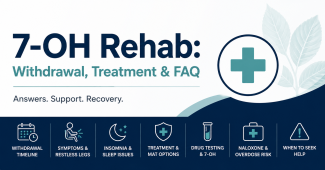
Quick Answer: 7-OH, short for 7-hydroxymitragynine, is a concentrated kratom-related compound with opioid-like effects. Some people develop tolerance, withdrawal, cravings, and difficulty stopping. 7-OH rehab may include medical evaluation, withdrawal support, therapy, relapse-prevention planning, and medication-assisted treatment when clinically appropriate.
Key Takeaways
- 7-OH is not the same as traditional kratom leaf; many current concerns involve concentrated 7-OH products.
- 7-OH withdrawal may include anxiety, restless legs, sweating, chills, insomnia, nausea, vomiting, diarrhea, muscle aches, cravings, and low mood.
- Suboxone should not be started on a fixed clock without medical guidance; clinicians usually wait for clear moderate withdrawal.
- Standard 5-panel, 10-panel, and 12-panel drug tests usually do not detect 7-OH unless kratom-specific testing is ordered.
- Naloxone may be used in a suspected opioid-like overdose involving 7-OH, especially if breathing is slowed or the person cannot be awakened.
- Medical help is important if withdrawal is severe, other substances are involved, or someone feels unsafe.
Table of Contents
- What Is 7-OH?
- Can You Go to Rehab for 7-OH?
- Can You Withdraw From 7-OH?
- What Are the Withdrawal Symptoms of 7-OH?
- How Long Does 7-OH Withdrawal Last?
- How Long Should You Wait to Take Suboxone After 7-OH?
- How Long Does 7-OH Take to Leave the System?
- Will 7-OH Show Up on a Drug Test?
- Will Naloxone Reverse 7-OH?
- Is 7-OH Stronger Than Kratom?
- What Should Pharmacists and Clinicians Know?
- More 7-OH Questions and Answers
What Is 7-OH?
7-OH is short for 7-hydroxymitragynine, a kratom-related alkaloid with opioid-receptor activity. Traditional kratom leaf contains small amounts of 7-OH, but many current concerns involve concentrated products such as tablets, gummies, extracts, shots, and enhanced formulations.
Because these products may vary in strength, labeling, and formulation, people may take more than intended or develop dependence faster than expected. Retail availability does not mean a product is FDA-approved, medically safe, or appropriate for self-treatment.
For a focused overview, see 7-OH Withdrawal, Rehab, and Treatment: Common Questions Answered.
Can You Go to Rehab for 7-OH?
Yes. A person can go to rehab for 7-OH if they cannot stop using it, experience withdrawal, develop cravings, or continue using despite consequences. Treatment is based on symptoms and function, not only whether the product is legal or sold in stores.
7-OH rehab may include medical assessment, withdrawal support, therapy, relapse-prevention planning, medication review, treatment for co-occurring mental health symptoms, and medication-assisted treatment evaluation when clinically appropriate.
Can You Withdraw From 7-OH?
Yes. People who use 7-OH regularly may experience withdrawal when they stop or reduce use. Some people describe the withdrawal as opioid-like, especially after daily use, high-dose use, or use of concentrated 7-OH products.
Withdrawal can be physical and psychological. Some people experience body symptoms, while others struggle most with cravings, insomnia, anxiety, and fear of running out.
What Are the Withdrawal Symptoms of 7-OH?
7-OH withdrawal symptoms may include muscle aches, anxiety, restless legs, sweating, chills, insomnia, nausea, vomiting, diarrhea, tremors, and cravings. The severity varies based on dose, frequency, product strength, duration of use, and other substances.
- Muscle aches and muscle stiffness
- Anxiety, irritability, and restlessness
- Restless legs
- Sweating, chills, and temperature dysregulation
- Watery eyes, runny nose, and yawning
- Insomnia or broken sleep
- Jerky movements, tremors, or body discomfort
- Nausea, vomiting, diarrhea, or stomach cramping
- Fatigue, low mood, or low motivation
- Strong cravings or fear of running out
How Long Does 7-OH Withdrawal Last?
7-OH withdrawal may begin within the first day, peak over the next several days, and gradually improve over one to two weeks, although sleep, mood, and cravings may last longer. The exact timeline varies widely.
| Time Period | Possible Symptoms | What to Watch For |
|---|---|---|
| First 12–24 hours | Anxiety, cravings, restlessness, early insomnia, fear of running out | This is when many people feel tempted to use again to stop symptoms. |
| Days 1–3 | Restless legs, sweating, chills, stomach symptoms, body aches, insomnia | This may be the most physically uncomfortable stage. |
| Days 4–7 | Gradual physical improvement, fatigue, poor sleep, mood swings, cravings | Relapse risk may remain high if sleep and cravings stay intense. |
| Week 2 and beyond | Low mood, low energy, anxiety, sleep disruption, lingering cravings | Ongoing support may be needed if symptoms affect work, family, or safety. |
How Long Should You Wait to Take Suboxone After 7-OH?
Do not start Suboxone after 7-OH based only on a fixed number of hours. With opioid-like substances, buprenorphine is usually started when a person is already in clear, moderate withdrawal, not simply because 12, 18, or 24 hours have passed.
Some clinicians may consider a 12–24 hour window after shorter-acting opioid-like substances, but 7-OH products vary widely in strength, duration, and formulation. Starting buprenorphine too early can worsen withdrawal symptoms.
People using 7-OH, kratom extracts, alcohol, benzodiazepines, opioids, or other sedatives should speak with an addiction-trained prescriber before starting Suboxone or any medication-assisted treatment plan.
| Suboxone Question | Safer Answer |
|---|---|
| Can Suboxone help 7-OH withdrawal? | It may be considered by a qualified clinician if symptoms resemble opioid withdrawal or opioid use disorder. |
| Can I start Suboxone on my own? | No. Buprenorphine timing and dosing should be managed by a prescriber. |
| When is Suboxone usually started? | Clinicians generally wait until clear moderate withdrawal is present. |
| Is MAT a failure? | No. Medication-assisted treatment can provide stability and reduce relapse risk when clinically appropriate. |
How Long Does 7-OH Take to Leave the System?
There is no fully standardized human clearance window for retail 7-OH products. Some estimates based on limited pharmacology or preclinical data suggest a longer elimination pattern, but real-world clearance can vary significantly.
Clearance may depend on dose, frequency, product strength, metabolism, liver function, hydration, body composition, and the testing method used. As a general pharmacology principle, a substance may take about five half-lives to be mostly eliminated. If a 24-hour half-life estimate is used, that would suggest several days before most of the substance is cleared.
This should be treated as an estimate, not a guaranteed safety, withdrawal, or drug-testing window.
Will 7-OH Show Up on a Drug Test?
No, 7-OH usually does not show up on standard 5-panel, 10-panel, or 12-panel drug tests. Routine urine screens typically look for common substances such as THC, cocaine, amphetamines, PCP, benzodiazepines, barbiturates, methadone, oxycodone, and traditional opiates.
However, 7-OH may be detectable if a laboratory uses a kratom-specific assay or advanced confirmatory testing, such as LC-MS/MS, that includes mitragynine, 7-hydroxymitragynine, or related compounds. Some clinical, forensic, treatment, pain-management, or monitoring programs may order specialized testing.
| Test Type | Will It Usually Detect 7-OH? | Notes |
|---|---|---|
| Standard 5-panel urine test | No | Usually screens for common workplace substances, not kratom alkaloids. |
| Standard 10-panel or 12-panel urine test | Usually no | May include more drug classes, but 7-OH is still not typically included unless specifically added. |
| Kratom-specific urine test | Yes, possible | May test for mitragynine, 7-hydroxymitragynine, or related compounds. |
| LC-MS/MS confirmatory testing | Yes, if included in the assay | Advanced lab testing can identify specific compounds when the lab is looking for them. |
| Hair testing | Possible, but not routine | Only relevant if the lab offers kratom or 7-OH-specific hair testing. |
Detection windows are not fully standardized. Some kratom-related urine testing may detect alkaloids for several days after use, depending on dose, frequency, metabolism, hydration, and test sensitivity. Unexpected positive results on rapid screens should be confirmed with laboratory-based testing.
Will Naloxone Reverse 7-OH?
Naloxone may be used in a suspected opioid-like overdose involving 7-OH. Because 7-OH has opioid-receptor activity, naloxone may be appropriate if someone has slowed breathing, blue or gray lips, extreme sedation, or cannot be awakened.
If overdose is suspected, call 911 immediately. Give naloxone if available, stay with the person, and follow emergency instructions. Do not wait to see whether the person improves on their own.
Emergency warning: Call 911 for slowed breathing, unconsciousness, blue or gray lips, seizure, severe confusion, chest pain, or suspected overdose.
Is 7-OH Stronger Than Kratom?
Concentrated 7-OH products may produce stronger opioid-like effects than traditional kratom leaf. Traditional kratom contains a mixture of alkaloids, while concentrated 7-OH products may deliver higher exposure to a specific opioid-like compound.
| Topic | Traditional Kratom Leaf | Concentrated 7-OH Products |
|---|---|---|
| Common forms | Leaf, powder, tea, capsules | Tablets, gummies, shots, extracts, enhanced products |
| Main concern | Dependence, withdrawal, variable potency, contamination risk | High-potency opioid-like effects, tolerance, withdrawal, cravings |
| Withdrawal risk | Possible with regular use | May be more intense with concentrated or frequent use |
| Treatment issue | May require substance use treatment if compulsive use develops | May require medical assessment, withdrawal support, or MAT evaluation |
What Should Pharmacists and Clinicians Know About 7-OH?
Pharmacists and clinicians should ask specifically about concentrated 7-OH products when patients report opioid-like withdrawal, cravings, or unexplained dependence symptoms. Patients may not describe these products as opioids and may only say they are using kratom, tablets, shots, gummies, or gas-station products.
Practice implications include screening for 7-OH tablets, gummies, shots, extracts, and enhanced kratom products; assessing withdrawal severity; avoiding casual buprenorphine initiation; timing medication-assisted treatment to moderate withdrawal when appropriate; offering harm-reduction counseling; checking for alcohol or sedative co-use; and staying current with changing state and federal regulations.
Myth vs. Fact
| Myth | Fact |
|---|---|
| “If 7-OH is sold in a store, it must be safe.” | Retail availability does not mean a product is FDA-approved, standardized, or low-risk. |
| “7-OH is just kratom, so withdrawal is always mild.” | Concentrated 7-OH products may cause significant opioid-like withdrawal in some people. |
| “A normal drug test always catches 7-OH.” | Many routine drug tests do not include specialized 7-OH or kratom alkaloid testing. |
| “Suboxone can be started whenever withdrawal feels uncomfortable.” | Buprenorphine timing should be guided by a qualified clinician and clear moderate withdrawal. |
| “Needing treatment means I failed.” | Needing help means the symptoms have become difficult to manage alone. Treatment can provide stability and safety. |
More 7-OH Questions and Answers
Does 7-hydroxymitragynine release dopamine?
7-OH affects opioid receptors, and opioid-receptor activity can influence reward pathways involving dopamine. This may contribute to reinforcement, cravings, and compulsive use in some people.
Does 7-OH feel good?
Some people report euphoria, relaxation, or pain relief. Those effects may reinforce repeated use and increase the risk of tolerance, dependence, withdrawal, and cravings.
Can I be addicted to 7-OH?
Yes. Addiction is possible when a person loses control over use, continues despite harm, develops cravings, spends significant time obtaining or using it, or cannot stop despite wanting to.
What is kratom poisoning?
Kratom poisoning usually refers to toxicity or overdose-like effects from kratom or related products. Symptoms may include severe nausea, vomiting, sedation, confusion, fast heart rate, high blood pressure, agitation, seizures, or respiratory depression, especially when mixed with other substances.
What drugs should not be mixed with 7-OH?
Avoid combining 7-OH with alcohol, benzodiazepines, opioids, sedatives, sleep medications, or other substances that impair breathing or consciousness. Combining substances can increase overdose and injury risk.
Can 7-OH damage the liver or kidneys?
Kratom-related products have been associated with adverse health events, and product contamination or mixing substances may increase risk. Anyone with jaundice, dark urine, severe abdominal pain, confusion, swelling, or severe dehydration should seek medical care.
Why am I throwing up from 7-OH?
Nausea and vomiting can occur from opioid-like effects, high doses, product potency, contamination, withdrawal, or mixing substances. Severe vomiting can cause dehydration and may require medical attention.
What is the “spit trick” for Suboxone?
People online sometimes discuss spitting after buprenorphine dissolves to reduce side effects, but patients should follow directions from their prescriber or pharmacist. Do not change how you take medication without medical advice.
What drinks contain kratom or kava?
Some commercial beverages may contain kratom, kava, or related extracts. Labels, serving sizes, and alkaloid content may be unclear, so people in recovery should be cautious with drinks marketed for relaxation, energy, mood, or euphoria.
When to Seek Medical Help
Seek medical help if 7-OH use is affecting your mood, sleep, relationships, work, finances, or safety. Help is especially important if you have tried to quit but keep returning to use, feel afraid of running out, or need more to feel normal.
- Slow or stopped breathing
- Blue or gray lips
- Severe confusion
- Chest pain
- Seizure
- Severe dehydration
- Suicidal thoughts
- Overdose symptoms
- Withdrawal mixed with alcohol, benzodiazepines, opioids, or sedatives
If you are in immediate danger, call 911. If you are experiencing suicidal thoughts or a mental health crisis in the United States, call or text 988 for the Suicide & Crisis Lifeline.
Related Guides
- 7-OH Withdrawal, Rehab, and Treatment: Common Questions Answered
- 7-OH Withdrawal Symptoms and Timeline
- Suboxone and Kratom Withdrawal
- Suboxone for Kratom Withdrawal
- Kratom Withdrawal Symptoms, Timeline & Treatment
- SAMHSA National Helpline
References
- U.S. Food and Drug Administration: kratom-related safety information and consumer warnings.
- Drug Enforcement Administration: controlled substance scheduling information.
- SAMHSA National Helpline: treatment information and referral support.
- 988 Suicide & Crisis Lifeline: crisis support in the United States.
- National Institute on Drug Abuse: opioid use disorder, withdrawal, and treatment information.
Author and Medical Review
Author: Benjamin Zohar, NCACIP — addiction recovery advocate, intervention professional, and ISSUP contributor.
Medical reviewer: Brandon McNally, RN — reviewed for clinical clarity, safety language, and appropriate treatment guidance.
This article was reviewed for clinical clarity, safety language, and appropriate referral guidance. It does not provide individualized medical advice.
Last updated: July 2026
Medical disclaimer: This article is for educational purposes only and is not a substitute for medical advice, diagnosis, detox, or emergency care. Do not start, stop, or combine medications without speaking with a qualified healthcare professional.