
Carfentanil Detected in Counterfeit Tablets and Powders: What the Substance Use Workforce Should Know
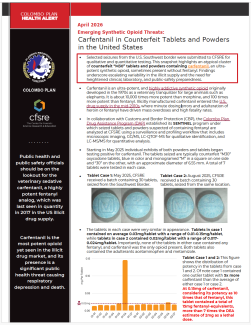
A recent Colombo Plan health alert highlights an important development in the rapidly changing synthetic opioid market. Laboratory testing by the Center for Forensic Science Research and Education (CFSRE) identified carfentanil in a small number of counterfeit tablets and powder samples seized at the United States Southwest border.
Carfentanil is an extremely potent synthetic opioid, originally developed for veterinary use with very large animals. The alert describes it as approximately 100 times more potent than fentanyl. Even a very small and unevenly distributed amount can therefore substantially increase the risk of respiratory depression, overdose and death.
What makes these findings particularly concerning is not only the potency of carfentanil, but the unpredictability of the products in which it was found.
The counterfeit blue “M30” tablets closely resembled oxycodone tablets. In the two tablet cases examined, carfentanil was the only opioid detected: the tablets did not contain fentanyl. Although most contained broadly similar amounts, one tablet contained approximately five times more carfentanil than the average. The alert estimated that this one tablet contained the equivalent potency of approximately 15 mg of fentanyl.
Carfentanil was also detected alongside fentanyl, xylazine and other substances in two purple powder samples. Concentrations differed considerably between the samples. These findings reinforce a familiar but critical message as shared in a recent ISSUP webinar: neither the appearance of a tablet or powder nor a person’s previous experience with a product can reliably indicate what it contains or how potent it may be.
This is a surveillance signal from selected seizures, rather than a complete picture of the United States or global drug supply. Nevertheless, it offers practical lessons for the full substance use workforce.
Key takeaways for prevention practitioners
Prevention messaging should make clear that counterfeit medicines can look very similar to legitimate pharmaceutical products. Colour, shape and markings such as “M30” cannot confirm a tablet’s contents or strength.
Information should be factual and proportionate, avoiding sensational language while explaining the risk plainly. Messages are likely to be more useful when they include something people can do: do not take medication obtained outside a regulated supply; learn to recognise an opioid overdose; know how to contact emergency services; and know where naloxone and local support are available.
Local context remains important. Prevention teams should work with public-health authorities, laboratories, community organisations and people with lived and living experience to ensure that alerts reflect substances actually being detected locally.
Key takeaways for treatment, healthcare and recovery professionals
Clinicians and service providers should consider exposure to highly potent synthetic opioids when a person presents with severe or unusually rapid respiratory depression, even if fentanyl is not initially reported or detected.
Naloxone remains an appropriate response to a suspected opioid overdose, including one involving carfentanil. Because very potent opioids may require additional naloxone, services should maintain adequate supplies and follow their clinical or emergency-response protocols. Emergency assistance, breathing support where appropriately trained, and continued observation remain essential because overdose symptoms can return after naloxone has worn off.
Treatment and recovery services can also use these alerts to open calm, non-judgemental conversations about overdose risk, reduced tolerance and practical safety planning. People leaving treatment, hospital care or custody may be at particularly high risk following a loss of opioid tolerance. Naloxone access and overdose-response education should ideally extend, where possible, to families, peers and recovery-support networks.
An overdose response should not end once the immediate medical crisis has passed. Rapid, respectful connections to treatment, recovery support and other needed services can turn an emergency encounter into an opportunity for continuing care.
Key takeaways for the drug supply and law enforcement workforce
The findings show why presumptive identification or visual inspection alone is insufficient. A counterfeit tablet resembling oxycodone may contain carfentanil without fentanyl, while a powder may contain several opioids, sedatives, adulterants and manufacturing by-products.
Forensic laboratories should test comprehensively for all opioids and other relevant substances, even when fentanyl has already been identified. Highly potent substances present in comparatively small amounts may otherwise be missed. Quantitative testing, where available, can also reveal variations between products that qualitative identification alone cannot show.
Law enforcement and other personnel encountering unknown tablets or powders should follow their agency’s approved handling procedures, use appropriate protective equipment and avoid unnecessary disturbance of suspected material. Suspected exposure or overdose requires an immediate medical response in accordance with local protocols.
Just as importantly, laboratory and seizure information should be shared rapidly through appropriate early warning and public health channels. Timely collaboration among law enforcement, customs, forensic and clinical laboratories, emergency services, public health, prevention, treatment and recovery organisations can help translate an isolated detection into a coordinated response.
A shared workforce response
Emerging synthetic opioids do not sit neatly within one professional field. The same signal has implications for surveillance, supply control, prevention communication, emergency care, treatment access and recovery support.
For the ISSUP community, the central takeaway is therefore one of connection: share verified information quickly, adapt it carefully to the local context, prepare for opioid overdoses, and ensure that people at risk can reach both lifesaving medication and longer term support.
The original April 2026 alert and related public alerts are available from the CFSRE NPS Discovery Programme. Practical guidance on recognising and responding to opioid overdose is available from the CDC.