

World Drug Report 2026: Key Trends and Policy Challenges for Africa
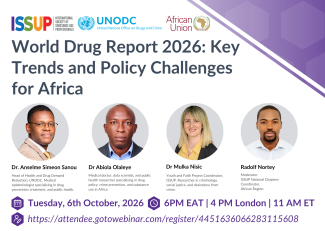
ISSUP Global, in collaboration with the African Union, presents World Drug Report 2026: Key Trends and Policy Challenges for Africa.
Date: Tuesday, 6th October, 2026
Time: 6PM EAT | 4 PM London | 11 AM ET
Language: English, with French interpretation available.
This webinar will examine the key findings of the UNODC World Drug Report 2026 and their implications for Africa. Drawing on the report’s analysis of drug market patterns and trends, contemporary drug-related issues and special points of interest, the session will highlight emerging patterns in drug use, production and trafficking, as well as changes in regional and transnational drug markets.
Particular attention will be given to the public health, security and development implications of these trends for African countries. The speakers will consider how the findings can inform balanced, evidence-informed responses encompassing prevention, treatment, recovery support, law enforcement, supply reduction and regional cooperation.
The presentations will be followed by a moderated discussion focused on translating the report’s findings into policy and practice across the continent.
Intended audience:
- Policy-makers and government officials working in drug control, public health, justice and security
- Prevention, treatment and recovery support professionals
- Healthcare and social service professionals
- Law enforcement and supply reduction practitioners
- Researchers and academics
- Civil society and community-based organisations
- Regional organisations and international development partners
- Others interested in drug-related trends and their implications for Africa
Learning outcomes:
By the end of the webinar, participants will:
-
Summarise the principal findings of the World Drug Report 2026 relevant to Africa.
-
Identify emerging patterns in drug use, production, trafficking and illicit drug markets across the continent.
-
Explain the implications of these trends for public health, security, development and national drug policy.
-
Consider how evidence and regional cooperation can support balanced and effective responses.
-
Identify priority areas for policy, programming and professional practice in Africa.
Presenter:
Dr. Anselme Simeon Sanou
Dr. Anselme Simeon Sanou has more than 15 years of experience in epidemiology and international health with national, regional and international organisations in designing and implementing various programmes to prevent, detect and respond to public health threats.
Since 2021, he has been leading the Health and Drug Demand Reduction Unit at the Regional Office for West and Central Africa of the United Nations Office on Drugs and Crime (UNODC). In his daily work, he coordinates programmes/projects related to drug information systems, drug use prevention, treatment of drug use disorders in the region.
He is a medical epidemiologist and holds a Medical Degree from the University of Ouagadougou (Burkina Faso), a Master in Epidemiology from the University of Bordeaux (France), and a PhD in International Health and Epidemiology from the University of Bergen (Norway).
Dr Abiola Olaleye
Dr. Abiola Olaleye is a medical doctor, data scientist, researcher, and international development professional with expertise in public health, drug policy, crime prevention, and development programming in Africa. He has extensive experience working at the intersection of health, policy, research, and international development.
He previously worked with the United Nations Office on Drugs and Crime (UNODC) and has collaborated with international organizations including WHO, UNFPA, UNAIDS, UNDP, UNICEF, and UN Women. His work includes policy analysis, programme evaluation, health systems research, drug policy, and evidence-based approaches to addressing substance use and related public health challenges.
Dr. Olaleye brings an African regional perspective to discussions on emerging drug trends, policy responses, and the evolving challenges facing the continent.
Dr. Mulka Nisic
Dr Mulka Nisic holds a PhD in Business, Law and Social Sciences specialising in Criminology and Social Justice, and an MSc in Desistance from Crime. Her work focuses on the intersection of substance use and drug related offending, with particular attention to the social and structural factors shaping vulnerability to substance use, crime involvement, as well as pathways toward resilience, recovery, and desistance.
She currently serves as Faith and Youth Project Coordinator at the International Society of Substance Use Professionals (ISSUP), where she leads global activities under the Faith and Youth Workplan aimed at strengthening the workforce in delivering community and faith-based responses to substance use as well as supporting youth engagement, professional capacity building of early career professionals, and cross-regional and global knowledge exchange.
Moderator:
Radolf Nortey
Moderator. ISSUP National Chapters Coordinator, African Region.
Webinars and online events delivered and hosted by the International Society of Substance Use Professionals (ISSUP) are provided for informational purposes only. They are educational in nature and do not constitute medical advice, diagnosis or treatment.