

The laws, regulations, strategies, and governance frameworks that guide how governments and institutions address substance use, substance use disorders, and illicit drug trafficking. These policies shape coordinated responses across prevention, treatment, recovery support, public health, regulatory control, and law enforcement. Effective substance use policies aim to reduce health and social harms, ensure access to prevention and treatment services, regulate controlled substances, and disrupt illicit drug markets. They are typically informed by scientific evidence, public health principles, and cross-sector collaboration to promote safer and healthier communities.
Policy
25th Annual Conference of the European Society of Criminology
The Annual Conference of the European Society of Criminology (ESC) is one of Europe's most significant gatherings of criminologists and professionals in related fields. It provides a platform for researchers, practitioners, and policymakers from all over the world to discuss and share their work on various aspects of criminology, criminal justice, and related social sciences.
Returning to Basics: Successful Advocacy 101
ISSUP Global, in collaboration with Faces & Voices of Recovery, presents its webinar titled 'Returning to Basics: Successful Advocacy 101'
Returning to Basics: Successful Advocacy 101
ISSUP Global, in collaboration with Faces & Voices of Recovery, invites you to part 4 of its webinar series titled 'Returning to Basics: Successful Advocacy 101'
Attitudes and views regarding law enforcement activity at large outdoor raves in Israel: a cross-sectional survey
ABSTRACT Harm reduction services, such as drug testing kiosks and ‘safe zones’ are often advocated for reducing the harms of drug use among rave and festival attendees. However, interaction with law enforcement can undermine efforts at...
Seattle’s law enforcement assisted diversion (LEAD): Program effects on criminal justice and legal system utilization and costs.
Abstract Objectives We evaluated a prebooking law enforcement assisted diversion (LEAD) program (i.e., initial diversion from the criminal justice system paired with harm-reduction case management and legal assistance to individuals with...
Law enforcement-led, pre-arrest diversion-to-treatment may reduce crime recidivism, incarceration, and overdose deaths: Program evaluation outcomes.
Abstract Introduction: Substance use disorder (SUD), overdose, and drug use-related crime continue to increase in the U.S. Pre-arrest diversion-to-treatment programs may decrease crime recidivism and overdose deaths. We assessed the impact...
A multi-site evaluation of law enforcement deflection in the United States.
Many law enforcement and other first responder agencies have adopted deflection as a front-line response to the increasing number of drug overdoses and deaths in the United States over the past two decades. Deflection programs aim to...
Moving Beyond Referrals: Addressing Multilevel Barriers to Substance Use Treatment Engagement Through Police-Led Recovery Management Check-Ups
ABSTRACT The opioid epidemic in the United States (US) has prompted innovative responses from law enforcement agencies including specialized units to refer overdose survivors to substance use treatment following an overdose. However...
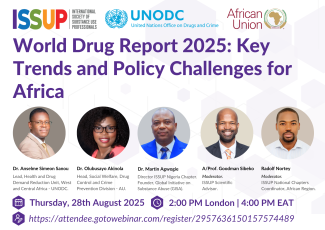
UNODC World Drug Report
A global reference on drug markets, trends and policy developments, the World Drug Report offers a wealth of data and analysis and in 2025 comprises several elements tailored to different audiences.
Improving reach and access to health promotion and preventive services for vulnerable children and adolescents
Across Europe, one in four children faces poverty or social exclusion, with vulnerable groups—such as migrants, refugees, and children from disadvantaged families—bearing the greatest burden. These disparities were worsened by the COVID-19...