
⚠️ Tusi ("Pink Cocaine"): What It Is, Risks and Where to Get Help
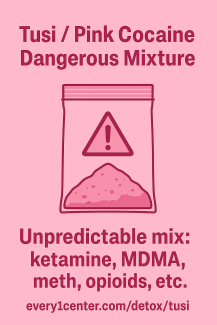
Tusi (also known as Tussi, Tuci, or "pink cocaine") is not pure cocaine, but a mixture of several rose-tinted drugs. Laboratory tests have detected combinations including ketamine, MDMA, methamphetamine, cocaine, opioids and new psychoactive substances. This makes its effects and the risk of overdose highly unpredictable.
What is Tusi / Pink Cocaine?
- It is a polydrug mixture sold like pink powder in party environments and nightclubs.
- It was originally related to the synthetic psychedelic 2C-B, but most current samples do not contain it.
- The pink color comes from dyes and does not guarantee their composition or safety.
Sources: DEA – Pink Cocaine · Palamar et al., 2023 (The American Journal of Drug and Alcohol Abuse).
Effects and Risks
- Overdose and severe reactions to unknown ingredients.
- Immediate risks: agitation, hallucinations, high blood pressure, vomiting, seizures.
- Long-term risks: dependence, mental health problems, increased danger in people with opioid use disorders (OUD).
- The risk increases if it contains fentanyl or other potent opioids or if it is mixed with alcohol or benzodiazepines.
Detox & Treatment (Every1 Center)
Since the composition of Tusi is unpredictable, supervised medical care is recommended to manage withdrawal, perform toxicology tests, and stabilize the patient.
👉 More information: Every1 Center – Tusi Detox and Rehabilitation
https://every1center.com/detox/tusi/
National Resources: SAMHSA – Find Help https://www.samhsa.gov/find-help
References
- DEA — Pink Cocaine (Tusi).
- Palamar, J.J. et al. (2023). Emergence of "Tusi" in the USA (PubMed).
- America's Poison Centers — Exhibitions and alerts.
- SAMHSA — Find treatment and support.
⚠️ Disclaimer: This resource is educational only. In case of emergency, call your local emergency number or Poison Help (1-800-222-1222 ).
Do you want it to be adapted to French and Portuguese as well, so that it is aligned with ISSUP's multilingual options?