

Chemsex, Mental Health, and Recovery Pathways with Ashwin Thind: Beginnings & Influences Pt.1
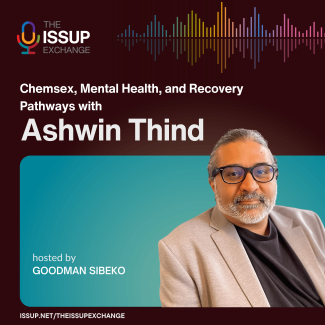
In this first episode, Associate Professor Goodman Sibeko is joined by Ashwin Thind to trace the personal and professional journey that led him into the field of addiction, mental health, and Chemsex.
Ashwin reflects on early curiosity about human behaviour, his own lived experience of recovery, and the turning points that shaped his decision to work in addiction psychology. He shares how gaps in treatment, particularly for people with complex and overlapping needs, pushed him to look beyond traditional approaches and towards more integrated, evidence-based care.
The conversation also touches on the realities of practice in resource-limited settings, the importance of professional training, and how global exposure through networks like ISSUP and UNODC helped shape his perspective.
A grounded starting point that sets the context for understanding the complexities of Chemsex, and why more responsive, compassionate approaches to care are needed.
Featured Voices
Host – A/Prof. Goodman Sibeko
ISSUP Global Scientific Advisor.
Head of Addiction Psychiatry, University of Cape Town.
LinkedIn: goodmansibeko
Twitter/X: @profgsibeko
Guest – Ashwin Thind
Ashwin Thind is a Clinical Psychologist and International Certified Addiction Professional (ICAP II) with extensive experience in substance use, behavioural addictions, and trauma related mental health issues. Currently pursuing a PhD in Public Health at the University of Malaya, his research focuses on developing psychological harm reduction interventions for chemsex management.
LinkedIn: ashwin-thind
Time Stamps
Professor Goodman Sibeko (00:00)
Hello and welcome to Understanding Chemsex, Mental Health, Substance Use and Recovery Pathways, a special ISSUP podcast series exploring an emerging and complex issue at the intersection of substance use, mental health and sexual health. I am Goodman Sibeko, ISSUP Global Scientific Advisor and your host. You can find me on LinkedIn and on social media at Prof.G.Sibeko. And you can find ISSUP on LinkedIn, X and Blue Sky by simply searching ISSUP.
Across four episodes, we will explore the phenomenon of Chemsex through the lens of clinical psychology, research, and public health practice. We will discuss how professionals can better understand the dynamics involved and how systems of care can more effectively address the harms related to substance use while supporting wellbeing and recovery. Joining us for this conversation is Ashwin Thind, whose work brings together clinical practice, research, training, and policy engagement in the field of addiction and mental health.
Ashwin is a clinical psychologist and internationally certified addiction professional with extensive experience in substance use disorders, behavioural addictions, trauma, and sexual health. He's currently pursuing a PhD in public health at the University of Malaya, where his research focuses on developing psychological interventions for the management of Chemsex. Ashwin serves in several advisory roles, including the Drug Policy Program Malaysia. He's also involved in national discussions on drug policy reform and is the co-founder of the Asia Recovery Network. As a global master trainer with UNODC, ISSUP and the Colombo Plan, Ashwin has delivered international training programs supporting workforce development in prevention, treatment and recovery. His clinical approach is humanistic and integrative, drawing on approaches such as eye movement, desensitization and reprocessing, otherwise known as EMDR, rational, emotive behaviour therapy and motivational interviewing. Through his clinical work, research and advocacy, Ashwin continues to advance compassionate evidence-informed responses to substance use and mental health challenges across Malaysia and the wider region.
In this first episode, we step back to the beginning to understand the journey that shaped Ashwin's work. We will explore the personal experience, professional influences, and the pivotal moments that led him into the field of addiction psychology and mental health. In a story about curiosity, compassion, and commitment, and about how clinicians and researchers find their place in addressing the complex and evolving health challenges.
Ashwin, it's an absolute pleasure to have you join us, perhaps to get us started. Could you tell us a little bit about your early life and experiences that shaped your interest in psychology and human behaviour?
Ashwin Thind (02:46)
Thank you, Goodman. It's lovely to be here. Thanks for having me and talking about, I think, a very important topic and emerging science on Chemsex and how do we go about working with Chemsex. For me, I think it's always a bit of a cliche why those of us actually get into the helping field. For me, I remember growing up, I always had a very curious mind, particularly so about why people would do the things that they do. I've always been curious that way. And in my early teens, I started getting into lots of poetry, lots of reading, and obviously lots of rock and roll music. And many of the people I listened to and I read either had very tragic lives, and some died by suicide, some had died prematurely. And that baffled me. Things like the 27 Club or things like the Sylvia Plath effect, that really baffled me to try to understand why, how did so much of pain bring about so much of beauty in art and you know, why did people live the lives that they did? And then as I got much older, I became intrigued with serial killers, for instance, reading about them, trying to understand the compulsions and the drives of what they did. And that further made me curious into mental health. But my journey in mental health started much, much later after that. But the seeds started to grow from there.
Professor Goodman Sibeko (04:07)
You've alluded Ashwin to some early inspirations, know, really talking about how your exposure to poetry and writing and art and how, you know, suffering and growth inspires that kind of output. Were there any particular experiences that come to mind or mentors that you think perhaps took this a step further for you and really influenced actively your decision to pursue a career in mental health?
Ashwin Thind (04:33)
Yeah, one of the other main factors that got me into the field formally is the fact that I am also in recovery myself. So, I'd always been in treatment with therapists, and you know, always also been intrigued. I remember thinking to myself, I wonder what's it like just to spend one minute in his mind, you know, to know the things that he actually knows. But one of my episodes in treatment, in that episode, I was working with a lovely clinical psychologist.
And I remember, know, made way through talking about what are my next steps going to be in life, I was telling her that, you know, I always wanted to write. I wanted to write as a career. And I said, well, you know, but look at things later on, I'm getting a bit older and I remember lamenting that to her. She said, know, reflecting back now, I know it was Eric Erickson's psychosocial stages. And she pointed that out to me and she said, well, you know, are the different stages in life. So it's never really too late to explore something new and say well you know don't always need to write poetry, you can always write scientific articles one day and you see you're passionate about wanting to do this work and that opened the pathway for me to then say you know what I think I'm really going to, why not I've got the opportunity now, I've got the space, I'm in a stable state of mind, I can go in and I can study this and that's how I began.
Yeah, from that experience, I said, well, this is an opportunity. I love mental health. I see what's happening in the treatment around me and why not get into the field? So, I think that's where the cliche is. It's a bit of a personal calling that way.
Professor Goodman Sibeko (06:04)
I think that's a cliche we can live with Ashwin. So, of all the cliches we can complain, I think that's probably an okay one. So, it's really that element of the lived experience. And for me, what I got from what you've said is that from your experience of therapy, you had this curiosity about wanting to be on the other side of the table. In addition to that, what specifically then drew you to want to work in addiction and beyond that in behavioural health. So, you didn't just want to be a therapist, you wanted to specifically be a therapist in addiction. So, what was that all about?
Ashwin Thind (06:35)
Well, my initial experience of being in therapy or my initial exposure to looking at how substance use disorders and addictions were managed, my treatment exposure were in peer-based settings, right? And the whole setting and scene in Malaysia, are very few addiction-trained professionals, so options are limited. So being in very traditional therapeutic community, behavioural approach, I felt that, you know, it worked for me. It worked great for me. Worked through many things. I got into good routines. I got my confidence. I got, you know, I started being more accountable with myself. I felt good naturally, but I felt that something was still missing. And I think that's the curiosity in me, right? Is that I watched certain people come in with certain very complex presentations and it seemed that what we were doing was not enough. Something was missing. It's limited.
You know, interestingly, I think that notion that nagging thought still lingers with me until today because you know, I think if 50 years from now, 100 years from now, if we look back and we look at how we actually do treatment, we're to say, wow, I don't believe you're doing treatment that way, right? You know, I think there's so much more for us to learn and how we manage substance use disorders and addiction. So that really got me on board to say that let's see, how do we do this. Can we do the best that we can do for people? And that's how I got interested in the work.
Professor Goodman Sibeko (07:59)
That's great. you really had this perspective as a service user that there's so much more to me as a person, you know, you can't be reductive in how you assist me. And that led you to saying, no, no, what are the other components that need to be brought in? And I think you're right. Hopefully in future we'll see a better integration of person-centred care. So, in addition to this exposure, so both from a personal perspective, in addition to that, how did your early professional experience in your mind shape how you began to understand substance use? Obviously, you had the personal experience component, so how did the professional experience add to that and understanding mental health issues in addition to that?
Ashwin Thind (08:41)
I think this is the challenge generally. Peer-based treatments, think if I only base it on my personal experience, it's myopic. And that's why I think a lot of the formal learning, a lot of the trainings that we do getting into programs, the purpose of that is to broaden the horizon. So, I'm able to look at things from different perspectives, analyse the evidence and see how that fits well into the work that we are doing. If not, it becomes very narrow. So, my experience that as I started getting engaged more into the field and I saw all the different approaches that people are using, different ways to sort of work. So that got me more curious and that got me more committed into wanting to learn more about substance use and mental health.
Professor Goodman Sibeko (09:26)
That's really great. I think, you know, one of the things we talk about a lot here at ISSUP is professionalisation. And that's the whole purpose of ISSUP is professionalisation, making sure people have the requisite skills to take on the challenges that they're so passionate about. so, you know, saying that expanding from the sense of being bothered by an issue to wanting to make sure that you're basing your intervention on science. So that's really what's inspiring me from what I'm hearing from you. So, as a lead on from that, what would you say drew you specifically then towards working with the complex issues such as trauma and behavioural addictions and then the intersection with sexual health?
Ashwin Thind (10:07)
You nailed it, think earlier when you said passion, right. A lot of us in the field are very passionate and substance use disorders and addiction is one of those fields where many people in the field have lived experience as well. But I think sometimes that's a double-edged sword. Passion alone can sometimes be very dangerous. If I do what I think I should be doing, that isn't always in the best interest of the client, right? It might be unfinished business that I haven't worked on as well. And so, I think passion is one thing, but that's why we need to like what you said, right? The professionalisation is very, important in that, in our arena. But to answer your question, what drew me specifically to work with more complex presentations is that while I was in treatment in my early years of working as well, I saw people come through the system with such complex challenges and presentations. And I was in a treatment setting wherein people are more from the marginalised community. So, it's more of a norm than it is an anomaly. Most people had come in with such complex presentations, but the treatment was not sufficient to address a lot of these issues.
For instance, you know, if somebody had flashbacks, PTSD flashbacks, we weren't sort of stabilising them. The treatment was actually trying to expose them more re-traumatising. So, when it came to things like Chemsex, I saw people coming in treatment settings, right? They're coming in trying to get help for all the other issues. But the focus always solely on, let's work on the substance. So, something was missing. And as I delved more, working more with individuals who had complex presentations, then I realised that we need to sort of go beyond this. Maybe it's also a bit of compassion and the curiosity to want to sort of understand, because it's never straightforward. And I think that is why we say there's no one size that fits all. And like you mentioned earlier, and that's why I think eventually I become more of an integrative clinician, because people aren't like a textbook and you need to be able to look at someone from a broader perspective.
Professor Goodman Sibeko (12:12)
Thank you, Ashwin. So really, we can mean well, like we can have the best intentions, but what we need to show those best intentions with and guide our passions is wanting to intervene safely. So, we should be seeking to really address all of those issues of concern and understand that we're dealing with a whole human being, not just a single entity. So, looking back, what moments would you say look to you or seem to you like they were either turning points that solidify your commitment to this field. So obviously there's the personal experience side. There's the desire to really expand what intervention looks like to address all the issues of concern. There's the elements where you started learning all the theory and how to engage with the work. But are there specific moments or turning points that you'd like to highlight?
Ashwin Thind (13:00)
I think for me, looking back then and sadly even now, I'm looking back at Malaysia and our response to substance use disorders and addictions are still so far behind. One, we have very, very limited number of mental health professionals, counsellors and psychologists or recovery coaches who are trained in managing addictions.
Secondly, a lot of our residential-based treatments, more intensive treatments are peer-based run by NGOs. So, peer-based run by NGOs usually do not include multidisciplinary teams, not really always evidence-based, still a lot of faith-based programs where, you know, people may be chained. And so, we still have a lot of these approaches. There may be one or two psychologically informed evidence-based treatments in the country, retreat based, but those are inaccessible to most, extremely expensive obviously, you need to pay for the team. And then we have our compulsory mandatory government centre. So, we are still very punitive in our approach. So, looking at that landscape, there's a huge need, there's been a huge need to solve one, professionalize the field is one thing, but to increase accessibility to evidence-based and safe treatment approaches. I mean, it's always been in terms of a career goal or maybe a kind of a career dream and hope. It's to see that, you know, at least around the country, one or two or three proper evidence-based clinics or, you know, residential treatment centres across the whole continuum of care in every state or every town. So, people need to have access to good treatment.
And I believe that, you know, we can find a way to make it cheap enough and accessible enough for people to have that. Because I feel it's so sad that families are desperate and you know, we work in a field where people are vulnerable, families are vulnerable, the people that we work with are vulnerable and they're so vulnerable, they don't know whether the treatment you're actually offering is safe, they don't know whether the treatment you're offering is effective, they just want their loved ones to be in a place where they think that they can get better. So, I think that when we look at that, have a responsibility or I feel that I would like to see better access and that's something that's always sort of driven me.
Professor Goodman Sibeko (15:23)
So, it's saying how do we create services to address these people who are really in need and are desperate and not just the individuals but their families as well. And how do we do this in a context where a lot of well-meaning organisations which are largely faith-based and there's also people who intend to provide a service but they're not reachable. So, it sounds to me like you're saying realising the disjointedness of this approach is what's really inspired you to continue pushing forward and trying to make sure there's accessibility for folks. So, thank you for that reflection. I'm curious Ashwin about, you know, your experience in terms of training, research and some of the work you've done around the globe. You know, you're involved or have been in the past certainly in training initiatives through the UNODC, through ISSUP and the Colombo Plan.
In addition to being aware of all of the concerns that are happening in your country and in your region, how would you say that this particular level of global engagement has added to or continue to shape your perspective on addiction and mental health?
Ashwin Thind (16:25)
So, I think first and foremost, being engaged with the Colombo Plan trainings, the ISSUP trainings and UNODC opened my eyes. It's a one-stop, the curriculums are there. It's a one-stop, eight curriculum, basic. You get exposed, you learn all the basic science. You don't learn specifically what you need to do, but it gives you the overarching concepts on what needs to be done to provide safe and effective treatment and care. You're looking at understanding the signs of addiction, understanding recovery, the process, screening, assessment, documentation. And then we look at also the specialised communities that we saw work with and specialised presentations. To me, first and foremost, that gave me the exposure. I mean, going to school, learning psychology, doing a masters in clinical-psych, they're still very broad. They don't really get into really understanding with working with addictions and substance use case order. So that was the first thing. Open my eyes to understanding addiction, gave me an opportunity to work with other people. And along the way, I met so many colleagues who are now friends. It's come to the point where we know we have a good network, we learn from each other. In that process, I've also learned how people work in different countries, in different settings. Other people who are in resource-limited settings, what are they doing and how do they do it?
Not only is that extremely inspiring, it also gives that opportunity to learn from one another. So, to me, I think it's just been a very humbling experience to be part of the global community.
Professor Goodman Sibeko (17:58)
So, it's really about learning from other successes, so not only being exposed to the stuff that isn't going well, but also being exposed to what people are doing that's working and being exposed to how people are engaging with gaining knowledge. And along the same vein, you're busy gaining more knowledge, aren't you? You're busy with a PhD. What motivated your decision to pursue the PhD and specifically focusing on Chemsex and psychological interventions?
Ashwin Thind (18:22)
So, what made me decide to do the PhD? I've always thought about wanting to do the PhD and you know, interestingly from day one, I knew I was going to do it in Chemsex. Ideally, what I'd really like to have done is to develop a proper psychological intervention for Chemsex, which is something that we still don't have, right? Still very emerging. But you know, finding supervision, in Malaysia was a bit limited. And that's why I've actually sort of done, I'm doing my PhD in public health, in sort of developing a program for peer supporters to better support people engaged in Chemsex using some of the psychological interventions. So, it's a implementation science project. But what motivated me to work on Chemsex or research Chemsex is because I could see there's a huge gap in what we are doing.
There's limited knowledge people that still are limited programs that are effective for Chemsex management around the world. And like I mentioned earlier, one of my earlier drivers was when I was here in Malaysia, I saw people coming in through the system. If you ask even a clinician, what is Chemsex? Not many people know that they'll ask you, you mean cameras and sex.
If there isn't that understanding of Chemsex, how are we going to work with the communities that we need to understand the nuances within the subcultures? So, I saw that people who struggle with Chemsex or engage with Chemsex or coming through systems, absolutely no help at all. And by the time they were looking at something, know, maybe HIV had progressed, they were not well, they were ill. So that told me that, you know, maybe this is something I can do. And also, I've always thought that doing a PhD now you this opportunity or you have no other opportunity but to sit down and really go through all the research, learn about it, think about it. So, at the end of the day, there can be some form of an intervention that's helpful for the people who are engaging.
Professor Goodman Sibeko (20:24)
That's great. know, I always say to my students who are doing PhDs, ask a question you're really interested in, you know, don't look for canary. So, you are really curious about, about Chemsex and you felt the PhD would give you an opportunity to dig deeper and learn more, but also help address this gap of knowledge with, with treatment professionals. So that, that, that's really an interesting perspective that clarifies why it is that you pursued the PhD.
So, you also mentioned, you when you were talking about the situation in Malaysia and the situation that you perhaps have been exposed to through your capacity building work, especially the lack of MDTs and the lack of public access to best practice care. What gaps in addition to those specifically would you say that you saw in practice or research that you really felt needed to be addressed?
Ashwin Thind (21:09)
If you look at Chemsex, think that the major gaps were one is in the lack of evidence-based interventions or specialist interventions for Chemsex, right? So much of the data, a lot of the programs still look at broader management, looking at broader management in prevention work, we are looking at more on substance management, we're looking at broader models of work, right?
Public health focus. And so, the fact that the community is a very huge part in Chemsex, but there is limited knowledge and science in the specialism of peer supporters. Most people who engage in Chemsex, obviously because of stigma and fear, don't feel comfortable reaching out to professionals. So, they're more comfortable speaking to people with lived and living experience.
Now, I think what's different is that in the traditional substance use disorder field, usually if you're working in the field, it's more people with lived experience in recovery. But when it comes to the Chemsex management field, still a lot of the times people have got living experience. So, they might still be engaging in Chemsex. And the very fact that Chemsex is also the fusion between substance and sex, right? So that causes a lot of boundaries, challenges for peers in the field to manage those boundaries. There's a lot of countertransference that's occurring. A lot of times the interventions may be there. Heart might be in the right place, but the work sometimes becomes extremely challenging. So that's one of the reasons why I felt that this is a huge gap that needs to be looked at. A couple of years ago, during COVID, one of my supervisors, they did an online intervention program for Chemsex, and they got people like Dr. Robert Eli to come in and do training on assist. They got the late David Stewart to come in, and they must have recruited about 20, to 70 peer supporters. But before the study was over, almost all of them had either dropped out or they had some struggles with the chem usage themselves. So that in itself said that there is a lot of work that needs to be done there. Those are the gaps that I thought need to be addressed now.
Professor Goodman Sibeko (23:24)
During that experience during COVID, Ashwin were the peers also part of an MDT or was that still a gap? Because it sounds to me that there's this tension that there's a gap in terms of how we're incorporating and capacitating and supporting peers versus the absence of the skills for an MDT to exist. So, what's the interaction there?
Ashwin Thind (23:45)
They're pretty much singular peer-based interventions. So, it's run by peers, developed by peers. In that particular study, obviously, it's overseen and developed by the academicians, but on the ground were full-on peers. And that's where I think a lot of the challenges came in. So not so much of a multidisciplinary approach. So that's it. Part of what I'm doing now in one of the NGOs is that we are doing a program for Chemsex care and management.
And that includes a multidisciplinary team. So, we have an infectious disease specialist. And then I'm together with him there. We have a counsellor. And then we have the program manager. And then we have the peers. So, they're proper protocols. We have regular supervision, case discussions. And then they've got the peer support. And you can see there's a huge difference when you have that kind of a system in place. So yeah, back in COVID days, they were doing a peer-to-peer based program.
Professor Goodman Sibeko (24:39)
Ashwin, thank you for sharing your journey with us. Your story really reminds us that professional parts are often shaped by curiosity, compassion, and a willingness to really engage with complex human experiences. In our next episode, we're going to turn our attention to the phenomenon of Chemsex itself, what it is, how it manifests, and why it's become an issue within conversations about substance use and mental health. So, stay with us and continue exploring this important topic.
Thank you for spending this time with us. We hope you enjoy that as much as we do. Be sure to hop on over to our website, ISSUP.net, where you'll find information on how to sign up for free membership. Take care and catch you on the next one.
About the ISSUP Exchange
The ISSUP Exchange podcast series explores the evolution of responses to the challenges of substance use—from research and training to ethics, quality standards and evidence-based practice. We connect the dots so you can see the big picture.
Explore more episodes and join the ISSUP podcast community here>>>
About ISSUP
ISSUP is a global network that unites, connects, and shares knowledge across the substance use prevention, treatment, and recovery support workforce. Our mission is to make our members’ work as effective as possible—by providing access to training, resources, and a vibrant professional community.