

Search
 Data
Data
Systematically collected information used to understand patterns of substance use, substance use disorders, treatment needs, and drug market dynamics. This may include epidemiological data, service utilisation records, treatment outcomes, law enforcement intelligence, and public health surveillance. Data helps identify emerging trends, assess the effectiveness of prevention and treatment programmes, monitor trafficking and market activity, and guide evidence-informed policy and decision-making. Reliable data systems are essential for improving responses to substance use and ensuring that interventions are targeted, effective, and responsive to population needs.

New Benzodiazepines in Europe – A Review
Summary
This report provides a technical review of the current body of knowledge regarding new benzodiazepines that are monitored by the EU Early Warning System.
The aims of this report are to strengthen situational awareness of new...

European Drug Report 2021
The Trends and Developments report presents the EMCDDA’s latest analysis of the drug situation in Europe. Focusing on illicit drug use, related harms and drug supply, the report contains a comprehensive set of national data across these...
Opportunity to Speak at the Civil Society Webinars on the World Drug Report
The VNGOC together with the UNODC Civil Society Unit will be holding two webinars to present and discuss the World Drug Report 2021, which will be launched on 25th June.
VNGOC are looking for civil society speakers wishing to present at...

Youth drinking declines - what have we learned?
Since the early 2000s, adolescent drinking in Australia and in many high income countries has fallen dramatically. For example, among 14-17 year old Australians, the rate of risky drinking has fallen from 30% in 2001 to 9% in 2019. This...
Wastewater Analysis and Drugs
Introduction
Analysing communal wastewaters for drugs and their metabolic products in order to estimate their consumption in the community is a developing field, involving scientists working in different research areas, including...
Addressing Unprecedented Challenges in Management of SUD’s and GBV in the midst of COVID-19
ISSUP Kenya would like to present their Webinar on Addressing Unprecedented Challenges in Management of SUD's and GBV in the midst of COVID-19. The Webinar will explore emerging trends in Substance Use Disorder and Gender-based violence in view of COVID-19 and the correlations between SUD’s and GBV, with special emphasis of the impact of COVID-19.
World Situation with Regard to Drug Abuse
This report contains a summary of the information available to the United Nations Office on Drugs and Crime (UNODC) on the extent of drug use and its health consequences.
The report includes information on:
- Emerging drig trends
- Challen...
Alcohol: A Public Health Issue
The Journal of Public Health has put together a selection of papers that highlights some of the most cited alcohol-related research published in the Journal of Public Health in recent years.
The collection starts with articles examining...
Younger age of first cannabis use or prescription drug misuse is associated with faster development of substance use disorders
NIH analysis measures the prevalence of nine substance use disorders after first substance use or misuse in young people.
Substance Use and Antisocial Behaviour in Adolescence in the UK
The Millennium Cohort Study (MCS), is following the lives of around 19,000 young people born across England, Scotland, Wales and Northern Ireland.
In 2018-2019, the researchers from UCL analysed data from 10,000 17 years olds on their...

Global Drug Survey 2020
Global Drug Survey (GDS) runs the world’s largest survey.
GDS believes that the expertise and experience of people who use alcohol and other drugs can be used to inform the creation of better drug policy.
The GDS 2020 includes data from...
Human Rights and People Who Use Drugs in the Mediterranean Region
This publication gives a first overview of the human rights situation of people who use drugs in 17 MedNET countries. MedNET is the Mediterranean network for co-operation on drugs and addictions of the Pompidou Group.
Among the topics...
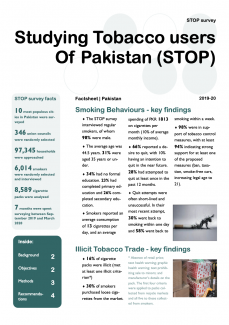
Studying Tobacco users Of Pakistan (STOP) Factsheet
Project Goals and Objectives:
The STOP survey has a long-term aim to provide objective, regular and timely information on tobacco users of Pakistan to help key policy decisions. Its specific objectives for 2019/2020 are to assess the:
- P...
EMCDDA Technical Report on New Psychoactive Substance
The purpose of this technical report is to provide an analysis of the available information on methyl 2-{[1-(4-fluorobutyl)-1H-indole-3-carbonyl]amino}-3,3-dimethylbutanoate (commonly known as 4F-MDMB-BICA), a synthetic receptor cannabinoid...
E-cigarette Use Among Adults in China
Despite China being the main producers of the world's e-cigarette, there is little research examining the trends in e-cigarette use.
Since 2018, policies in China have restricted e-cigarette use. Therefore, it is of interest to...

Webinar | Prevention of Drug Use and other Risky Behaviours in Youth: Data-Based Planning for Effective Prevention
On 11th February 2021, ISSUP Lebanon presented their Webinar on the topic of Substance Use Epidemiology and Evidence-based Prevention Programs.
Monitoring the Future Study: Trends in Prevalence of Various Drugs
On December 15, the United States National Institute on Drug Abuse announced new data from the annual Monitoring the Future study led by researchers at the University of Michigan.
On December 16, a data processing error was found. This...
State of the Nation
The third edition of NZ Drug Foundation annual report on how New Zealand is dealing with alcohol and other drugs was published in December 2020.
The aim of State of the Nation is to provide a backdrop against which we can assess the impact...

Global Synthetic Drugs Assessment 2020
The Global Synthetic Drugs Assessment 2020 provides an analysis of the global synthetic drugs market.
- The first part of this report provides options for responses to counter the synthetic drug problem.
- The second part presents a global...