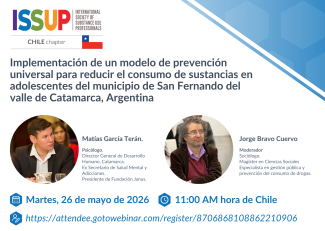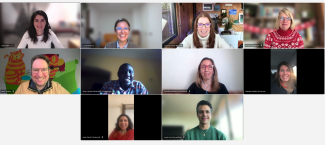
ISSUP Colombia invites you to its webinar on 'Implementation of a universal prevention model to reduce substance use in adolescents in the municipality of San Fernando del Valle de Catamarca, Argentina'
ISSUP, in collaboration with the Inter-American Drug Abuse Control Commission (CICAD), will host a high-priority Knowledge Exchange Session on Faith-Based Approaches, bringing together ISSUP National Chapters across Latin America to strengthen collaboration, share experiences, and advance community and faith-based responses to substance use and crime related challenges. The session will be held online via Microsoft Teams on Tuesday, 12 May 2026, at the following times:
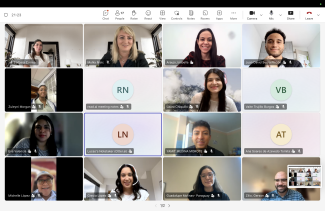
ISSUP and the OAS/CICAD, continues to strengthen its joint efforts to establish and coordinate a Latin American Youth Leaders Network. This initiative brings together youth representatives from 10 countries across the region, each representing their respective ISSUP National Chapters.
The network aims to ensure that the voices of young people are actively heard and meaningfully integrated into global responses to substance use and drug related challenges. A key focus is addressing the vulnerability of youth to drug use and drug-related crime, while fostering a proactive and empowered...
Global Initiative Against Transnational Organized and Crime
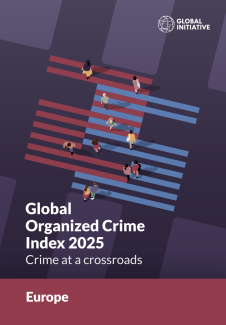
The 2025 Global Organized Crime Index shows that overall crime levels in Europe remain stable, and the region continues to rank among the least affected globally. However, this stability hides a more complex reality, with criminal markets and actors evolving and expanding.
Financial crime is the most widespread threat, driven by online fraud and cross-border schemes, while cybercrime continues to grow, often linked to state-backed or hybrid actors. Drug markets are also shifting, with cocaine and synthetic drugs increasing, while trafficking and smuggling networks remain deeply entrenched.
Global Initiative Against Transnational Organized Crime.
Short Summary
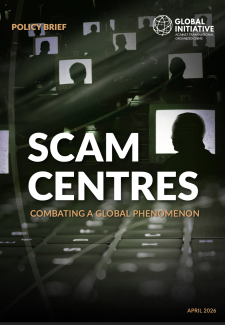
Scam centres are a fast-growing global organized crime threat, generating over $1 trillion in losses in 2024. They use technology and psychological manipulation to target victims worldwide, supported by global criminal networks and easy-to-access tools.
Despite enforcement efforts, scams are expanding and adapting, often moving to low-governance environments and exploiting geopolitical gaps.
Key Actions
Increase international coordination and intelligence sharing
Pressure safe havens and strengthen regulation of tech and financial platforms
The Central East ATTC- Addiction Technology Transfer Center Network managed by the Danya Institute
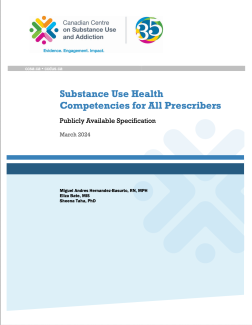
This guide highlights the critical importance of maintaining personal well-being in a field that is both highly rewarding and emotionally demanding. The guide explores common workplace stressors, such as high caseloads, complex client needs, and organisational pressures, and how these can lead to burnout, compassion fatigue, and reduced effectiveness if left unaddressed.
It presents a whole-health approach to well-being, emphasising multiple dimensions including emotional, physical, social, and occupational health, and underscores the shared responsibility between individuals and...
A new chapter in training has begun at ISSUP. A new Training Team has been formed with the goal of improving the accessibility and relevance of ISSUP’s training, while ensuring it reflects the learning needs of members worldwide.
In the early months of its work, the team carried out a training needs assessment to better understand members’ online learning needs. At the same time, the team engaged with several Learning Management System (LMS) providers to explore options for a new platform that supports accessible, high-quality learning. The proposals received are now being reviewed.
ISSUP was honoured to participate in the 78th Regular Session of the Inter-American Drug Abuse Control Commission (CICAD), where Joanna Travis Roberts, Chief Executive of the International Society of Substance Use Professionals (ISSUP), delivered remarks to representatives of Member States, civil society organisations, experts, and partners from across the Americas.
Speaking to the importance of collective and evidence-informed responses to substance use, Joanna highlighted that challenges related to drugs intersect with public health, social development, community safety, and human rights...
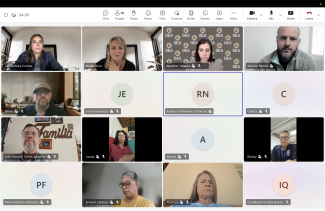
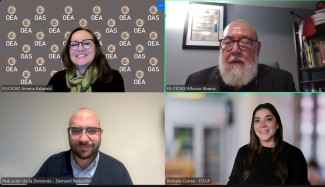
Jimena Kalawski, Chief of the Demand Reduction Unit of the Inter-American Drug Abuse Control Commission (CICAD) of the Organization of American States (OAS), and Barbara Correa, Regional Coordinator of the International Society of Substance Use Professionals (ISSUP), offered welcoming remarks at the closing of a training for young leaders based on the Universal Prevention Curriculum (UPC).
Twenty-seven youth from nine Latin American Member States participated in this online training, developed within the framework of the priority that the CICAD Executive Secretariat gives to youth prevention...
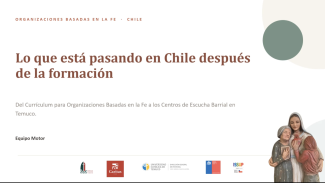
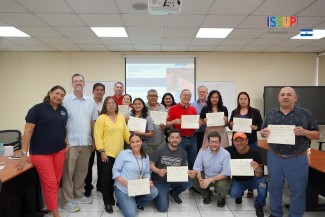
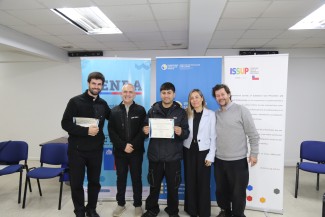
Entre el 6 y el 9 de octubre se desarrolló en el Obispado de Temuco la Capacitación del Currículum de Prevención, Tratamiento y Recuperación del Uso de Drogas para Organizaciones Basadas en la Fe.
La actividad reunió a agentes pastorales, trabajadores del Estado vinculados a la temática del consumo de sustancias y representantes de organizaciones no gubernamentales que trabajan con poblaciones vulnerables en el territorio, en un espacio de diálogo y aprendizaje conjunto.
El objetivo fue fortalecer las capacidades para acompañar y atender a personas con uso problemático de sustancias...
We’re excited to share that ISSUP has successfully launched the pilot of the Investing in Evidence-Based Prevention (IEP) Workshop, attended by 18 participants from 17 countries. The workshop was delivered in two online sessions, held on 14 and 21 August, bringing together policy-makers, decision-makers and funders.
The IEP workshop was developed by Jeff Lee, and Rachele Donini, together with the Scientific Support Team (SST). The pilot was delivered by Rachele Donini as trainer.
The first session, Introduction to Prevention Science, focused on the fundamentals of prevention...
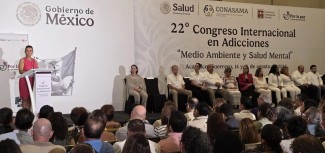
The 22nd International Congress of Youth Integration Centers (CIJ), convened under the theme “Environment and Mental Health”, brought together authorities, specialists, and international representatives to examine the interrelationship between environmental conditions and psychological well-being.
The Congress was honored by the presence of the Governor of Guerrero, Evelyn Salgado Pineda, and the Mayor of Acapulco, Abelina López Rodríguez. Both emphasized the imperative of positioning mental health as a priority within public policy, particularly in communities of young people and in contexts...
Recovery is not a one-size-fits-all process—it is dynamic, multifaceted, and deeply individual. To truly support individuals on their recovery journey, practitioners must access tools, systems, and knowledge that reflect the realities of those they serve.
The WHO Global Status Report on Alcohol and Health and Treatment of Substance Use Disorders provides a comprehensive snapshot of global trends in alcohol consumption, related harms, and national policy responses, alongside the availability and quality of treatment services for alcohol and drug use disorders.
Key Highlights:
Presents the latest data from WHO Member States, aligned with SDG Health Target 3.5: “Strengthen prevention and treatment of substance abuse, including narcotic drug abuse and harmful use of alcohol.”
Offers updated insights on global alcohol consumption patterns...
This survey is a collaborative effort by ICUDDR, NECPAM and ISAM. Together, we are trying to assess the impact recent reductions in funding have had to the workforce of fields dealing with substance use related issues.
The International Drug Policy Academy (IDPA), established by the Council of Europe's Pompidou Group, is dedicated to enhancing the capabilities of professionals involved in drug policy and addiction services. With over 50 years of international cooperation and capacity building, the IDPA aims to bridge the gap between policy, research, and practice across various sectors, fostering the development of coherent and sustainable drug policies.
Objectives of the IDPA
Capacity Building: Strengthening the skills of professionals for effective design, management and evaluation of drug...
Lee, EH., Yu, HJ. Effectiveness of nurse-initiated smoking cessation intervention: a systematic review and meta-analysis. Subst Abuse Treat Prev Policy 20, 18 (2025). https://doi.org/10.1186/s13011-025-00648-8
Background
Smoking is one of the top causes of preventable death and is linked to many serious health problems, including cancer and chronic diseases. Nurses can play a big role in helping people quit smoking by offering support through counselling, education, and mental health care. These nurse-led programs have been shown to increase quit rates. Training nurses to deliver these programs is important, and reviewing past studies helps us understand what works best.
Methods
Researchers searched eight major health databases between March 27 and August 1, 2024, to find studies on nurse-led...
CSUCH’s data visualisation tool can be used to estimate substance use trends across the country. The data helps inform programs, practices, and research to protect communities, save lives, and improve the well-being of people in Canada.
Spotlight: Top 3 causes of death due to substance use in Canada
More than 200 people died each day due to substance use (SU) in 2020 (the latest year for which data are available). That works out to 73,994 deaths that year. The average age of death due to SU was 45 years. Tobacco use caused 63% (46,366) of SU-related deaths, followed by alcohol at 23%...
Addiction and obesity share similar neurological pathways, both linked to compulsive behaviors and the brain's reward system. Research has highlighted the potential of GLP-1 receptor agonists, originally developed for diabetes, to help manage both appetite and addictive cravings. These medications, such as semaglutide, may regulate addictive behaviors by influencing reward circuits in the brain. However, they come with potential side effects, and their long-term effects are still under investigation.
In addition, a new compound, 5-Methoxy-2-aminoindane (MEAI), is being researched for its...