
Suboxone for 7-OH Withdrawal: How Buprenorphine Helps with Kratom Dependence
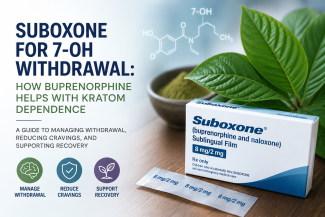
Suboxone for 7-OH Withdrawal: How Buprenorphine Helps with Kratom Dependence
Written by Benjamin Zohar, NCACIP
Published: 21 June 2026 | Last Updated: 21 June 2026 | 5 min read
Reviewed by Brandon McNally, RN
Short answer: yes. When kratom dependence is driven by 7-hydroxymitragynine (7-OH), prescribers can use Suboxone (buprenorphine/naloxone) to take the edge off withdrawal and steady cravings. It is an off-label application, and it belongs in the hands of a clinician who knows how 7-OH behaves—never a do-it-yourself plan.
The Receptor Connection
People are often surprised that an opioid-treatment medication would touch a "herbal" product at all. The reason comes down to chemistry. 7-OH is the alkaloid responsible for most of kratom's opioid-like punch, and concentrated extracts have pushed its strength far past anything found in a raw leaf. To understand how a botanical compound ended up acting like a prescription opioid, start with What Is 7-OH? The Emerging Opioid Threat.
Buprenorphine, the active ingredient in Suboxone, latches onto the very same mu-opioid receptors that 7-OH targets—and it holds on tightly. By parking itself on those receptors, it quiets the withdrawal signal and dulls cravings without producing the full high of a stronger opioid. The naloxone component is there mainly to discourage misuse. That shared receptor target is the whole reason an OUD medication translates to a kratom problem.
What a Supervised Course Usually Looks Like
No two cases are identical, but a thoughtful Suboxone start for 7-OH tends to move through the same stages:
- Honest intake: The prescriber needs the real history—which 7-OH products, how concentrated, how often, and what else is in the mix. Convenience-store extracts vary wildly in potency, so vague answers lead to bad dosing.
- Waiting for the window: Buprenorphine is only introduced once clear withdrawal has set in. Going too early risks precipitated withdrawal—a sudden, sharp worsening—so timing is tied to potency and hours since the last dose.
- Dialing in the dose: The starting and maintenance amounts usually scale with how heavy the prior use was, then get tuned to hold symptoms steady without leaving the person sedated.
- Filling the gaps: Non-opioid supports handle the leftovers—restlessness, stomach upset, broken sleep—while counseling addresses the habit itself.
If you want the hour-by-hour symptom and taper picture before deciding anything, read 7-OH Withdrawal: Symptoms, Timeline, and Treatment Considerations.
How Solid Is the Evidence?
Honest framing matters here. The support for buprenorphine in kratom and 7-OH cases is genuine but not yet airtight:
- What exists: Published case reports—including a 2023 Cureus write-up—and clinical reviews such as the University of Illinois Chicago Drug Information Group summary describe patients who stabilized on buprenorphine-based treatment.
- What's missing: There are no randomized controlled trials specific to kratom. Until those arrive, clinicians lean on established opioid-use-disorder principles and case-by-case judgment.
Is It the Right Fit?
Suboxone tends to come up when the situation is heavier than a simple taper can handle:
- Severe withdrawal, or tapers that have already failed more than once—common with high-potency extracts.
- Cravings strong enough to interfere with daily functioning.
- Other substances in play (opioids, benzodiazepines, alcohol) that raise the stakes.
- Anxiety or depression that needs to be treated alongside the dependence.
One real caution: in someone with little or no opioid history, buprenorphine can create a new opioid dependence of its own. That trade-off is exactly why this is a shared decision with a knowledgeable prescriber, not a protocol to copy from a forum.
If Suboxone Isn't the Answer
- A slow, structured 7-OH taper paired with behavioral support and frequent check-ins.
- Comfort-focused, non-opioid care—clonidine for the physical agitation, for example—while keeping a close eye on progress.
- Other OUD medications like methadone or naltrexone, which show up in scattered case reports but carry thinner evidence than buprenorphine.
Get Help
Coming off 7-OH after heavy or long-term use is not something to white-knuckle alone. A supervised, individualized plan is safer and far more likely to hold. For confidential guidance and connections to providers who actually understand 7-OH:
- Compare accredited programs and levels of care: Long Island Rehabs.
- Find detox, IOP, and aftercare options: Long Island Addiction Resources.
- Arrange testing or a family consultation: Intervention NY.
Call Now: (631) 888-6282
Talk with a licensed specialist about medically supervised detox from 7-OH and the recovery options that fit your situation.
Crisis Resources
- Emergency: Call 911
- 988 Suicide & Crisis Lifeline: Call or text 988
- SAMHSA National Helpline: 1-800-662-HELP (4357) (Free, confidential, 24/7)
Disclaimer
This article is for informational purposes only and does not constitute medical, legal, or financial advice. Suboxone® is a prescription medication; any induction or taper should be directed by a qualified prescriber. Treatment decisions should be made with a licensed healthcare provider. If you are experiencing a medical emergency, call 911 immediately.