
Detox Centers in New Jersey: Alcohol & Drug Detox Guide
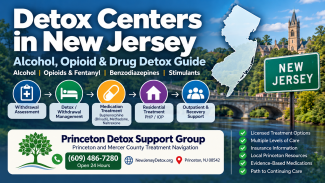
Quick answer: New Jersey offers ambulatory, residential and hospital-based withdrawal-management services for people who need help stopping alcohol, opioids, benzodiazepines or other substances. The appropriate setting depends on withdrawal risk, medical and psychiatric needs, the substance involved and the person's recovery environment. Detox should normally connect directly to continuing addiction treatment.
Emergency warning: Call 911 for seizures, severe confusion, loss of consciousness, difficulty breathing, suspected overdose or other life-threatening symptoms. Alcohol and benzodiazepine withdrawal can become medically dangerous. Do not abruptly stop regularly used benzodiazepines without clinical guidance.
Key Takeaways
- New Jersey offers ambulatory and residential withdrawal-management services along with hospital care when higher medical intensity is required.
- Not everyone entering addiction treatment requires detox first. A clinical assessment should determine the appropriate starting level of care.
- Alcohol withdrawal can cause seizures and delirium and may require medical monitoring.
- Benzodiazepines should not be stopped abruptly when physical dependence is likely.
- Opioid detox alone is generally not adequate treatment for opioid use disorder. Evidence-based medications include buprenorphine, methadone and naltrexone.
- Brixadi is an extended-release buprenorphine injection available in weekly and monthly formulations for treatment of moderate-to-severe opioid use disorder.
- The NJSAMS Treatment Directory can be used to search licensed New Jersey substance-use treatment services.
- Continuing care after detox matters. Treatment may include medications, residential care, PHP, IOP, outpatient treatment and recovery support.
Princeton and Mercer County resource: Princeton Detox Support Group provides free, confidential general treatment information and referral support for people exploring detox, addiction treatment and recovery resources in the Princeton area. Contact Princeton Detox Support Group or call (609) 486-7280. Phone availability is 24 hours. View the Google Maps profile — CID 9708871870985104638.
Table of Contents
- What Is Detox?
- Detox Services in New Jersey
- Levels of Care
- Ambulatory vs Residential Detox
- Detox Needs by Substance
- Alcohol Detox
- Opioid and Fentanyl Detox
- Brixadi and Extended-Release Buprenorphine
- Benzodiazepine Withdrawal
- Cocaine and Stimulant Withdrawal
- How Long Does Detox Take?
- Detox vs Rehab
- Choosing a New Jersey Detox Program
- Finding Licensed NJ Programs
- Princeton and Mercer County Resources
- Insurance and Paying for Detox
- What Happens After Detox?
- Myth vs Fact
- When to Seek Immediate Help
- Frequently Asked Questions
- Related Guides
- References
What Is Detox?
Detoxification, more precisely called withdrawal management, is the process of helping a person reduce or stop a substance while monitoring and treating withdrawal symptoms. It is not the same thing as comprehensive addiction treatment.
Withdrawal management may involve:
- medical and substance-use assessment;
- monitoring withdrawal severity;
- medications when clinically appropriate;
- management of nausea, dehydration, insomnia or other symptoms;
- mental-health assessment;
- overdose-prevention planning;
- naloxone education;
- planning for the next level of treatment.
The word detox remains common in consumer searches, but clinicians increasingly use withdrawal management. The purpose is not merely to wait until a substance leaves the body. The goal is to manage withdrawal safely while preparing the person for continuing care.
Clinical Pearl: Withdrawal management is an entry point into addiction treatment, not a complete treatment by itself. ASAM specifically states that alcohol withdrawal management alone is not an effective treatment for alcohol use disorder.
What Types of Detox Services Are Available in New Jersey?
New Jersey's treatment system includes ambulatory withdrawal management, residential withdrawal management, residential treatment, outpatient care, intensive outpatient programs, partial-care programs and opioid treatment programs.
The state's NJSAMS Addiction Services Treatment Directory allows people to search licensed substance-use disorder treatment providers by factors such as provider, service and level of care.
Common treatment settings include:
- ambulatory withdrawal management;
- 24-hour residential withdrawal management;
- hospital-based withdrawal care when medically necessary;
- short-term and long-term residential treatment;
- partial hospitalization or partial care;
- intensive outpatient programs;
- standard outpatient care;
- opioid treatment programs;
- medication treatment for substance use disorders.
The New Jersey Addiction Services Treatment Directory is an important starting point when researching licensed programs.
Levels of Addiction Treatment in New Jersey
The correct level of care depends on withdrawal severity, medical stability, psychiatric needs, substance-use history and the person's ability to remain safe outside a 24-hour setting.
| Level | Primary Purpose | General Setting |
|---|---|---|
| Ambulatory withdrawal management | Manage lower-risk withdrawal while the person remains outside a 24-hour facility | Outpatient |
| Residential withdrawal management | Provide 24-hour structure and monitoring during withdrawal | Residential |
| Hospital withdrawal management | Manage severe withdrawal or significant medical complications | Hospital |
| Residential addiction treatment | Provide structured ongoing treatment after acute stabilization | Residential |
| PHP / partial care | Provide intensive daytime treatment without overnight residence | Outpatient |
| Intensive outpatient program | Provide structured treatment multiple times each week | Outpatient |
| Standard outpatient | Ongoing counseling, medication management and recovery support | Outpatient |
| Opioid Treatment Program | Provide specialized OUD medication treatment and related services | Outpatient |
For a more focused comparison, see Detox vs Outpatient Rehab in New Jersey.
Medical Detox vs Ambulatory Detox: What Is the Difference?
The primary difference is the intensity and location of monitoring. Some people can receive withdrawal-management services while living at home, while others require 24-hour residential or hospital care.
| Ambulatory Withdrawal Management | Residential / 24-Hour Withdrawal Management |
|---|---|
| The person returns home between scheduled treatment contacts | The person remains in a supervised setting |
| Appropriate only when withdrawal risk can be managed safely | Provides greater monitoring for higher-risk withdrawal |
| Requires reliable follow-up and an appropriate home environment | Provides around-the-clock structure |
| May include medication and clinical monitoring | May include medical, nursing and medication support depending on the program |
ASAM's alcohol-withdrawal guideline recognizes both ambulatory and inpatient withdrawal-management settings. Placement should be based on clinical risk rather than convenience alone.
Does Everyone Need the Same Type of Detox?
No. Alcohol, opioids, benzodiazepines and stimulants produce different withdrawal syndromes and different medical risks.
| Substance | Major Concern | Treatment Consideration |
|---|---|---|
| Alcohol | Seizures, delirium and autonomic instability in severe withdrawal | Risk assessment may indicate ambulatory, residential or hospital withdrawal management |
| Opioids / fentanyl | Severe withdrawal, cravings, return to opioid use and overdose risk | Medication treatment for OUD should be considered |
| Benzodiazepines | Seizures, delirium and potentially dangerous withdrawal after abrupt discontinuation | Gradual supervised taper may be required |
| Cocaine / methamphetamine | Depression, fatigue, sleep changes, agitation and cravings | Psychiatric and safety evaluation may be especially important |
| Polysubstance use | Overlapping withdrawal syndromes and medication interactions | Assessment should account for all substances being used |
Alcohol Detox in New Jersey
Alcohol withdrawal can become medically dangerous, particularly in people with substantial physical dependence or a history of severe withdrawal.
Symptoms can include:
- tremor;
- sweating;
- anxiety;
- nausea;
- insomnia;
- rapid heart rate;
- hallucinations;
- seizures;
- severe confusion or withdrawal delirium.
Clinical risk assessment may consider:
- amount and frequency of alcohol use;
- prior withdrawal history;
- previous seizures or withdrawal delirium;
- co-occurring substance use;
- medical conditions;
- psychiatric symptoms;
- medications;
- availability of reliable support.
ASAM emphasizes that withdrawal management should be connected to treatment for alcohol use disorder rather than treated as the endpoint of care.
For additional background, see Alcohol Detox in Long Island: Medically Supervised Care and the Path to Recovery.
People who combine alcohol and stimulants can also review Cocaine and Alcohol: Cocaethylene and Cardiac Risk.
Opioid and Fentanyl Detox: Why Medication Treatment Matters
For opioid use disorder, the central question should not simply be “Where can I detox?” but “What treatment can reduce withdrawal, cravings, return to opioid use and overdose risk?”
SAMHSA identifies three FDA-approved medications for opioid use disorder:
- buprenorphine;
- methadone;
- naltrexone.
Buprenorphine and methadone can treat opioid withdrawal and cravings while also serving as ongoing treatment for OUD. Naltrexone is an opioid antagonist and generally requires an opioid-free interval before initiation.
Buprenorphine is available in several formulations. These include transmucosal products as well as longer-acting injectable medications such as Brixadi.
SAMHSA's TIP 63 explains that short-term medically supervised opioid withdrawal by itself is associated with high rates of return to opioid use. Loss of opioid tolerance after withdrawal can also increase overdose danger if someone returns to an opioid dose they previously used.
This is especially important in the fentanyl era because opioid potency and exposure can be unpredictable.
Clinical Pearl: “Detoxing from fentanyl” and receiving treatment for opioid use disorder are not the same thing. A person may need acute withdrawal support, but the larger treatment decision involves reducing cravings, return to use and overdose risk over time.
What Is Brixadi and How Does It Fit Into Opioid Treatment?
Brixadi is an extended-release formulation of buprenorphine used to treat moderate-to-severe opioid use disorder. It is not a separate medication class from buprenorphine; it is a long-acting injectable form of buprenorphine.
Brixadi is available as:
- weekly injections;
- monthly injections.
The current prescribing information states that Brixadi is administered subcutaneously by a healthcare provider.
For people who are not currently receiving buprenorphine, current labeling calls for a transmucosal buprenorphine test dose before initiating Brixadi weekly. Patients already being treated with another buprenorphine-containing product may be transitioned to weekly or monthly Brixadi when clinically appropriate.
Brixadi may be useful for some people who would benefit from an extended-release buprenorphine option rather than taking medication every day. Treatment selection remains individualized and should be made with a qualified prescriber.
| OUD Medication | Medication Type | General Role |
|---|---|---|
| Buprenorphine | Partial opioid agonist | Reduces withdrawal and cravings and supports ongoing OUD treatment |
| Brixadi | Extended-release injectable buprenorphine | Provides weekly or monthly buprenorphine exposure |
| Methadone | Full opioid agonist | Reduces withdrawal and cravings as part of OUD treatment |
| Naltrexone | Opioid antagonist | Blocks opioid receptors after an adequate opioid-free period |
Brixadi should not be described as a fourth FDA-approved OUD medication alongside buprenorphine, methadone and naltrexone. It is one formulation of buprenorphine.
Benzodiazepine Withdrawal and Detox in New Jersey
Benzodiazepines should not be abruptly discontinued when physical dependence is likely. Rapid discontinuation can produce serious and potentially life-threatening withdrawal.
Benzodiazepines include:
- alprazolam (Xanax);
- lorazepam (Ativan);
- clonazepam (Klonopin);
- diazepam (Valium).
Withdrawal symptoms can include:
- severe anxiety;
- insomnia;
- tremor;
- sensory disturbances;
- confusion;
- hallucinations;
- seizures;
- delirium.
The 2025 Joint Clinical Practice Guideline led by ASAM recommends gradual tapering under clinical supervision for people likely to be physically dependent rather than abrupt discontinuation.
For a detailed explanation, see Benzodiazepine Dependence vs. Addiction and Withdrawal.
Do Cocaine and Methamphetamine Require Medical Detox?
Stimulant withdrawal is generally different from alcohol or benzodiazepine withdrawal because psychiatric, behavioral and functional symptoms are often the major concern.
Symptoms can include:
- profound fatigue;
- depression;
- anxiety;
- sleep disturbance;
- increased appetite;
- agitation;
- difficulty concentrating;
- strong cravings.
Severe depression, suicidal thinking, psychosis, cardiovascular complications or polysubstance use can require urgent assessment or higher-level care.
How Long Does Detox Take?
There is no universal number of days that applies to every detox episode. Duration depends on the substance, degree of dependence, medical complications, medications used and the person's response to treatment.
Examples include:
- acute alcohol withdrawal may be managed over several days but can last longer when complications occur;
- opioid withdrawal management may transition directly into ongoing buprenorphine or methadone treatment;
- benzodiazepine tapering may require substantially longer than a conventional short residential detox stay;
- stimulant-related depression, fatigue, sleep changes and cravings can persist after the acute phase.
The more useful endpoint is whether the person is medically stable and connected to an appropriate continuing-care plan.
What Is the Difference Between Detox and Rehab?
Detox focuses on acute withdrawal stabilization, while rehabilitation and continuing addiction treatment address the broader substance-use disorder.
| Detox / Withdrawal Management | Ongoing Addiction Treatment |
|---|---|
| Manages acute withdrawal | Addresses ongoing substance-use patterns and recovery |
| Generally short-term | May continue for weeks, months or longer |
| Focuses on stabilization and safety | May involve therapy, medications and recovery support |
| Helps determine the next level of care | Builds a longer-term treatment and recovery plan |
The next step may include residential care, PHP, IOP, outpatient treatment, medication treatment or community-based recovery support.
How to Choose a Detox Center in New Jersey
Choose a program based on clinical capability, licensing and fit with the person's actual needs rather than proximity or advertising alone.
1. Identify the Needed Level of Care
Ask whether the recommended service is ambulatory withdrawal management, residential withdrawal management, hospital care or another level of treatment.
2. Ask Whether the Program Treats the Specific Substance
Alcohol withdrawal, benzodiazepine tapering, fentanyl dependence and stimulant withdrawal require different clinical approaches.
3. Ask About Medical Coverage
- Is medical or nursing support available around the clock?
- What happens if withdrawal becomes severe?
- Can the program transfer someone to a hospital?
- How are medical conditions handled?
4. Ask About Opioid Use Disorder Medications
For opioid or fentanyl dependence, ask whether the program offers or coordinates:
- buprenorphine;
- extended-release buprenorphine such as Brixadi when appropriate;
- methadone;
- naltrexone;
- naloxone overdose-prevention planning.
5. Ask About Mental-Health Treatment
Depression, anxiety, trauma, psychosis and other psychiatric conditions can influence the safest treatment setting.
6. Ask What Happens After Detox
A discharge plan should address continuing treatment, medications, appointments, transportation and recovery support.
7. Ask About Insurance and Costs
Confirm network status, authorization requirements, deductibles, coinsurance and estimated out-of-pocket expenses before admission whenever possible.
How Do I Find Licensed Detox Centers in New Jersey?
The NJSAMS Addiction Services Treatment Directory is New Jersey's searchable directory of licensed substance-use disorder treatment services.
The directory can help consumers research services such as:
- withdrawal management;
- residential treatment;
- outpatient treatment;
- intensive outpatient services;
- partial care;
- opioid treatment programs;
- medication treatment.
Use the NJSAMS Addiction Services Treatment Directory to research New Jersey providers.
SAMHSA also operates FindTreatment.gov, which provides a national treatment-directory search.
For a broader provider-evaluation framework, see How to Find Licensed Addiction Treatment on Long Island. Although that guide focuses on New York, many of its questions about licensing, levels of care and treatment capability are useful when evaluating programs elsewhere.
Princeton and Mercer County Detox & Treatment Navigation
People in Princeton and Mercer County can use state resources alongside local information and referral services when researching detox and addiction-treatment options.
Princeton Detox Support Group is an independent information and referral resource based in Princeton, New Jersey. It provides general information for people and families researching detoxification, residential treatment, outpatient services, medication support and recovery resources.
Princeton Detox Support Group
184 Nassau St
Princeton, NJ 08542
Phone: (609) 486-7280
Phone availability: Open 24 hours
Google Maps CID: 9708871870985104638
View Princeton Detox Support Group on Google Maps
For local educational and treatment-navigation resources, visit Looking for Treatment Options?.
The resource covers topics including:
- detox and rehab options serving Princeton and Mercer County;
- alcohol detox in New Jersey;
- opioid and fentanyl detox;
- paying for detox;
- levels of addiction treatment;
- questions to ask when evaluating a program;
- family and recovery resources.
Does Insurance Cover Detox in New Jersey?
Many insurance plans include substance-use treatment benefits, but coverage depends on the individual plan, network, medical necessity, authorization requirements and recommended level of care.
Before admission, ask:
- Is the specific facility in network?
- Is withdrawal management covered?
- Does residential treatment require prior authorization?
- What deductible remains?
- What copayment or coinsurance applies?
- Is PHP or IOP covered?
- Are buprenorphine, methadone or injectable buprenorphine covered?
- Does the plan have separate pharmacy and behavioral-health benefits?
A provider saying that it “works with” an insurance company does not necessarily mean the provider is in network.
People who are uninsured, underinsured or uncertain where to begin can also contact ReachNJ. New Jersey states that ReachNJ provides referral assistance regardless of insurance status or ability to pay.
What Happens After Detox?
Continuing treatment should begin as soon as clinically appropriate after withdrawal stabilization. Detox should be treated as the beginning of a treatment pathway rather than a stand-alone intervention.
Continuing care may include:
- residential addiction treatment;
- partial hospitalization or partial care;
- intensive outpatient treatment;
- standard outpatient counseling;
- buprenorphine treatment;
- Brixadi or another appropriate extended-release buprenorphine option;
- methadone treatment;
- medications for alcohol use disorder;
- psychiatric care;
- peer recovery support;
- family education;
- recovery housing when appropriate;
- naloxone access and overdose-prevention education.
New Jersey Community Peer Recovery Centers also provide services such as peer recovery coaching, support groups and naloxone education.
New Jersey Detox: Myth vs Fact
| Myth | Fact |
|---|---|
| Everyone with addiction needs inpatient detox. | No. The appropriate setting depends on withdrawal risk, medical needs and clinical assessment. |
| Detox cures addiction. | No. Withdrawal management addresses acute stabilization but does not treat the entire substance-use disorder. |
| Opioid detox is always preferable to medication treatment. | No. Buprenorphine, methadone and naltrexone are evidence-based treatments for opioid use disorder. |
| Brixadi is a fourth type of OUD medication. | No. Brixadi is an extended-release injectable formulation of buprenorphine. |
| Brixadi is only a detox medication. | No. Brixadi is an ongoing medication treatment for moderate-to-severe opioid use disorder. |
| Benzodiazepines can simply be stopped during detox. | No. Abrupt discontinuation can cause serious withdrawal when physical dependence is present. |
| Every detox takes 3–7 days. | No. Duration depends on the substance, medications, clinical risk and response to treatment. |
| The nearest program is automatically the right program. | No. Clinical capability and the appropriate level of care are more important than distance alone. |
When to Seek Immediate Medical Help
Some withdrawal and overdose symptoms require emergency medical care rather than an ordinary treatment-navigation call.
Call 911 for:
- seizures;
- loss of consciousness;
- very slow, stopped or irregular breathing;
- suspected opioid overdose;
- severe confusion or delirium;
- extreme agitation with loss of contact with reality;
- serious chest pain or cardiovascular symptoms;
- repeated vomiting with reduced consciousness;
- other life-threatening symptoms.
If opioid overdose is suspected, administer naloxone if available and call 911.
For suicidal thoughts or an immediate mental-health crisis in the United States, call or text 988.
For non-emergency treatment-navigation assistance in New Jersey, ReachNJ is available at 1-844-REACHNJ (1-844-732-2465).
Frequently Asked Questions About Detox Centers in New Jersey
How do I find a detox center in New Jersey?
Use New Jersey's NJSAMS Addiction Services Treatment Directory to research licensed substance-use treatment services. ReachNJ can also provide 24/7 referral assistance, and SAMHSA's FindTreatment.gov provides a national directory. Confirm the specific service, location, current availability, insurance participation and whether the program treats the substance involved.
Does everyone with addiction need detox?
No. Detox is appropriate when structured withdrawal management is clinically necessary. Some people can begin outpatient addiction treatment without a detox admission, while others require ambulatory, residential or hospital withdrawal management. The decision should be based on substance use, physical dependence, medical risks and the person's living environment.
How long does alcohol or drug detox take?
There is no universal detox duration. Acute withdrawal may last several days for some substances, while other situations require longer management. Benzodiazepine tapering can take substantially longer than a conventional short detox stay. Treatment length should be based on clinical stability rather than a fixed number of days.
Can I detox from alcohol at home?
Some lower-risk alcohol withdrawal can be managed in an ambulatory program after proper assessment. However, attempting significant alcohol withdrawal without medical evaluation can be dangerous. A history of withdrawal seizures or delirium, heavy ongoing drinking, serious medical illness or limited support can indicate the need for more intensive monitoring.
Can opioid withdrawal be treated without inpatient detox?
Yes. Many people with opioid use disorder can begin medication treatment without a traditional residential detox admission. Buprenorphine and methadone can reduce withdrawal and cravings while continuing as ongoing OUD treatment. The appropriate approach should be determined with a qualified healthcare professional.
Is opioid detox alone enough?
Generally, opioid withdrawal management should not be the entire treatment plan. Return to opioid use is common after short-term withdrawal management, and loss of tolerance can increase overdose risk. Continuing treatment may include buprenorphine, methadone, naltrexone, counseling, harm-reduction planning and recovery support.
What is Brixadi?
Brixadi is a long-acting injectable form of buprenorphine used to treat moderate-to-severe opioid use disorder. It is available in weekly and monthly formulations and is administered by a healthcare provider. It provides another way to receive buprenorphine without taking a daily transmucosal dose.
Is Brixadi used for opioid detox?
Brixadi is not simply a short-term detox medication. It is an extended-release buprenorphine treatment for opioid use disorder. Buprenorphine can help control withdrawal and cravings, while Brixadi provides sustained medication exposure through weekly or monthly injections as part of ongoing OUD treatment.
Can someone start directly on monthly Brixadi?
Current prescribing information distinguishes weekly and monthly initiation. For people not already receiving buprenorphine, labeling calls for a transmucosal buprenorphine test dose followed by Brixadi weekly. Patients already maintained on buprenorphine may be eligible to transition to weekly or monthly Brixadi based on clinical judgment.
Do benzodiazepines require detox?
People who are physically dependent on benzodiazepines may need supervised withdrawal management or a structured outpatient taper. Current ASAM-led guidance recommends against abrupt discontinuation in patients likely to be physically dependent because rapid dose reduction can cause serious and potentially life-threatening withdrawal.
What is ambulatory detox?
Ambulatory withdrawal management provides structured clinical care without requiring the person to live at a facility around the clock. It may be appropriate for selected lower-risk patients who have reliable follow-up, an appropriate home environment and no clinical indication for 24-hour monitoring.
What is the difference between detox and residential rehab?
Detox primarily addresses withdrawal stabilization. Residential rehabilitation provides continuing addiction treatment in a 24-hour living environment. A person may transition from withdrawal management into residential care, PHP, IOP, medication treatment or another level based on clinical needs.
Does insurance pay for detox in New Jersey?
Insurance coverage varies by plan, network and clinical circumstances. Verify benefits with both the insurer and provider. Ask specifically about withdrawal management, residential care, PHP, IOP, medication treatment, prior authorization, deductible, coinsurance and network status.
What if I do not have insurance?
ReachNJ is available at 1-844-732-2465. The New Jersey Department of Human Services states that ReachNJ connects residents with treatment and supportive services regardless of insurance status or ability to pay.
Related Guides
- Detox vs Outpatient Rehab in New Jersey
- Alcohol Detox in Long Island: Medically Supervised Care and the Path to Recovery
- Alcohol Detox Near Me: How to Find Safe Medical Detox on Long Island and Across New York
- Benzodiazepine Dependence vs. Addiction and Withdrawal
- Cocaine and Alcohol: Cocaethylene and Cardiac Risk
- How to Find Licensed Addiction Treatment on Long Island
- Free Long Island 22-Panel Urine Drug Test
- 7-OH Rehab: Withdrawal, Treatment & FAQ
References
- New Jersey Department of Human Services, Division of Mental Health and Addiction Services. Substance Use Disorder Resources and NJSAMS Treatment Directory.
- New Jersey Department of Human Services. Addiction Services Treatment Directory.
- New Jersey Department of Human Services. ReachNJ Addiction Helpline.
- Substance Abuse and Mental Health Services Administration. FindTreatment.gov.
- Substance Abuse and Mental Health Services Administration. TIP 63: Medications for Opioid Use Disorder.
- U.S. Food and Drug Administration. FDA Approves New Buprenorphine Treatment Option for Opioid Use Disorder.
- DailyMed. Brixadi (buprenorphine) Extended-Release Injection Prescribing Information.
- American Society of Addiction Medicine. The ASAM Clinical Practice Guideline on Alcohol Withdrawal Management.
- American Society of Addiction Medicine and partner organizations. Joint Clinical Practice Guideline on Benzodiazepine Tapering.
Last updated: September 27, 2026.
About the Author
Benjamin Zohar, NCACIP is a Nationally Certified Advanced Clinical Intervention Professional and ISSUP network moderator specializing in addiction intervention, treatment navigation and emerging substance-use risks. His educational work published through ISSUP on counterfeit medications, fentanyl exposure and concentrated 7-hydroxymitragynine has been cited or referenced by GoodRx, The Washington Post, WIRED and Newsweek.
Medical reviewed by: Brandon McNally, RN
Medical disclaimer: This article is intended for educational and public-health purposes. It does not provide individualized medical advice, diagnosis or a tapering schedule. Do not start, stop or alter a prescription medication without consulting a qualified healthcare professional. Call emergency services for seizures, difficulty breathing, loss of consciousness, severe confusion or other life-threatening symptoms.