
What Is Mitragynine Pseudoindoxyl? The Kratom-Derived Opioid Compound Explained
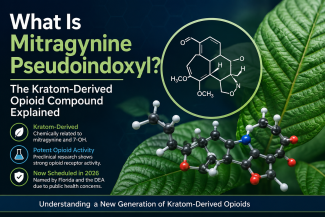
What Is Mitragynine Pseudoindoxyl? The Kratom-Derived Opioid Compound Explained
By Benjamin Zohar, NCACIP
Medically reviewed by Brandon McNally, RN
Last Updated: July 2026
Mitragynine pseudoindoxyl is a potent opioid-active compound chemically related to mitragynine and 7-hydroxymitragynine (7-OH), two alkaloids associated with the kratom plant, Mitragyna speciosa. It is not the same as traditional kratom leaf, and it became a major regulatory concern in 2026 after Florida and the DEA named it alongside 7-OH, MGM-15, and MGM-16.
Table of Contents
- What Is Mitragynine Pseudoindoxyl?
- Key Takeaways
- Is Mitragynine Pseudoindoxyl Found Naturally?
- Mitragynine Pseudoindoxyl vs. 7-OH
- Why Researchers Study It
- Why Florida Scheduled It in 2026
- DEA Federal Action in 2026
- Could It Appear in Commercial Products?
- Dependence and Withdrawal Concerns
- What Addiction Professionals Should Know
- Related Articles
- References
- Disclaimer
What Is Mitragynine Pseudoindoxyl?
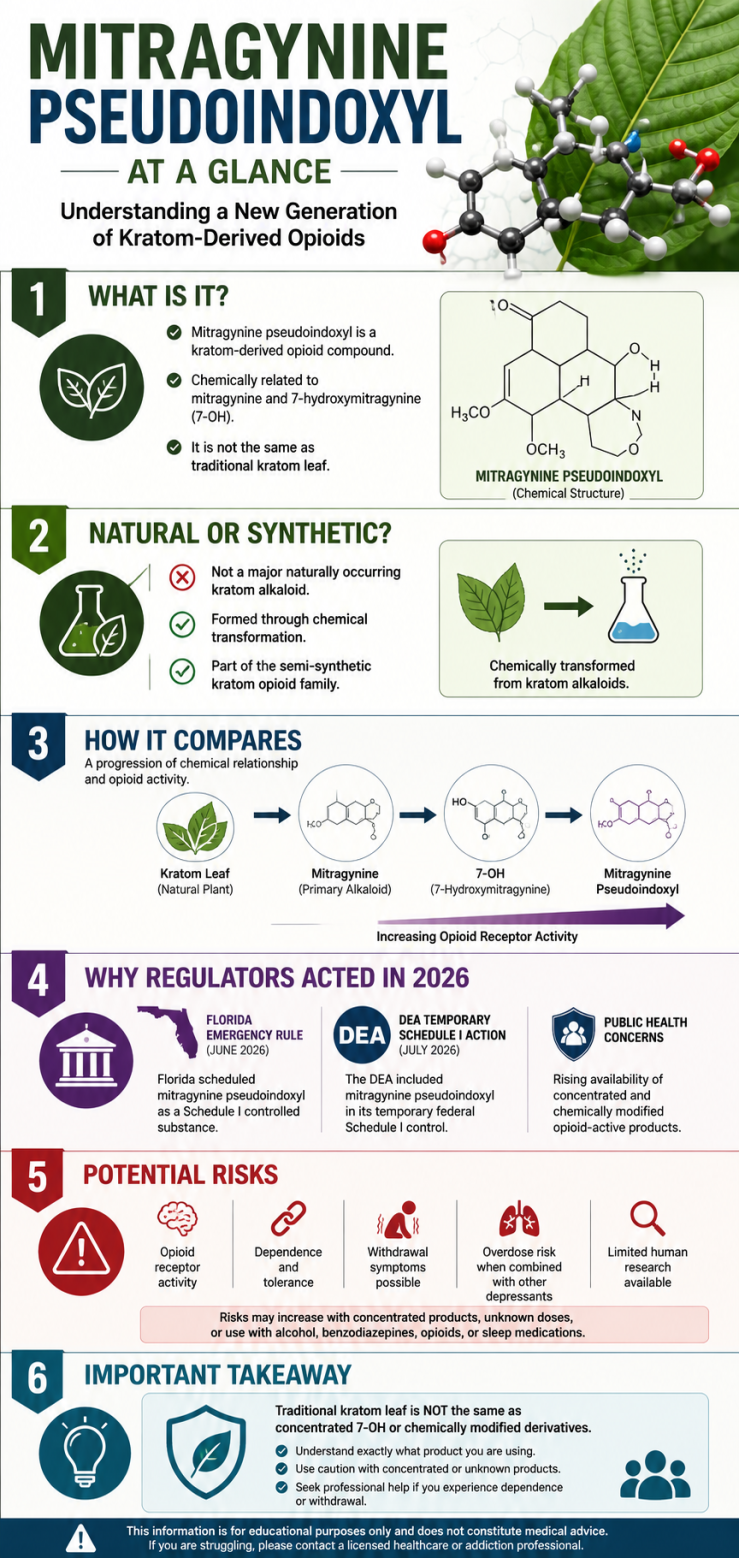
Mitragynine pseudoindoxyl is a kratom-derived opioid compound formed through chemical transformation of kratom alkaloids. It is closely related to mitragynine, the primary alkaloid in kratom, and 7-hydroxymitragynine, the opioid-active alkaloid commonly called 7-OH.
Although mitragynine pseudoindoxyl comes from the same chemical family as kratom alkaloids, it should not be described as ordinary kratom. Traditional kratom leaf contains a broad mix of naturally occurring alkaloids. Mitragynine pseudoindoxyl is a much more specific, chemically transformed compound that has drawn attention because of its strong opioid receptor activity.
For background on the broader issue, read What Is 7-OH? The Emerging Opioid Threat Addiction Professionals Need to Understand in 2026.
Key Takeaways
- Mitragynine pseudoindoxyl is chemically related to mitragynine and 7-OH.
- It is not traditional kratom leaf and should not be marketed or understood as a simple botanical supplement.
- Laboratory research suggests strong opioid receptor activity, but human clinical data remain limited.
- Florida named mitragynine pseudoindoxyl in its June 2026 emergency rule on 7-OH-related compounds.
- The DEA included mitragynine pseudoindoxyl in its July 2026 temporary federal Schedule I action.
- It belongs in the same public health discussion as MGM-16, MGM-15, and semi-synthetic kratom opioids.
Is Mitragynine Pseudoindoxyl Found Naturally?
Traditional kratom leaf naturally contains dozens of alkaloids. Mitragynine is typically the dominant alkaloid, while 7-hydroxymitragynine occurs only in trace amounts.
Mitragynine pseudoindoxyl is different. It is not considered a meaningful naturally occurring constituent of ordinary kratom leaf products. Instead, it is generally discussed as a compound produced through chemical conversion of kratom alkaloids.
This distinction matters because the modern kratom market now includes products that go far beyond traditional leaf powder. Some products sold as “kratom extract,” “7-OH,” or “advanced alkaloids” may contain concentrated or chemically altered compounds with a stronger opioid-like risk profile.
Mitragynine Pseudoindoxyl vs. 7-OH
Mitragynine pseudoindoxyl and 7-OH are chemically related, but they are not identical.
| Feature | 7-Hydroxymitragynine | Mitragynine Pseudoindoxyl |
|---|---|---|
| Common name | 7-OH | Pseudoindoxyl |
| Natural occurrence | Trace amounts in kratom leaf | No meaningful natural occurrence in consumer kratom leaf |
| Commercial relevance | Widely marketed in concentrated products | No established retail brands identified |
| 2026 regulatory status | Named by Florida and DEA | Named by Florida and DEA |
| Clinical concern | Dependence, withdrawal, overdose risk | Strong opioid activity; limited human data |
For readers trying to understand 7-OH itself, see 7-hydroxymitragynine explained. For treatment implications, see 7-OH withdrawal symptoms and treatment considerations.
Why Researchers Study It
Researchers have studied mitragynine pseudoindoxyl because it interacts strongly with opioid receptors. Medicinal chemists have explored whether compounds built from the kratom scaffold could one day lead to pain-relief medications with different risk profiles than conventional opioids.
That research context should not be confused with consumer safety. Mitragynine pseudoindoxyl is not an FDA-approved medication. It has no accepted medical use in the United States, and most available evidence comes from laboratory or animal research rather than human clinical trials.
This is why addiction professionals should avoid treating every kratom-related compound as if it were the same. Traditional kratom leaf, concentrated 7-OH, MGM-15, MGM-16, and mitragynine pseudoindoxyl differ in potency, evidence base, and clinical risk.
Why Florida Scheduled It in 2026
On June 22, 2026, Florida Attorney General James Uthmeier signed an emergency rule placing highly concentrated 7-OH and several related compounds into Schedule I under Florida law.
The Florida rule named:
- 7-hydroxymitragynine
- Mitragynine pseudoindoxyl
- 7-acetoxymitragynine
- 9-hydroxycorynantheidine
- 10-hydroxycorynantheidine
- MGM-15
- MGM-16
Florida officials focused on concentrated and chemically modified 7-OH-related products sold in gas stations, vape shops, smoke shops, and online. The rule distinguished those products from traditional kratom leaf, where naturally occurring 7-OH appears only in trace amounts.
For a broader explanation of the compounds named in the Florida rule, read MGM-16, MGM-15, and 7-OH: Understanding the New Generation of Semi-Synthetic Kratom Opioids.
DEA Federal Action in 2026
On July 1, 2026, the DEA announced temporary federal Schedule I control of several 7-OH-related substances, including:
- 7-hydroxymitragynine
- Mitragynine pseudoindoxyl
- MGM-15
- MGM-16
The DEA also made an important distinction: the federal action does not apply to botanical kratom products containing naturally occurring 7-OH below the specified threshold. Instead, the focus is on synthesized products and products containing elevated concentrations of 7-OH-related substances.
That distinction should guide clinical messaging. Traditional kratom leaf and concentrated kratom-derived opioid products should not be discussed as if they are identical.
Could Mitragynine Pseudoindoxyl Appear in Commercial Products?
At this time, there are no well-established retail brands publicly confirmed to intentionally contain mitragynine pseudoindoxyl. However, regulators remain concerned because many commercial kratom-derived products are poorly labeled, inconsistently tested, or marketed with vague language such as “advanced alkaloids” or “plant alkaloid extract.”
Consumers should not assume that a product labeled as kratom extract, 7-OH, or alkaloid blend accurately discloses every active compound. Product formulations can change quickly, and some products may contain unexpected or chemically modified ingredients.
Known commercial exposure today is more strongly associated with concentrated 7-OH products. For public-facing education on those products, see What Is 7-OH? and 7-OH Withdrawal.
Dependence and Withdrawal Concerns
Direct human data on mitragynine pseudoindoxyl remain limited. Still, its strong opioid receptor activity raises concern for opioid-like risks, especially if it appears in concentrated or mislabeled products.
Potential concerns include:
- Tolerance
- Physical dependence
- Opioid-like withdrawal
- Respiratory depression
- Overdose risk when combined with alcohol, benzodiazepines, opioids, sleep medications, or other sedatives
- Relapse risk for people with opioid use disorder
People struggling after using kratom extracts, 7-OH tablets, gummies, powders, or other concentrated alkaloid products should seek medical evaluation. For treatment-related questions, read 7-OH, kratom withdrawal, and whether Suboxone may help and Does Suboxone help with kratom withdrawal?.
What Addiction Professionals Should Know
Clinicians should recognize that “kratom” has become an umbrella term covering products with very different pharmacology. A patient may say they are using kratom when they are actually using concentrated 7-OH tablets, kratom extract shots, semi-synthetic alkaloid products, or mislabeled blends.
Assessment should include:
- Exact product name and brand
- Photos of packaging, if available
- Product form: powder, capsule, gummy, tablet, liquid shot, vape, or extract
- Frequency and dose
- Withdrawal symptoms between doses
- Use with alcohol, benzodiazepines, opioids, gabapentin, pregabalin, or sleep medications
- History of opioid use disorder or kratom dependence
- Prior attempts to stop
Treatment planning should be based on the actual product used, not the word “kratom” alone. A person using traditional leaf powder may require a different clinical approach than someone using high-potency 7-OH or semi-synthetic kratom-derived opioid products.
Related Articles
- What Is 7-OH? The Emerging Opioid Threat Addiction Professionals Need to Understand in 2026
- MGM-16, MGM-15, and 7-OH: Understanding the New Generation of Semi-Synthetic Kratom Opioids
- 7-OH Withdrawal: Symptoms, Timeline, and Treatment Considerations
- 7-Hydroxymitragynine and Kratom Withdrawal
- Does Suboxone Help With Kratom Withdrawal?
References
- Florida Office of the Attorney General. “Attorney General James Uthmeier Signs Emergency Rule Immediately Scheduling Dangerous 7-OH and Related Compounds as Schedule I Controlled Substances.” June 22, 2026.
- U.S. Drug Enforcement Administration. “DEA to Temporarily Schedule 7-OH and Related Substances to Protect Public Safety.” July 1, 2026.
- Kruegel AC, et al. Research on kratom-derived opioid ligands and mitragynine pseudoindoxyl.
- Hemby SE, McIntosh S, Leon F, Cutler SJ, McCurdy CR. “Abuse liability and therapeutic potential of the Mitragyna speciosa alkaloids mitragynine and 7-hydroxymitragynine.” Addiction Biology.
- Smith KE, Boyer EW, Grundmann O, McCurdy CR, et al. “The rise of novel, semi-synthetic 7-hydroxymitragynine products.” Addiction.
Disclaimer
This article is for educational and informational purposes only and does not constitute medical, legal, or emergency advice. If you are experiencing a medical emergency, call 911. If someone may be overdosing, administer naloxone if available and seek emergency medical care immediately. If you are struggling with 7-OH, kratom, opioids, or withdrawal symptoms, contact a licensed medical or addiction professional.