
How Long Does Cocaine Stay in Your System? Test Windows
Medical Review: Brandon McNally, RN | Published: July 25, 2026 | Last Updated: July 25, 2026
Quick answer: Cocaine itself leaves the bloodstream within hours — its half-life is roughly 45 to 90 minutes. Drug tests do not look for cocaine. They look for benzoylecgonine, a metabolite that lingers far longer: 2 to 4 days in urine after occasional use, and up to two weeks after heavy or chronic use.
Key Takeaways
- Cocaine's psychoactive effects last 15 to 90 minutes; detection lasts days.
- Standard urine screens target benzoylecgonine at a 300 ng/mL cutoff, not cocaine itself.
- Benzoylecgonine reaches concentrations roughly 50 to 100 times higher than the parent drug, which is why tests target it.
- Hair testing has a blind spot: it cannot detect use in the previous 7 to 10 days, because the drug needs time to be incorporated into the hair shaft.
- Nothing meaningfully speeds up clearance — not water, not exercise, not commercial detox products.
- If cocaethylene appears on a confirmatory test, that is direct evidence cocaine and alcohol were used together.
On This Page
- Detection Windows
- What Tests Detect
- How Long Effects Last
- Urine Testing
- Blood Testing
- Saliva Testing
- Hair Testing
- What Changes the Window
- Can You Flush It Out?
- Questions People Ask
- When to Seek Help
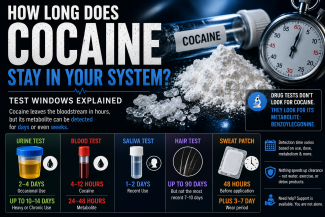
Cocaine Detection Windows by Test Type
| Test type | What it detects | Occasional use | Heavy or chronic use |
|---|---|---|---|
| Urine | Benzoylecgonine | 2–4 days | Up to 10–14 days; documented beyond 20 in some cases |
| Blood | Cocaine, then benzoylecgonine | Cocaine 4–12 hours; metabolite 24–48 hours | Similar; blood is a recency test, not a history test |
| Saliva | Cocaine and metabolites | 1–2 days | Up to 2–3 days |
| Hair | Metabolites in the hair shaft | Up to 90 days — but not the most recent 7–10 | Up to 90 days or longer |
| Sweat patch | Cocaine and metabolites | 48 hours before application, plus the 3–7 day wear period | Same |
Every figure above is an estimate. Detection is a probability, not a switch — two people who used identical amounts on the same night can test differently three days later.
What Drug Tests Are Actually Looking For
This is the single most misunderstood part of cocaine testing. A urine drug screen is not looking for cocaine. Cocaine leaves the blood too quickly to be a useful target — by the time most tests are administered, it is largely gone.
What the test looks for is benzoylecgonine, the inactive metabolite the liver produces when it breaks cocaine down. Benzoylecgonine is not psychoactive, produces no effect, and does nothing except sit in the body waiting to be excreted. It reaches concentrations roughly 50 to 100 times higher than the parent drug and persists far longer.
Standard immunoassay screens use a 300 ng/mL cutoff for benzoylecgonine. A positive screen is typically confirmed by gas chromatography–mass spectrometry or liquid chromatography–mass spectrometry at a lower threshold, around 150 ng/mL.
Clinical pearl: Confirmatory testing can also identify cocaethylene, which forms only when cocaine and alcohol are in the body at the same time. Its presence on a panel is not incidental — it is direct evidence of concurrent alcohol use, and it flags a combination associated with substantially higher cardiac risk. Most people disclose the cocaine and omit the drinking. The lab result does not. See Cocaine and Alcohol: Cocaethylene and Cardiac Risk.
How Long Do the Effects Last?
Far shorter than the detection window, which is why the two get confused.
- Snorted: onset within a few minutes, effects lasting roughly 15 to 30 minutes.
- Smoked or injected: onset within seconds, effects lasting around 5 to 15 minutes.
- Half-life: approximately 45 to 90 minutes, meaning cocaine is largely cleared from the blood within several hours.
The gap between "the high ended two hours ago" and "the test is positive four days later" is entirely explained by the metabolite. Nothing is still working. Something is still measurable.
Urine Testing
Urine is the most common method in workplace, legal, probation and clinical settings — non-invasive, inexpensive, and with the longest practical detection window short of hair.
For occasional use, benzoylecgonine is typically detectable for 2 to 4 days. For frequent or heavy use — multiple sessions per week, or large single doses — the window extends to 10 to 14 days, because the metabolite accumulates faster than the body eliminates it. Clinical reports have documented positive results beyond three weeks in chronic daily users, though that is uncommon.
A direct test for cocaine itself in urine is possible but only within roughly 1 to 5 hours of use, which makes it clinically useless for most purposes.
Blood Testing
Blood has the shortest window and is used almost exclusively where recency matters: emergency care, suspected overdose, and roadside testing. Cocaine is detectable for approximately 4 to 12 hours; benzoylecgonine for around 24 to 48 hours.
Blood testing answers "did this happen recently and does it explain what I'm seeing?" — not "has this person been using?"
Saliva Testing
Saliva testing detects cocaine and its metabolites for roughly 1 to 2 days. It is increasingly common in roadside and some workplace settings because collection is simple and observed, which makes tampering harder. Like blood, it is an indicator of recent use rather than a history.
Hair Testing
Hair has the longest window — commonly cited as up to 90 days, with some evidence of detection considerably beyond that.
It also has a limitation almost nobody explains: hair testing cannot detect use within the previous 7 to 10 days. Drugs enter the hair shaft through the blood supply at the follicle, and the affected hair then has to grow far enough above the scalp to be collected. Recent use is invisible.
Hair testing is also less reliable for detecting single or very low-level use, and cutting hair shortens the available history.
The practical consequence: hair and urine testing answer different questions. Hair shows a pattern over months but misses last weekend. Urine shows last weekend but nothing about last month.
What Actually Changes the Detection Window
- How much and how often. The largest factor by a wide margin. Chronic use extends the urine window from days to weeks.
- Liver function. Cocaine is metabolised hepatically; impaired liver function slows clearance.
- Kidney function and hydration. Affects excretion rate, though far less than people assume.
- Body composition and metabolic rate. Modest individual variation.
- Concurrent alcohol use. Produces cocaethylene, which is itself longer-lived and detectable separately.
- Route of administration. Affects onset and intensity more than total clearance time.
- Test sensitivity. A lower cutoff detects for longer. Not all panels are equivalent.
Can You Flush Cocaine Out of Your System?
No. This deserves a direct answer because a great deal of misleading information exists on the subject.
Clearance is governed by enzymatic metabolism and renal excretion, and neither responds meaningfully to intervention. Specifically:
- Drinking large amounts of water dilutes urine but does not remove metabolites faster. It can push a sample below the cutoff while also flagging it as dilute, which most laboratories treat as a failed or invalid specimen. Extreme water intake also carries a genuine risk of hyponatremia, which can be fatal.
- Exercise does not accelerate benzoylecgonine elimination, and vigorous exercise after recent cocaine use adds cardiac strain to an already stressed cardiovascular system.
- Commercial detox drinks and kits have no demonstrated effect on actual clearance. What they do, at best, is dilute — with the same consequences.
- Time is the only variable that matters, and it cannot be compressed.
If the reason you are searching this is an upcoming test tied to employment, custody, or probation, the more useful conversation is about what happens next rather than about the test itself. A positive result is a consequence; the use pattern behind it is the thing that can actually be changed.
Frequently Asked Questions
How long does cocaine stay in your system?
Cocaine itself clears the bloodstream within hours, with a half-life of roughly 45 to 90 minutes. Its metabolite benzoylecgonine remains detectable in urine for 2 to 4 days after occasional use and up to 10 to 14 days after heavy or chronic use.
How long does cocaine stay in your urine?
Two to four days for occasional use. Heavy or chronic use extends this to roughly two weeks, and clinical reports document longer in some daily users. Standard screens detect benzoylecgonine at a 300 ng/mL cutoff.
How long does cocaine stay in your blood?
Cocaine is detectable in blood for about 4 to 12 hours; benzoylecgonine for roughly 24 to 48 hours. Blood testing is used mainly in emergency and roadside settings where recent use matters.
How long does cocaine stay in your saliva?
Around 1 to 2 days, sometimes up to 3 with heavier use. Saliva testing indicates recent use rather than a longer pattern.
How long does cocaine stay in your hair?
Up to 90 days, and sometimes longer. Note that hair testing cannot detect use within the previous 7 to 10 days, because the drug needs time to be incorporated into hair that has grown above the scalp.
How long does cocaine take to kick in and how long does it last?
Snorted, effects begin within a few minutes and last roughly 15 to 30 minutes. Smoked or injected, onset is within seconds and effects last around 5 to 15 minutes. Detection outlasts the effects by days.
What do cocaine drug tests actually look for?
Benzoylecgonine, the inactive metabolite produced when the liver breaks cocaine down. It reaches concentrations roughly 50 to 100 times higher than cocaine itself and persists much longer, which makes it the practical target.
How do you get cocaine out of your system faster?
You cannot. Clearance depends on liver metabolism and kidney excretion, neither of which responds to water, exercise, or detox products. Excessive water intake dilutes a sample rather than clearing the drug, which laboratories flag, and carries its own health risk.
Can you test positive for cocaine days after the effects wore off?
Yes, and this is the normal case rather than the exception. Tests detect a metabolite that is no longer producing any effect. Feeling completely unaffected has no bearing on whether a test will be positive.
How long does crack stay in your system?
Crack cocaine is chemically the same drug in a smokable form. Onset is faster and effects are shorter, but it produces the same metabolite, so detection windows are broadly comparable to powder cocaine.
Does drinking alcohol change how long cocaine stays in your system?
Yes. Using both produces cocaethylene, a metabolite with a longer half-life than cocaine that confirmatory testing can identify separately. Its presence indicates the two were used together.
When to Seek Help
People arrive at this question for very different reasons — an upcoming test, worry about a family member, or a private attempt to work out how much is too much. All three are worth taking seriously.
If you are counting days until a test with any regularity, that pattern is itself the more useful piece of information. Occasional use does not usually require this kind of calculation.
Two situations warrant medical attention rather than planning. Anyone who has had chest pain, palpitations, or a frightening episode during or after use should be evaluated regardless of how well they feel now. And anyone using cocaine alongside heavy drinking should know that stopping alcohol abruptly can be dangerous, and needs clinical assessment before doing so.
If the counting has become routine, Cocaine Use Disorder sets out the withdrawal timeline and the levels of care that match different patterns of use, and Intervention New York works with families trying to reach someone who does not see it yet.
Related Guides
- Cocaine and Alcohol: Cocaethylene and Cardiac Risk
- What Is Fishscale Cocaine? Purity, Adulterants and Risk
- Cocaine Overdose: Signs, Symptoms, and What to Do
- Is Cocaine the Hardest Drug to Quit? Withdrawal & Recovery
- Coke Nose: How Cocaine Damages the Nose and When It Becomes Irreversible
- 5 Most Addictive Drugs of Abuse in 2026: Evidence-Based Rankings
- Strengthening New York's Recovery Community Through Evidence-Based Intervention & Education
References
- NIDA — Cocaine Research Report.
- Cocaethylene cardiotoxicity in emergency department patients with acute drug overdose — cocaine half-life data.
- Cocaethylene: When Cocaine and Alcohol Are Taken Together. Cureus.
- SAMHSA National Helpline: 1-800-662-4357.
- [ADD: SAMHSA/HHS Mandatory Guidelines for Federal Workplace Drug Testing Programs — cite for the 300/150 ng/mL cutoffs. Verify the current edition before publishing.]
About the Author
Benjamin Zohar, NCACIP, is a Nationally Certified Advanced Clinical Intervention Professional and ISSUP network moderator specializing in addiction intervention, treatment navigation and emerging substance-use risks.
He publishes evidence-informed resources addressing counterfeit medications, fentanyl exposure, benzodiazepine safety, kratom dependence and concentrated 7-hydroxymitragynine products. His work published through ISSUP has been cited or referenced by GoodRx, The Washington Post, WIRED and Newsweek.
Written by: Benjamin Zohar, NCACIP
Medical Review
Medically reviewed by: Brandon McNally, RN
Medical Disclaimer
This article is intended for educational and public-health purposes. It does not provide individualized medical advice, diagnosis or a tapering schedule. Do not start, stop or alter a prescription medication without consulting a qualified healthcare professional. Call emergency services for seizures, difficulty breathing, loss of consciousness, severe confusion or other life-threatening symptoms.