
What Is Fishscale Cocaine? Purity, Adulterants and Risk
Medical Review: Brandon McNally, RN | Published: July 25, 2026 | Last Updated: July 25, 2026
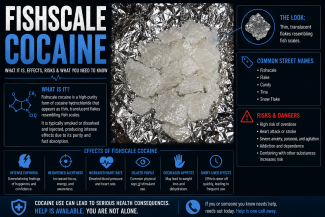
Quick answer: "Fishscale" is street slang for cocaine with a pearlescent, flaky appearance resembling fish scales, sold on the claim that it is purer or uncut. It is a marketing term, not a purity grade. Appearance cannot establish what is in a powder — and levamisole, present in the majority of the US cocaine supply, is used partly because it looks like cocaine.
Fentanyl contamination cannot be seen, smelled, or tasted. If someone becomes unresponsive or their breathing slows or stops, call 911 and give naloxone if available — it is safe to administer even if opioids turn out not to be involved. For substance use support, the free SAMHSA National Helpline is 1-800-662-4357.
Key Takeaways
- "Fishscale" describes an appearance, not a verified composition. No standard, testing, or regulation stands behind the term.
- Levamisole — a veterinary dewormer withdrawn from human medicine over safety concerns — has been detected in around 70 percent of US cocaine.
- It is added partly because it resembles cocaine visually, which is precisely why appearance cannot be used to judge purity.
- Levamisole can cause agranulocytosis, a collapse in the white cells that fight infection, and a distinctive vasculitis that produces skin necrosis, most often on the ears.
- Fentanyl contamination is invisible and has no taste or smell. Nothing about how a powder looks rules it out.
- Genuinely higher purity is more dangerous, not safer — the same amount delivers a larger dose than tolerance is calibrated for.
On This Page
- What "Fishscale" Means
- Why the Term Exists
- Why Appearance Fails
- What's Actually in It
- The Levamisole Problem
- Fentanyl Contamination
- Why Purer Is More Dangerous
- Myths vs. Facts
- Questions People Ask
- When to Seek Help
What Does "Fishscale" Mean?
Fishscale — also written fish scale, or shortened to fish — refers to cocaine with a shimmering, iridescent, flaky texture said to resemble the scales of a fish. The term describes light catching the surface of a compressed or flaked powder.
The implied claim is that this appearance indicates high purity or minimal cutting. That claim has no basis. There is no testing, no standard, and no authority behind the word. It is a description of how something looks, deployed as a sales pitch.
Why the Term Exists
Street drug vocabulary consistently invents grades that sound technical and mean nothing verifiable. "Fishscale," "fire," "pure," "uncut," "pharmaceutical grade" — these function the way any unregulated product claim functions. They increase perceived value and justify price.
The important asymmetry: the seller knows what was done to the product, and the buyer has only appearance to go on. Any term that encourages a purchase decision based on appearance benefits the person who already knows the answer.
Why Appearance Cannot Tell You What Is in a Powder
This is the part that most coverage of the term misses entirely, and it is the reason the whole framework collapses.
Adulterants used in cocaine are not chosen at random. They are chosen because they are cheap, because they extend volume, and — critically — because they resemble cocaine. Research on levamisole notes explicitly that one reason for its use as an adulterant is its similar appearance to cocaine, alongside its ability to potentiate cocaine's stimulant effects.
The logic follows directly. If the most widespread adulterant in the supply is selected in part for looking like the drug it is diluting, then visual assessment is testing for the wrong thing. A powder that looks impressive may be impressive-looking adulterant. There is no version of looking harder that solves this.
The same applies to texture, taste, and the numbing sensation people describe checking for. Several common cutting agents are themselves local anaesthetics, which means the numbing test confirms the presence of an anaesthetic — not of cocaine.
What Is Actually in the US Cocaine Supply
| Substance | What it is | Why it is present | Main risk |
|---|---|---|---|
| Levamisole | Veterinary antihelminthic (dewormer) | Cheap bulking; potentiates cocaine's effects; visually similar | Agranulocytosis; vasculitis with skin necrosis |
| Fentanyl and analogues | Synthetic opioids | Cross-contamination in handling and packaging; sometimes deliberate | Fatal respiratory depression, often in people with no opioid tolerance |
| Local anaesthetics (lidocaine, benzocaine, tetracaine) | Numbing agents | Mimic cocaine's numbing effect, defeating the "taste test" | Cardiac effects at high doses; conceal low cocaine content |
| Phenacetin | Withdrawn analgesic | Cheap bulking with similar appearance | Kidney damage; withdrawn from medical use over safety concerns |
| Inert fillers (sugars, starches, creatine) | Bulking powders | Volume and weight | Lower actual dose, unpredictable potency between batches |
None of these can be distinguished from cocaine by looking at them.
The Levamisole Problem
Levamisole deserves its own section because the scale is extraordinary and most people who use cocaine have never heard of it.
Levamisole was developed in the 1960s as an antihelminthic — a dewormer — and was later used in human medicine as an immunomodulating agent. It was withdrawn from the US human market around 1999–2000 because of serious toxicity, principally agranulocytosis. It remains widely available in veterinary medicine.
It was first identified as a cocaine adulterant in the United States in the early-to-mid 2000s. By July 2009, the DEA reported levamisole in roughly 69 percent of cocaine entering the country, and subsequent literature has consistently estimated around 70 percent of the US supply, with some analyses detecting it in up to 79 percent of samples at concentrations reaching 74 percent by weight.
What Levamisole Does
Two syndromes dominate the clinical literature.
Agranulocytosis. A severe drop in granulocytes, the white blood cells that defend against bacterial infection. During levamisole's therapeutic era, agranulocytosis occurred in an estimated 2.5 to 13 percent of exposed patients. It generally resolves when exposure stops, but it can be fatal. Published cases include patients who developed febrile neutropenia, recovered, resumed cocaine use, and returned weeks later with septic shock and bowel necrosis requiring resection.
Vasculitis and skin necrosis. A distinctive vasculopathy producing purpura that progresses to blistering, tissue death, and ulceration. A systematic review found skin involvement in 91 percent of cases and kidney involvement in 21 percent. Purpura appeared in 83 percent, necrosis in 51 percent. Lesions concentrated on the head and neck in 65 percent of cases — with the ears alone accounting for 54 percent — and the lower limbs in 62 percent.
Clinical pearl: Retiform purpura on the earlobes is close to a signature finding. Ears are involved in over half of cutaneous cases, and the combination of purpuric ear lesions with leukopenia and ANCA positivity should prompt a direct question about cocaine use rather than an autoimmune workup alone. Lesions typically resolve on cessation and reliably recur on re-exposure — which makes the skin an unusually honest record of whether use has stopped.
Fentanyl Contamination Is Invisible
The most serious risk in the current supply cannot be assessed by any sensory means. Fentanyl and its analogues are active in microgram quantities, and a quantity capable of killing someone with no opioid tolerance is too small to see distributed through a powder.
It has no distinguishing appearance, no taste, and no smell. Contamination is frequently uneven, so one portion of a supply can be harmless and another lethal. No amount of visual inspection changes this, and no marketing term — including "fishscale" — carries information about it.
This is also why naloxone matters for people who use stimulants and have no intention of touching opioids. It reverses opioid overdose, it is safe when opioids are not involved, and it is available without a prescription in every US state.
Why Genuinely Higher Purity Is More Dangerous
Suppose the claim were true and a given supply really were less adulterated. That would make it more hazardous, not less.
Tolerance and habitual dose are calibrated to whatever a person has been using. If purity rises, the familiar amount delivers a substantially larger dose of active drug. Cardiovascular strain scales with that dose — as do the risks of arrhythmia, heart attack, seizure, and stroke.
Unpredictable variation between batches is the underlying danger, and it cuts in both directions. "Purer" is not a safety feature. It is a change in dose that the person is not aware they are making.
Myths vs. Facts
| Myth | Fact |
|---|---|
| The shimmer means it is pure. | Appearance is not a composition test. Common adulterants are chosen partly for looking like cocaine. |
| You can tell by the numbing on your gums. | Lidocaine, benzocaine and tetracaine numb too. The test confirms an anaesthetic, not cocaine. |
| Fishscale is a recognised grade. | It is street vocabulary with no standard, testing, or authority behind it. |
| Fentanyl would be obvious in cocaine. | It is active in microgram amounts and has no visible appearance, taste, or smell. |
| Purer cocaine is safer cocaine. | Higher purity means a larger effective dose at the same amount, raising cardiac and seizure risk. |
| Adulterants are just filler. | Levamisole is a veterinary drug withdrawn from human medicine that can destroy white cell counts and cause tissue necrosis. |
Frequently Asked Questions
What is fishscale cocaine?
Fishscale is slang for cocaine with a pearlescent, flaky appearance, marketed as being purer or uncut. The word describes how a powder looks. It carries no verified information about what the powder contains.
Is fishscale cocaine purer than regular cocaine?
There is no way to know from appearance, and no standard behind the term. The most common adulterant in the US supply is used partly because it resembles cocaine, which is exactly why visual assessment does not work.
Why is it called fishscale?
The name comes from a shimmering, iridescent, flaky texture said to resemble fish scales. It is descriptive vocabulary that became a sales term.
Is fishscale cocaine safer?
No. If it is adulterated, the adulterants carry their own serious risks. If it genuinely is more potent, the same familiar amount delivers a larger dose than tolerance is set for, which increases the risk of cardiac events and seizure.
What is cocaine usually cut with?
Levamisole is the most prevalent adulterant in the US supply, present in roughly 70 percent of samples in published estimates. Local anaesthetics such as lidocaine and benzocaine, phenacetin, and inert bulking powders are also common. Fentanyl contamination is a separate and more acute danger.
Can you tell if cocaine has fentanyl in it?
Not by looking, smelling, or tasting. Fentanyl is active in microgram quantities and distributes unevenly, so one part of a supply can differ from another. Naloxone reverses opioid overdose, is safe when opioids are not involved, and is available without a prescription.
What does levamisole do to you?
It can cause agranulocytosis — a severe loss of the white cells that fight infection — and a vasculitis producing purpura, skin necrosis and ulceration, most often affecting the ears. Kidney involvement occurs in around a fifth of reported cases. Skin lesions usually resolve when exposure stops and recur if it resumes.
What are the signs of levamisole-adulterated cocaine?
Purplish, net-patterned skin lesions on the ears, cheeks, nose or legs; repeated or unusually severe infections; and unexplained low white cell counts. Anyone using cocaine who develops these should be evaluated promptly, and should tell the clinician about the cocaine use — the diagnosis is difficult to reach without it.
When to Seek Help
Searching for a purity grade is usually a proxy for a different question: whether what is being used is safe. The honest answer is that the supply cannot be verified by anyone buying it, and it has become less predictable rather than more.
Seek medical attention promptly for purplish or net-patterned skin lesions, particularly on the ears; repeated or severe infections; chest pain or palpitations during or after use; or any episode that frightened you. Tell the clinician what was taken. Levamisole vasculitis and cocaine-associated cardiac events are both routinely misdiagnosed when that information is withheld, and no useful purpose is served by withholding it.
If cocaine use has become something you plan around, Cocaine Addiction Treatment on Long Island covers harm-reduction measures including fentanyl test strips and naloxone alongside confidential placement into vetted programs.
Related Guides
- How Long Does Cocaine Stay in Your System? Test Windows
- Cocaine and Alcohol: Cocaethylene and Cardiac Risk
- Cocaine Overdose: Signs, Symptoms, and What to Do
- Is Cocaine the Hardest Drug to Quit? Withdrawal & Recovery
- Coke Nose: How Cocaine Damages the Nose and When It Becomes Irreversible
- Drug Street Names: A Reference Glossary of Common Slang Terms
- 5 Most Addictive Drugs of Abuse in 2026: Evidence-Based Rankings
References
- Levamisole-Contaminated Cocaine: An Emergent Cause of Vasculitis and Skin Necrosis.
- Vasculopathy and vasculitis associated with levamisole-adulterated cocaine: a systematic review. 2025.
- Complications Associated With Use of Levamisole-Contaminated Cocaine. Mayo Clinic Proceedings.
- Cutaneous Vasculopathy Associated with Levamisole-Adulterated Cocaine. Clinical Medicine & Research.
- Genetic determinants of cocaine-associated agranulocytosis.
- CFSRE Public Alert — Levamisole: A Toxic Adulterant Found in Illicit Street Drugs.
- NIDA — Cocaine Research Report.
- SAMHSA National Helpline: 1-800-662-4357.
About the Author
Benjamin Zohar, NCACIP, is a Nationally Certified Advanced Clinical Intervention Professional and ISSUP network moderator specializing in addiction intervention, treatment navigation and emerging substance-use risks.
He publishes evidence-informed resources addressing counterfeit medications, fentanyl exposure, benzodiazepine safety, kratom dependence and concentrated 7-hydroxymitragynine products. His work published through ISSUP has been cited or referenced by GoodRx, The Washington Post, WIRED and Newsweek.
Written by: Benjamin Zohar, NCACIP
Medical Review
Medically reviewed by: Brandon McNally, RN
Medical Disclaimer
This article is intended for educational and public-health purposes. It does not provide individualized medical advice, diagnosis or a tapering schedule. Do not start, stop or alter a prescription medication without consulting a qualified healthcare professional. Call emergency services for seizures, difficulty breathing, loss of consciousness, severe confusion or other life-threatening symptoms.