
How Long Does Alcohol Stay in Urine? EtG, EtS & Detection Windows
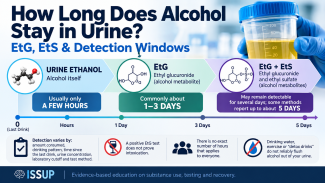
Quick answer: Alcohol itself is usually detectable in urine for only a few hours, but urine tests that measure the alcohol metabolites EtG and EtS can detect recent alcohol exposure for much longer. EtG is commonly detectable for about 1–3 days, while some sensitive laboratory EtG/EtS methods may detect exposure for up to about 5 days.
Important: A urine alcohol-test result cannot tell you exactly when someone drank, how impaired they were, or precisely how much alcohol they consumed. Detection depends on the test used, cutoff concentration, drinking pattern, urine concentration, time since drinking and individual biological factors.
Key Takeaways
- Ethanol itself is usually detectable in urine for only a few hours.
- EtG and EtS are direct alcohol metabolites that can remain measurable after ethanol itself is gone.
- EtG is commonly detectable for about 1–3 days, although some laboratory methods may detect EtG or EtS for up to approximately 5 days.
- An “80-hour EtG test” does not guarantee that alcohol will remain detectable for exactly 80 hours.
- Test cutoff matters. Lower thresholds may detect smaller concentrations for longer.
- A positive EtG result does not prove intoxication at the time the urine specimen was collected.
- Incidental exposure to alcohol-containing products can sometimes contribute to low EtG or EtS concentrations.
- Water, exercise, saunas and “detox drinks” do not provide a reliable way to rapidly eliminate EtG.
Table of Contents
- Alcohol Urine Detection Times by Test Type
- How Long Does Alcohol Stay in Urine?
- Urine Ethanol vs EtG and EtS
- Alcohol Urine Detection Timeline
- What Is an EtG Urine Test?
- What Is EtS?
- What Is an 80-Hour EtG Test?
- Can Alcohol Be Detected in Urine for 5 Days?
- How Do EtG Cutoffs Affect Detection?
- Does the Amount of Alcohol Matter?
- Does Beer Stay in Urine Longer Than Liquor?
- What Affects the Detection Window?
- Can EtG Be Positive Without Drinking?
- What Does a Positive EtG Result Mean?
- Can You Flush Alcohol Out of Urine?
- Does a Regular Urinalysis Test for Alcohol?
- Urine vs Blood and Breath Alcohol Testing
- Alcohol Testing vs Alcohol Withdrawal
- Myth vs Fact
- When to Seek Medical Help
- Frequently Asked Questions
- Related Guides
- References
Alcohol Urine Detection Times by Test Type
How long alcohol can be found in urine depends primarily on whether the test measures ethanol itself or longer-lasting alcohol metabolites such as EtG and EtS. These tests answer different questions and therefore have very different detection windows.
| Test | What It Detects | General Detection Window | What the Result Means |
|---|---|---|---|
| Urine ethanol | Alcohol itself | Usually only a few hours | Relatively recent ethanol exposure |
| EtG urine screen | Ethyl glucuronide | Commonly about 1–3 days | Recent alcohol exposure after ethanol may already be gone |
| EtG + EtS laboratory confirmation | Ethyl glucuronide and ethyl sulfate | May remain detectable for several days; some methods report up to about 5 days | Evidence of recent ethanol exposure, not proof of intoxication |
These ranges are not guarantees for an individual person. Detection varies with drinking pattern, laboratory cutoff, assay sensitivity, urine concentration and time since the final drink.
For a broader example of urine drug testing that includes an EtG alcohol panel, see Free Long Island 22-Panel Urine Drug Test (Detects Xylazine, Fentanyl & Tianeptine).
How Long Does Alcohol Stay in Urine?
Alcohol itself generally remains detectable in urine for a much shorter period than its metabolites. Mayo Clinic Laboratories states that ethanol in urine is normally detectable for only a few hours, whereas EtG can commonly be detected for 1–3 days.
This distinction explains why two people can both ask, “How long does alcohol stay in urine?” but receive very different answers depending on the test involved.
A standard ethanol test looks for the alcohol molecule itself. An EtG or EtS test looks for compounds the body creates after processing ethanol.
Therefore, a urine specimen may contain:
- no measurable ethanol;
- but still contain detectable EtG or EtS.
That does not mean the tests disagree. They are measuring different substances at different stages of alcohol metabolism.
Urine Ethanol vs EtG and EtS: What Is the Difference?
Urine ethanol testing measures alcohol itself, while EtG and EtS testing measures direct metabolites formed after exposure to ethanol. The metabolite tests therefore provide a substantially longer detection window.
Most consumed ethanol is metabolized through oxidative pathways, primarily in the liver. Smaller amounts are converted into direct biomarkers including:
- ethyl glucuronide (EtG);
- ethyl sulfate (EtS).
Because these metabolites persist after ethanol levels have declined, they are useful when the question is whether recent alcohol exposure occurred rather than whether a person is currently intoxicated.
Clinical Pearl: EtG is a marker of recent ethanol exposure, not a retrospective blood-alcohol concentration. A positive EtG test should not be used to calculate how intoxicated someone was or the exact number of drinks consumed.
Alcohol Urine Detection Timeline
The urine detection window generally becomes longer when testing shifts from ethanol itself to EtG and EtS metabolites. The timeline below is a general framework rather than a countdown that applies identically to every person.
| Time Since Drinking | Possible Urine Finding | Interpretation |
|---|---|---|
| First several hours | Ethanol, EtG and EtS may be detectable | Recent alcohol exposure |
| Within about 24 hours | EtG and EtS may remain detectable after ethanol has declined | Recent drinking may still be identified |
| About 24–72 hours | EtG may remain detectable in many cases | Result depends on drinking pattern, cutoff and specimen concentration |
| Beyond 72 hours | Some sensitive EtG/EtS methods may still be positive | Detection becomes increasingly dependent on amount consumed and assay characteristics |
| Up to about 5 days | Possible with some laboratory EtG/EtS methods | Should not be treated as a universal detection period |
The further testing occurs from the last drink, the more important the laboratory method and cutoff become.
What Is an EtG Urine Test?
An EtG urine test looks for ethyl glucuronide, a direct metabolite produced after the body is exposed to ethanol. It is widely used when the goal is to identify alcohol exposure after ethanol itself is no longer readily detectable.
EtG urine testing may be used in:
- addiction-treatment monitoring;
- recovery programs;
- clinical evaluations;
- professional monitoring programs;
- probation or justice-system settings;
- medical programs requiring alcohol abstinence;
- laboratory substance-use monitoring.
Mayo Clinic Laboratories describes EtG as generally detectable in urine for approximately 1–3 days in its screening documentation.
More sensitive confirmatory testing that measures both EtG and EtS may sometimes identify alcohol exposure for longer.
What Is EtS and Why Is It Tested With EtG?
EtS, or ethyl sulfate, is another direct ethanol metabolite that can be tested alongside EtG. Measuring both biomarkers can provide additional information when evaluating recent alcohol exposure.
Laboratories may use liquid chromatography-tandem mass spectrometry, often abbreviated LC-MS/MS, to quantify EtG and EtS.
Combined testing may be useful because interpretation of EtG alone can be affected by:
- incidental environmental alcohol exposure;
- specimen handling;
- biological variation;
- immunoassay cross-reactivity;
- urine concentration.
This is why a laboratory report should be interpreted according to the actual biomarker and method used rather than being described simply as an “alcohol urine test.”
What Is an 80-Hour EtG Test?
The phrase “80-hour alcohol test” is commonly used for EtG testing, but it should not be interpreted as a guaranteed 80-hour detection period. Eighty hours is approximately three days and eight hours, but EtG does not disappear at the same time in every person.
Whether EtG remains above a laboratory cutoff at 80 hours can depend on:
- how much ethanol was consumed;
- whether drinking occurred once or repeatedly;
- the time of the last drink;
- the laboratory cutoff;
- urine concentration;
- individual biological variation;
- the specific test method.
Someone with lower exposure may fall below a test cutoff earlier, while heavier or repeated exposure can sometimes remain detectable longer.
The term “80-hour EtG test” is therefore best understood as shorthand for an extended alcohol-metabolite test, not an exact biological deadline.
Can Alcohol Be Detected in Urine for 5 Days?
EtG and EtS can sometimes remain detectable in urine for up to approximately five days with sensitive laboratory testing, but five days is not a universal detection window.
Mayo Clinic Laboratories states that EtG and EtS may be detectable for up to five days in urine with certain laboratory methods.
Its EtG screening documentation also describes a more typical EtG detection period of approximately 1–3 days.
Both can be true because detection is influenced by:
- assay sensitivity;
- cutoff concentration;
- amount consumed;
- frequency of drinking;
- time since drinking;
- urine concentration;
- individual variation.
Bottom line: EtG is commonly detectable for about 1–3 days and may sometimes remain detectable longer, including up to approximately five days with some laboratory methods and patterns of alcohol exposure.
How Do EtG Test Cutoffs Affect Detection?
The cutoff is the concentration a laboratory uses to determine whether an EtG or EtS result is reported as positive or below threshold. Different testing methods and programs can use different cutoffs.
For example, Mayo Clinic Laboratories lists a screening cutoff of:
- 500 ng/mL for EtG on one urine immunoassay screen.
Its LC-MS/MS confirmation method reports cutoffs of:
- 250 ng/mL for EtG;
- 100 ng/mL for EtS.
A lower cutoff can detect smaller concentrations and may extend sensitivity to lower-level or more remote exposure.
However, increased sensitivity also makes contextual interpretation more important because incidental exposure may contribute to very low metabolite concentrations.
This is one reason the question “How many hours does alcohol stay in urine?” cannot be answered precisely without knowing the type of test being used.
Does the Amount of Alcohol Consumed Affect an EtG Test?
Yes. The amount and pattern of alcohol exposure can influence how high EtG and EtS concentrations become and how long they remain above a laboratory cutoff.
In general, greater or repeated alcohol exposure can result in:
- higher metabolite concentrations;
- a greater likelihood of remaining above a cutoff later;
- a potentially longer detection period.
However, an EtG result should not be converted into an exact number of drinks.
A urine concentration cannot reliably determine:
- the exact number of drinks consumed;
- the precise time drinking occurred;
- the person's peak blood alcohol concentration;
- whether the person was intoxicated at a particular time.
For example, two people who consumed similar amounts could have different EtG concentrations because of differences in timing, urine concentration, metabolism and testing conditions.
Does Beer Stay in Urine Longer Than Liquor?
Beer, wine and liquor all contain ethanol, so urine detection depends primarily on the total amount of ethanol consumed rather than the name of the beverage.
A 12-ounce beer does not have a special alcohol metabolite that disappears faster than liquor. The body processes ethanol regardless of whether it came from:
- beer;
- wine;
- vodka;
- whiskey;
- rum;
- mixed drinks.
What matters is the total ethanol exposure, drinking duration and the test being used.
This is also why statements such as “one beer takes exactly one hour to leave your system” or “six beers take six hours” are oversimplifications. Alcohol elimination varies between people, and EtG may remain detectable well after the intoxicating effects have ended.
What Affects How Long Alcohol Is Detectable in Urine?
Urine alcohol detection varies because both biological factors and laboratory methodology affect the result.
Important factors include:
- Amount consumed: greater alcohol exposure may produce higher metabolite concentrations.
- Frequency of drinking: repeated alcohol consumption can produce a different testing pattern than a single exposure.
- Time since the last drink: metabolite concentrations generally decline as time passes.
- Test type: ethanol, EtG and EtS have different detection windows.
- Laboratory cutoff: lower thresholds may detect smaller concentrations.
- Urine concentration: hydration and biological variation affect measured concentration.
- Individual physiology: alcohol processing is not identical from person to person.
- Specimen handling: collection and storage procedures can influence laboratory reliability.
Responsible interpretation therefore uses ranges rather than promising an exact hour when a urine test will become negative.
Can an EtG Test Be Positive Without Drinking Alcohol?
Low-level EtG or EtS exposure can sometimes occur after substantial exposure to products containing ethanol, which is why sensitive test results need clinical context.
Potential sources of incidental ethanol exposure can include some:
- alcohol-based hand sanitizers;
- mouthwashes;
- liquid medicines;
- personal-care products;
- household products containing ethanol.
SAMHSA guidance has cautioned that highly sensitive EtG and EtS testing can detect some extraneous alcohol exposure, particularly when concentrations are low.
Mayo Clinic Laboratories similarly notes that products such as hand sanitizer and mouthwash can produce detectable EtG or EtS in some circumstances.
This does not make the testing useless. Instead, it means:
- the actual concentration matters;
- the cutoff matters;
- confirmation testing may be useful;
- the result should be interpreted alongside clinical and behavioral information.
For another example involving an alcohol-containing over-the-counter product, see ZzzQuil and Alcohol: Risks, Side Effects, and Why Mixing Them Can Be Dangerous.
What Does a Positive EtG Urine Test Mean?
A confirmed positive EtG or EtS result generally supports recent ethanol exposure, but it does not prove current intoxication.
According to Mayo Clinic Laboratories, higher EtG concentrations can be compatible with more recent or heavier exposure, while lower concentrations can reflect:
- more remote drinking;
- lighter alcohol exposure;
- or, in some situations, intense incidental ethanol exposure.
The concentration should not be treated as an exact clock.
Interpretation may consider:
- the test method;
- screening versus confirmation;
- the cutoff used;
- time since drinking;
- self-reported alcohol use;
- other biomarkers;
- the reason testing was performed.
Can You Flush Alcohol Out of Your Urine Faster?
There is no reliable way to rapidly remove EtG or EtS from the body after alcohol has been metabolized. Time is the primary factor.
Drinking excessive water does not significantly accelerate hepatic alcohol metabolism or instantly eliminate ethanol metabolites.
Large fluid intake may dilute urine, but dilution is not the same as faster metabolism and does not provide a predictable way to change a laboratory result.
Methods sometimes promoted online, including:
- “detox drinks”;
- saunas;
- exercise;
- coffee;
- vitamin products;
- excessive water intake;
do not provide a scientifically reliable shortcut for eliminating EtG.
Does a Regular Urinalysis Test for Alcohol?
No. A routine urinalysis does not automatically test for alcohol or EtG. Alcohol or alcohol-metabolite testing generally needs to be specifically included or ordered.
A laboratory may test urine for:
- ethanol itself;
- EtG;
- EtS;
- or EtG and EtS together.
Similarly, a standard multi-panel urine drug screen does not necessarily contain an EtG panel unless the manufacturer or laboratory specifically includes one.
For an example of a multi-panel test that includes EtG, review Free Long Island 22-Panel Urine Drug Test (Detects Xylazine, Fentanyl & Tianeptine).
How Is Urine Alcohol Testing Different From Blood or Breath Testing?
Blood and breath alcohol tests are generally better suited to evaluating recent ethanol concentration, while EtG and EtS urine tests provide a longer window for identifying recent alcohol exposure.
| Test | What It Measures | Primary Use |
|---|---|---|
| Breath alcohol | Ethanol | Recent alcohol concentration and impairment-related testing |
| Blood alcohol | Ethanol | Direct measurement of recent blood alcohol concentration |
| Urine ethanol | Ethanol | Short-window evidence of recent alcohol exposure |
| Urine EtG/EtS | Ethanol metabolites | Extended-window evidence of recent alcohol exposure |
An EtG urine test therefore should not be interpreted as the equivalent of a breathalyzer or blood-alcohol test.
Does a Negative Alcohol Urine Test Mean Withdrawal Risk Is Over?
No. Alcohol-testing results and alcohol-withdrawal risk are separate clinical issues. A person may have little or no measurable ethanol remaining while still entering a medically dangerous withdrawal period.
Alcohol withdrawal can develop after alcohol concentrations decline, particularly in people who have been drinking heavily or regularly.
Possible withdrawal symptoms include:
- tremor;
- sweating;
- anxiety;
- rapid heart rate;
- nausea;
- insomnia;
- hallucinations;
- seizures;
- severe confusion or delirium.
People with prolonged heavy alcohol use, a history of withdrawal seizures or previous alcohol-withdrawal delirium should not use a negative urine test as evidence that suddenly stopping alcohol is medically safe.
For more information about supervised withdrawal, see Alcohol Detox in Long Island: Medically Supervised Care and the Path to Recovery.
Readers trying to understand what medically supervised detox involves can also review Alcohol Detox Near Me: How to Find Safe Medical Detox on Long Island and Across New York.
Alcohol Urine Testing: Myth vs Fact
| Myth | Fact |
|---|---|
| Alcohol always stays in urine for 80 hours. | No. EtG may sometimes remain detectable around that period, but 80 hours is not guaranteed. |
| A positive EtG test means the person is drunk. | No. EtG indicates recent ethanol exposure and may remain positive after intoxication has ended. |
| Alcohol itself remains in urine for several days. | Usually not. The longer window generally comes from metabolites such as EtG and EtS. |
| One beer always takes exactly one hour to leave the body. | No. Alcohol elimination varies, and urine metabolite testing may remain positive much longer. |
| Six beers always take six hours to clear. | No. An exact drink-to-hour formula cannot reliably predict alcohol elimination or EtG detection. |
| Drinking water quickly removes EtG. | No. Water may change urine concentration but does not rapidly remove alcohol metabolites. |
| Every EtG test uses the same cutoff. | No. Screening and confirmation methods can use different concentrations and technologies. |
| An EtG level tells exactly how many drinks someone had. | No. EtG concentration cannot reliably be converted into an exact drink count. |
| A negative urine alcohol test means withdrawal is impossible. | No. Withdrawal can occur after ethanol itself has already been eliminated. |
When to Seek Medical Help
Alcohol poisoning and severe alcohol withdrawal require medical attention regardless of what a urine test shows.
Call emergency services for symptoms such as:
- inability to wake the person;
- slow or irregular breathing;
- seizures;
- repeated vomiting with reduced consciousness;
- severe confusion;
- hallucinations with agitation or disorientation;
- bluish, pale or clammy skin;
- loss of consciousness.
Medical evaluation is also important when someone who drinks heavily develops withdrawal symptoms after reducing or stopping alcohol.
ASAM's alcohol-withdrawal guideline describes withdrawal seizures and alcohol-withdrawal delirium as serious complications that may require close monitoring and hospital-level care.
For a comparison of withdrawal management and continuing outpatient treatment, see Detox vs Outpatient Rehab in New Jersey.
For a broader overview of treatment levels, see Detox Centers in New Jersey: Complete Guide to Alcohol and Drug Detox, Rehab Options, and Levels of Care.
Families evaluating treatment options may also find How to Find Licensed Addiction Treatment on Long Island useful when comparing levels of care and checking whether a provider is appropriately licensed.
Frequently Asked Questions About Alcohol and EtG Urine Tests
How long does EtG stay in your urine?
EtG is commonly detectable in urine for approximately 1–3 days after alcohol exposure. Some sensitive laboratory methods that measure EtG and EtS may identify alcohol metabolites for longer, including up to about five days in some circumstances. Detection depends on the amount consumed, timing, laboratory cutoff, urine concentration and test method.
How long is alcohol detectable in urine?
Ethanol itself is normally detectable in urine for only a few hours. Tests that look for the metabolites EtG and EtS can identify alcohol exposure for much longer, commonly for several days. This is why the answer depends on whether the test measures ethanol or one of its metabolites.
How long does alcohol show up in a urine test?
Urine ethanol testing has a relatively short detection window, while EtG and EtS tests may remain positive for days after drinking. EtG is commonly detectable for about 1–3 days, while some sensitive laboratory methods may detect EtG or EtS for as long as approximately five days.
Can a urine test detect alcohol after 48 hours?
Yes. EtG or EtS may remain detectable 48 hours after alcohol exposure, especially after greater or repeated alcohol consumption. Whether a test remains positive depends on the assay, cutoff, urine concentration, time since the last drink and individual biological factors.
Can an EtG test detect alcohol after 72 hours?
It can. Seventy-two hours falls within the extended detection period sometimes seen with EtG testing, but a positive test at that point is not guaranteed. Some people may fall below the laboratory cutoff sooner, while greater or repeated exposure may remain detectable for longer.
Is EtG really an 80-hour alcohol test?
“80-hour EtG test” is a popular description rather than a guaranteed detection period. EtG may sometimes remain detectable around 80 hours, but the actual window depends on alcohol exposure, laboratory sensitivity, cutoff concentration, specimen concentration and individual variation.
Can alcohol show in urine after five days?
EtG and EtS may sometimes remain detectable for up to approximately five days with certain sensitive laboratory methods. Five days should not be interpreted as the standard result for every person or drinking episode. Many EtG results become negative considerably sooner.
How long does beer stay in your urine?
Beer contains ethanol just like wine and liquor, so detection depends on the total alcohol dose and the type of urine test rather than the beverage itself. Ethanol has a relatively short urine detection window, while EtG and EtS can remain measurable for several days.
How long does one beer stay in your system?
There is no universal number of hours that applies to everyone after one beer. Alcohol elimination varies with serving size, alcohol concentration, drinking speed, physiology and other factors. EtG may remain detectable in urine after the intoxicating effects of a single drink have ended.
How long do six beers stay in your system?
Six beers cannot reliably be converted into a fixed six-hour or eight-hour elimination timeline. Beer strength, serving size, drinking duration and individual alcohol elimination all matter. EtG and EtS testing can continue to identify alcohol exposure after ethanol itself has been eliminated.
Can a regular urinalysis test for alcohol?
A routine urinalysis does not automatically test for alcohol. Ethanol, EtG or EtS usually needs to be specifically included in the laboratory order or drug-testing panel. Some multi-panel substance-use tests contain an EtG panel, while others do not.
Can hand sanitizer cause a positive EtG test?
Intense or repeated exposure to ethanol-containing products such as hand sanitizer can sometimes contribute to low EtG or EtS concentrations. SAMHSA and clinical laboratories therefore recommend interpreting low-level results in context rather than assuming every detectable amount proves beverage alcohol consumption.
Does drinking lots of water make EtG leave faster?
No. Water does not substantially accelerate the body's metabolism of ethanol or directly eliminate EtG. Heavy fluid intake can dilute urine, but dilution does not provide a predictable or reliable way to make an EtG test negative.
Does a positive EtG test mean someone was intoxicated?
No. EtG indicates recent ethanol exposure rather than current impairment. A person can have no intoxicating effects and no measurable ethanol remaining while EtG is still present in urine.
Can an EtG result tell exactly how many drinks someone had?
No. EtG concentration is affected by timing, urine concentration, metabolism, drinking pattern, assay and cutoff. A laboratory value cannot reliably be translated into an exact number of beers, glasses of wine or shots of liquor.
Related Guides
- Free Long Island 22-Panel Urine Drug Test (Detects Xylazine, Fentanyl & Tianeptine)
- Alcohol Detox in Long Island: Medically Supervised Care and the Path to Recovery
- Alcohol Detox Near Me: How to Find Safe Medical Detox on Long Island and Across New York
- ZzzQuil and Alcohol: Risks, Side Effects, and Why Mixing Them Can Be Dangerous
- Detox vs Outpatient Rehab in New Jersey
- Detox Centers in New Jersey: Complete Guide to Alcohol and Drug Detox, Rehab Options, and Levels of Care
- How to Find Licensed Addiction Treatment on Long Island
- Cocaine and Alcohol: Cocaethylene and Cardiac Risk
References
- Mayo Clinic Laboratories. Ethyl Glucuronide Screen with Reflex, Random, Urine.
- Mayo Clinic Laboratories. Ethyl Glucuronide Screen with Reflex, Random, Urine.
- Mayo Clinic Laboratories. Ethyl Glucuronide Confirmation, Random, Urine.
- Substance Abuse and Mental Health Services Administration. The Role of Biomarkers in the Treatment of Alcohol Use Disorders.
- American Society of Addiction Medicine. The ASAM Clinical Practice Guideline on Alcohol Withdrawal Management.
- National Institute on Alcohol Abuse and Alcoholism. National Institute on Alcohol Abuse and Alcoholism.
Last updated: September 27, 2026.
About the Author
Benjamin Zohar, NCACIP is a Nationally Certified Advanced Clinical Intervention Professional and ISSUP network moderator specializing in addiction intervention, treatment navigation and emerging substance-use risks. His educational work published through ISSUP on counterfeit medications, fentanyl exposure and concentrated 7-hydroxymitragynine has been cited or referenced by GoodRx, The Washington Post, WIRED and Newsweek.
Medical reviewed by Brandon McNally, RN
Medical disclaimer: This article is intended for educational and public-health purposes. It does not provide individualized medical advice, diagnosis or a tapering schedule. Do not start, stop or alter a prescription medication without consulting a qualified healthcare professional. Call emergency services for seizures, difficulty breathing, loss of consciousness, severe confusion or other life-threatening symptoms.