Psychoactive substances are natural or synthetic substances that act on the central nervous system and alter mental processes such as mood, perception, cognition, consciousness, and behaviour. These substances may be legally prescribed medications (e.g., pain medications or sedatives), legally available substances such as alcohol or caffeine, or controlled or illicit drugs. Psychoactive substances can be used for medical, social, cultural, or recreational purposes, but some carry risks of misuse, dependence, and health or social harms when used in harmful ways.
Psychoactive Substances
Culture of Care’ Barometer
An organisational culture is the collection of values, expectations, and practices that shape the overall feeling and actions among staff members. A culture of care is an environment that is created where people feel valued and supported as...
EMCDDA initial report on the new psychoactive substance 1-(3-chlorophenyl)-2-(methylamino)propan-1-one (3-chloromethcathinone, 3-CMC)
1-(3-Chlorophenyl)-2-(methylamino) propan-1-one (3-chloromethcathinone, 3-CMC) is a synthetic cathinone stimulant. It is a ring-substituted cathinone, which is structurally related to methcathinone and 4-chloromethcathinone (4-CMC). The...
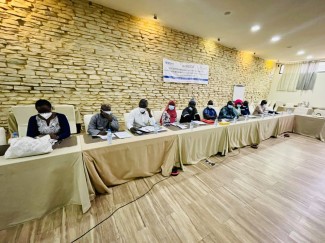
UNODC supports 28 health care providers from all 14 regions in Senegal with a training on treatment and care of people who inject drugs in Senegal
Since December 2014, methadone maintenance treatment is available at the Centre de Prise en Charge Intégrée des Addictions à Dakar, Senegal (CEPIAD). This center, located within the Centre Hospitalier National Universitaire de Fann, allows...
DECCA Big Guides
Downloadable information on alcohol, drugs and tobacco.
New Determinants of Addictions’ Creation and Development in Changed Social Conditions
EDITORIAL Dear readers, This issue of the journal Addictology offers you many interesting articles on addiction, while each article’s research area is very specific. Authors examine various aspects of addiction in connection with marketing...
Trends in Buprenorphine Use in US Jails and Prisons From 2016 to 2021
Source: Thakrar AP, Alexander GC, Saloner B. Trends in Buprenorphine Use in US Jails and Prisons From 2016 to 2021. JAMA Netw Open. 2021;4(12):e2138807. doi:10.1001/jamanetworkopen.2021.38807 Discussion In the US, buprenorphine use...
Challenges in prevention and treatment in the post-pandemic (Argentina-Chile-Mexico-Peru)
ISSUP Argentina presented a webinar that addressed the increased impact of isolation and social distancing stemming from the pandemic on the quality of life of vulnerable populations in Latin America, including children and adolescents...
Guide to Indispensable Criteria for Starting-up and Operating Treatment Centers for People with Psychoactive Substance Use Disorders
The WHO Expert Committee on Drug Dependence defines treatment as the process that begins when psychoactive substance users contact a health provider or other community service and may continue through a succession of specific interventions...
Academic Session "The discount of the subjective value of the reinforcer with people who consume psychoactive substances"
Speaker: Dr. Silvia Morales Chainé Academic session held on Monday, November 8, 2021. The slides used by Dr. Morales Chainé are available at ISSUP: https://www.issup.net/node/15736 For more publications, presentations, videos and materials...
Synthetic drugs and new psychoactive substances in Latin America and the Caribbean- 2021
The report provides a regional analysis of the key trends and emerging developments of the synthetic drugs and NPS market as well as options for response in Latin America and the Caribbean. Over the past years, the synthetics drug market...