Psychoactive substances are natural or synthetic substances that act on the central nervous system and alter mental processes such as mood, perception, cognition, consciousness, and behaviour. These substances may be legally prescribed medications (e.g., pain medications or sedatives), legally available substances such as alcohol or caffeine, or controlled or illicit drugs. Psychoactive substances can be used for medical, social, cultural, or recreational purposes, but some carry risks of misuse, dependence, and health or social harms when used in harmful ways.

Psychoactive Substances
The Role of Faith Communities in Addressing Substance Use and Crime – Reading List (Part 2)
In this second reading list, we continue exploring the growing evidence on the role and contribution of faith communities and faith-based organisations in addressing substance use and crime, with a particular focus on treatment engagement...
2024 NIDA International Forum: Call for Research Poster Abstracts and Travel Award Requests
Call for Research Poster Abstract Submissions and Travel Award Requests Submission Deadline: January 14, 2024 Present your international drug use and addiction research during the 2024 NIDA International Forum, which will be held June 14–17...
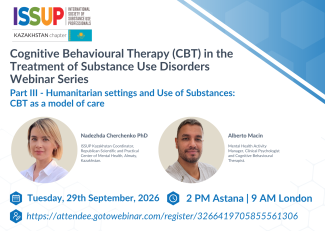
Humanitarian settings and Use of Substances: CBT as a model of care
ISSUP Kazakhstan, ISSUP Indonesia and ISSUP Sri Lanka, welcome you to a three-part part webinar series on Cognitive Behavioural Therapy (CBT) in the Treatment of Substance Use Disorders.
The product may not be what it says: What emerging synthetic drugs and dangerous mixtures mean for practice
The clearest message from our recent ISSUP Global webinar was a simple but important one: we should stop assuming that an unregulated drug product contains only what it is sold as containing. That uncertainty now has direct implications for prevention, clinical care, recovery support, toxicology, law enforcement, policy and the administration of justice.
Xylazine-Fentanyl Positivity and Concentration in Urine Drug Tests
Abstract Importance The US opioid crisis is currently driven by illicitly manufactured fentanyl combined with an evolving mix of stimulants and adulterants, such as the veterinary sedative xylazine, which further complicate clinical and...
Assessment of the threat posed by highly potent synthetic opioids in Europe
This threat assessment examines the potential risks posed by highly potent synthetic opioids (HPSOs) in Europe over the next two years. Drawing on early warning data, forensic and clinical evidence, and expert input, the report explores how...
Heroin Trafficking Along the Northern and Southern Routes: Emerging Trends and Strategic Implications
This paper examines how heroin trafficking routes from Afghanistan into Europe have evolved following the Taliban's return to power in 2021. It explores the changing dynamics of the northern and southern trafficking routes, highlighting how...
Spirituality and Harmful or Hazardous Alcohol and Other Drug Use
This meta-analysis synthesises evidence from 55 longitudinal studies involving more than 540,000 participants to examine the relationship between spirituality and harmful or hazardous alcohol and other drug (AOD) use. The findings...
Association Between Religiosity and Spirituality and Cocaine Use: A Systematic Review
This systematic review examines the association between religiosity, spirituality, and cocaine use by analysing findings from 20 observational studies involving adults and adolescents. Most studies found that higher levels of religiosity...