Professional Self-Care in Addiction Services: Ethical Practice, Compassion Fatigue, and Workforce Sustainability
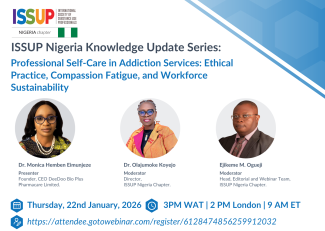
ISSUP Nigeria would like to invite you to the 31st session of its bi-monthly webinar in the Knowledge Update Series. This webinar will focus on the topic 'Professional Self-Care in Addiction Services: Ethical Practice, Compassion Fatigue, and Workforce Sustainability'.
Date: 22nd January 2026
Time: 3:00 PM WAT | 2:00 PM London | 9 AM ET
This webinar examines the critical role of self-care in sustaining effective and ethical addiction practice, recognising that professionals routinely work under conditions of high emotional demand, trauma exposure, resource constraints, and systemic pressure. Participants will explore self-care as a professional responsibility rather than a personal indulgence, and how practitioner wellbeing directly influences therapeutic outcomes, service quality, and workforce retention. Drawing on research, ethics, neuroscience, and wellness science, the session presents practical and culturally adaptable self-care strategies applicable across prevention, treatment, and recovery settings.
Discussion Topics:
- Burnout, secondary traumatic stress, and compassion fatigue in addiction work
- Ethical and professional obligations for self-care in substance use services
- The Seven Pillars of Self-Care and their relevance to addiction professionals
- Mindfulness, sleep hygiene, emotional regulation, and boundary-setting
- Organisational culture and policies that support workforce wellbeing and drive work - life balance
- Developing realistic personal and institutional self-care plans
Relevance and Significance:
Addiction professionals are essential to effective prevention, treatment, and recovery systems, yet face high rates of burnout, emotional strain, and workforce attrition.
Strengthening self-care capacity:
- Enhances quality, safety, and continuity of care
- Reduces ethical risk and professional impairment
- Supports sustained compassion and therapeutic presence
- Improves organisational effectiveness and service outcomes
- This webinar supports ISSUP’s global commitment to ethical practice, workforce sustainability, and evidence-based professional development in substance use prevention, treatment, and recovery.
Target Audience:
- Addiction counsellors and treatment providers, Mental health and behavioural health professionals, Prevention specialists, Public health practitioners, Peer support workers, Programme managers and supervisors, Policymakers and regulators, ISSUP members and affiliates.
Learning Outcomes:
Following this webinar, participants will be able to:
-
Explain the impact of burnout and compassion fatigue on addiction practice.
-
Explain why self-care is an ethical and professional responsibility in substance use work.
-
Identify at least three early warning signs of professional burnout or impairment.
-
Apply at least three of the Seven Pillars of Self-Care to daily professional practice.
-
Develop an individualised self-care plan to support long-term professional resilience.
-
Advocate for organisational policies and practices that promote workforce wellbeing.
Presenter:
Dr Monica Hemben Eimunjeze FPSN, FNAPharm
Monica Hemben Eimunjeze is a seasoned pharmacist, wellness advocate, and corporate executive with over 30 years of professional experience spanning policy formulation, regulatory affairs, compliance, supply chain security, and quality management systems. She is the Founder and CEO of DeeDoo Bio Plus Pharmacare Limited and the Convener of the D’Bio Wellness & Self-Care Summit, a platform dedicated to advancing holistic wellbeing across professional sectors.
She holds a Bachelor of Pharmacy, a Doctor of Pharmacy (PharmD), and a Master’s degree in Biotechnology, Innovation, and Regulatory Science. Monica currently serves as an Executive in Residence at Lagos Business School, where she contributes to leadership development, ethical decision-making, and organisational excellence.
She provides leadership and thought advocacy on the wellbeing of diverse populations across professional and community settings, with a strong emphasis on science-based wellness approaches grounded in ethics, regulatory insight, and professional sustainability. Through her work, Monica advances self-care as a strategic foundation for effective service delivery, professional resilience, and long-term workforce sustainability.
Moderators:
Dr. Olajumoke Koyeojo
Director, ISSUP Nigeria Chapter
Ejikeme M. Ogueji
Head, Editorial and Webinar Team, ISSUP Nigeria Chapter
References:
- Barnett, J. E., & Cooper, N. (2009). Creating a culture of self-care. Clinical Psychology: Science and Practice, 16(1), 16.
- Coll, K. M., Doumas, D. M., Trotter, A., & Freeman, B. J. (2013). Developing the counselor as a person and as a professional. Journal of Humanistic Counseling, 52(1), 54–66.
- Enos, G. A. (2016). Clinicians adjust priorities to ward off burnout. Addiction Professional, 14(4), 14–17.
- Geppert, C. M. A., & Roberts, L. W. (2008). The book of ethics: Expert guidance for professionals who treat addiction. Hazelden.
- NAADAC. (2016). NAADAC/NCC AP Code of Ethics.
- Richards, K., Campenni, C., & Muse-Burke, J. (2010). Self-care and well-being in mental health professionals. Journal of Mental Health Counseling, 32(3), 247–264.
- American College of Neuropsychopharmacology. (2018). Why empathy may contribute to relapse risk.
Webinars and online events delivered and hosted by the International Society of Substance Use Professionals (ISSUP) are provided for informational purposes only. They are educational in nature and do not constitute medical advice, diagnosis or treatment.