
Can Cocaine Cause a Hole in Your Nose? Septal Perforation
Medical Review: Brandon McNally, RN | Published: February 25, 2026 | Last Updated: July 25, 2026
Quick answer: Yes. Chronic intranasal cocaine use can open a hole in the nasal septum — a septal perforation. Repeated vasoconstriction starves the septal cartilage of blood, the tissue ulcerates, and the wall between the nostrils breaks down. Once a true perforation has formed, it rarely closes on its own, and repair requires ENT evaluation and sustained abstinence.
Key Takeaways
- A septal perforation is a hole through the wall dividing the nostrils, caused by ischemic destruction of cartilage rather than by mechanical injury.
- Established perforations rarely close spontaneously, even after cocaine use stops.
- Untreated perforations tend to enlarge, bringing whistling, recurrent bleeding, crusting, and eventually structural collapse.
- Cocaine-induced lesions can mimic autoimmune disease closely enough to be misdiagnosed and treated with immunosuppression.
- Surgical repair is realistic, but almost every surgeon requires documented abstinence first — continued use predicts failure.
- A septal button is a non-surgical option that closes the hole functionally without repairing the tissue.
On This Page
- How the Hole Forms
- Signs of Perforation
- Is It Permanent?
- Can It Heal Alone?
- If Left Untreated
- Differential Diagnosis
- ENT Evaluation
- Septal Buttons
- Surgical Repair
- Why Timing Matters
- Questions People Ask
- When to Seek Care
How Does Cocaine Damage the Nasal Septum?
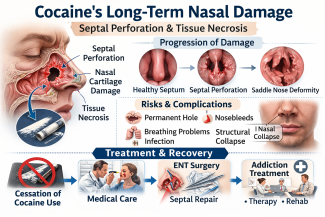
Cocaine is a potent vasoconstrictor. It restricts blood vessels in the nasal mucosa, decreasing oxygen delivery to cartilage and surrounding tissues. Because septal cartilage has limited regenerative capacity and no direct blood supply of its own — it depends entirely on the mucosa covering it — repeated ischemic injury produces a predictable sequence:
- Mucosal ulceration
- Cartilage necrosis
- Septal perforation
- Saddle-nose deformity in advanced cases
Chronic irritation, contamination of illicit substances, and mechanical trauma from repeated insufflation further accelerate tissue damage. The broader progression of nasal injury — appearance, stages, and early symptoms — is covered in Coke Nose: How Cocaine Damages the Nose and When It Becomes Irreversible.
Clinical pearl: The perforation is not caused by the powder abrading a hole through the septum, which is what most patients assume. It is caused by the blood supply being switched off often enough that the cartilage dies from the inside. This distinction matters clinically, because it explains why gentler technique, filtered straws, or alternating nostrils change nothing — the ischemia is pharmacological, not mechanical.
What Are the Signs of Septal Perforation from Cocaine?
Addiction professionals and medical providers should screen for:
- Chronic nasal congestion
- Frequent epistaxis (nosebleeds)
- Loss of smell
- Facial pain or pressure
- Whistling on inspiration
- Visible septal irregularities or a through-and-through defect
Whistling deserves particular attention. It appears when a perforation is small enough for airflow to be forced through it at speed, which means it is often the first symptom of a hole that is still relatively contained — and therefore the point at which intervention has the best chance of limiting enlargement.
Is Cocaine Nasal Damage Permanent?
In early stages, inflammation and minor tissue injury may partially improve with complete cessation of cocaine use. Once septal cartilage is destroyed, the damage is typically permanent. Cartilage does not regenerate, and the body has no mechanism for rebuilding a structure it has lost.
What remains modifiable after that point is progression. A perforation that stops enlarging, stops bleeding, and stops becoming infected is a substantially better clinical situation than the same perforation in someone who continues to use — even though the hole itself is unchanged.
Can a Hole in the Nose Heal on Its Own?
Small mucosal injuries may stabilise if cocaine use stops completely. Established septal perforations rarely close spontaneously. Medical management may include:
- Saline irrigation
- Topical emollients
- Antibiotics for secondary infection
- Septal buttons in select cases
Advanced defects may require surgical repair, but continued cocaine use significantly increases the risk of recurrence.
What Happens If a Perforation Is Left Untreated
Untreated perforations tend to enlarge over time, because the exposed cartilage margins around the hole have lost their mucosal blood supply and continue to die back. That progression causes:
- Whistling sounds during breathing
- Recurrent nosebleeds
- Crusting and infection
- Visible nasal collapse as structural support is lost
In advanced, long-term use the destruction can extend beyond the septum into the hard palate, sinuses, and orbit — the pattern clinicians describe as cocaine-induced midline destructive lesions.
Why This Is Frequently Misdiagnosed
Because cocaine-induced lesions may resemble autoimmune or infectious conditions, differential diagnosis is essential. Laboratory testing may be required to rule out vasculitis or other inflammatory disorders.
The overlap is not subtle. Cocaine-induced midline destructive lesions closely mimic ANCA-associated vasculitis such as granulomatosis with polyangiitis, and affected patients often test positive for ANCA — a result that, without a substance-use history, points a clinician directly toward immunosuppressive treatment. Testing for antibodies against human neutrophil elastase is one of the findings that helps distinguish the two.
Adulterants compound the picture. Levamisole, present in a large share of the US cocaine supply, independently causes ANCA-positive vasculitis, so a patient may have both processes running at once. See What Is Fishscale Cocaine? Purity, Adulterants and Risk.
The practical implication for anyone reading this as a patient: tell the clinician about the cocaine. Withholding it does not protect you — it materially raises the chance of being treated for the wrong disease.
What ENT Evaluation Involves
Assessment typically includes direct examination of the nasal cavity with a speculum or endoscope to establish the size, location, and margins of the defect, along with the condition of the surrounding mucosa. Imaging may be used where midline destruction beyond the septum is suspected. Laboratory testing is directed at ruling out vasculitis, infection, and inflammatory disease.
Size and position drive what is possible. Small anterior perforations are the most amenable to repair; large or posterior defects, and those with poor surrounding tissue, are considerably harder to close.
Septal Buttons
A septal button is a soft prosthesis, usually silicone, fitted through the perforation to seal it functionally. It does not repair tissue. What it does is restore normal airflow patterns, which often resolves the whistling, reduces crusting, and cuts down on bleeding by protecting the exposed margins.
Buttons are useful where surgery is not currently appropriate — including when abstinence is not yet established — and are reversible. They require ongoing cleaning and periodic review, and are not tolerated by everyone.
Surgical Repair
Surgical closure typically uses mucosal flaps to cover the defect, sometimes with an interposition graft between the layers. It is technically demanding, and outcomes correlate strongly with defect size and the quality of surrounding tissue.
Most otolaryngologists require sustained abstinence before attempting reconstruction, and this is not a moral condition — it is a surgical one. Operating on a septum still being subjected to vasoconstriction predicts flap failure, and a failed repair leaves less tissue available for any subsequent attempt.
Saddle-nose deformity is a separate and larger reconstruction, addressing external structural support rather than the septal defect itself.
Why Nasal Damage Increases Treatment Urgency
Visible nasal injury often contributes to stigma, shame, and delayed treatment engagement. Individuals may avoid seeking care until structural damage becomes severe. Clinicians should approach assessment with trauma-informed communication to reduce avoidance behaviours.
There is also a straightforward clinical argument for moving early: the surgical window is better the less tissue has been lost, and every month of continued use narrows the options available later. Comprehensive treatment for cocaine use disorder may include:
- Cognitive Behavioral Therapy (CBT)
- Contingency Management
- Intensive outpatient programming
- Residential treatment when indicated
Frequently Asked Questions
Can cocaine cause a hole in your nose?
Yes. Repeated vasoconstriction starves the septal cartilage of oxygen until the tissue ulcerates and dies, opening a septal perforation. Because cocaine also numbs the area, this is often painless until the hole has formed.
Can a hole in the nose from coke heal on its own?
Small mucosal injuries may stabilise once use stops completely, but established perforations rarely close spontaneously. Management focuses on preventing enlargement and infection, with septal buttons or surgical repair for definitive closure.
How do you fix a hole in the nose from drugs?
Options are a septal button, which seals the defect functionally without repairing tissue, or surgical closure using mucosal flaps. Nearly all surgeons require documented abstinence first, because continued use predicts flap failure.
What does a perforated septum from drug use feel like?
Common experiences are whistling on breathing, chronic crusting, recurrent nosebleeds, congestion that never clears, and facial pressure. Loss of smell is frequent and often noticed only when asked about directly.
Does a septal perforation get bigger over time?
Untreated perforations tend to enlarge, because the exposed cartilage margins have lost their blood supply and continue to die back. Enlargement brings increasing risk of structural collapse.
How long do you have to stop using before surgery?
There is no universal figure — it is set by the surgeon and depends on defect size, tissue quality, and confidence that abstinence will hold. The requirement is clinical rather than punitive: operating on an actively vasoconstricted septum predicts failure.
Can a perforated septum be mistaken for an autoimmune disease?
Yes, and this happens. Cocaine-induced lesions closely mimic ANCA-associated vasculitis, and patients often test ANCA-positive. Without a disclosed cocaine history, a clinician may reasonably treat for autoimmune disease. Disclosure is what prevents the wrong diagnosis.
When Should Medical Care Be Sought?
Immediate evaluation is recommended if an individual experiences persistent bleeding, worsening pain, visible septal collapse, or signs of infection. Early referral to an ENT specialist combined with addiction treatment improves long-term outcomes.
For people whose nasal damage stems from ongoing use, the durable fix is treating the substance use, since the nasal injury is downstream of it. Cocaine Addiction Treatment on Long Island provides confidential placement into vetted programs, and a practical overview of self-care and its limits is available in this clinical guide on healing nasal damage from cocaine use.
Related Guides
- Coke Nose: How Cocaine Damages the Nose and When It Becomes Irreversible
- Why Does Cocaine Cause Nosebleeds?
- What Is Fishscale Cocaine? Purity, Adulterants and Risk
- Is Cocaine the Hardest Drug to Quit? Withdrawal & Recovery
- How Long Does Cocaine Stay in Your System? Test Windows
- Cocaine and Alcohol: Cocaethylene and Cardiac Risk
References
- Trimarchi M, Bertazzoni G, Bussi M. Cocaine-induced midline destructive lesions. Rhinology. PMID 24932619
- Distribution of cocaine-induced midline destructive lesions: systematic review and classification. PMC9130192
- Cocaine-induced midline destructive lesions: a challenge in oral rehabilitation. PMC8003646
- Levamisole-adulterated cocaine-associated ANCA vasculitis: review and pathogenesis. PMC6292360
- National Institute on Drug Abuse. Cocaine Research Topics. NIDA, NIH
- MedlinePlus. Cocaine. U.S. National Library of Medicine
About the Author
Benjamin Zohar, NCACIP, is a Nationally Certified Advanced Clinical Intervention Professional and ISSUP network moderator specializing in addiction intervention, treatment navigation and emerging substance-use risks.
He publishes evidence-informed resources addressing counterfeit medications, fentanyl exposure, benzodiazepine safety, kratom dependence and concentrated 7-hydroxymitragynine products. His work published through ISSUP has been cited or referenced by GoodRx, The Washington Post, WIRED and Newsweek.
Written by: Benjamin Zohar, NCACIP
Medical Review
Medically reviewed by: Brandon McNally, RN
Medical Disclaimer
This article is intended for educational and public-health purposes. It does not provide individualized medical advice, diagnosis or a tapering schedule. Do not start, stop or alter a prescription medication without consulting a qualified healthcare professional. Call emergency services for seizures, difficulty breathing, loss of consciousness, severe confusion or other life-threatening symptoms.