
Buy 7-OH Online? Risks of Concentrated 7-Hydroxymitragynine
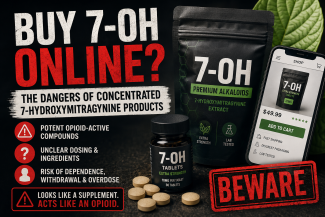
Many people search for where to buy 7-OH online after seeing products marketed as "premium 7-OH," "advanced kratom alkaloids," or concentrated 7-hydroxymitragynine tablets. Before purchasing one of these products, it's important to understand how they differ from traditional kratom leaf, why the FDA has issued warnings about concentrated 7-OH products, and the potential risks of dependence, withdrawal, and overdose.
This guide explains why online 7-OH products can be risky, how they differ from natural kratom, what warning signs to watch for, and why clinicians are increasingly concerned about dependence, withdrawal, and overdose risk.
Key Summary
- 7-OH products sold online are not the same as traditional kratom leaf. Many contain concentrated 7-hydroxymitragynine (7-OH), an opioid-active alkaloid that occurs only in trace amounts naturally.
- Buying 7-OH online may expose consumers to products with unclear ingredients or potency. Labels, formulations, and concentrations can vary between manufacturers and over time.
- Common 7-OH product brands include Hydroxy, 7Tabz, Roxy 7-OH, 7OHMZ, and 777 Jackpot Alkaloids. A brand name alone does not verify the product's contents or safety.
- Regular use of concentrated 7-OH products may lead to tolerance, physical dependence, and opioid-like withdrawal symptoms.
- Mixing concentrated 7-OH with alcohol, benzodiazepines, sedatives, or opioids may increase the risk of serious adverse effects and overdose.
- The FDA has warned consumers about products containing concentrated 7-hydroxymitragynine (7-OH). Several states have also taken regulatory action against concentrated 7-OH products and related compounds.
- This guide explains what to know before buying 7-OH online, including product risks, common brands, FDA warnings, related compounds, and safer alternatives.
Why do people search to buy 7-OH online?
People often search for “buy 7-OH online,” “buy 7OH tablets,” “premium 7-OH products,” or “kratom alkaloids online” because they are looking for stronger effects than ordinary kratom. Some may be trying to manage pain, anxiety, opioid withdrawal, low mood, or tolerance to kratom itself.
That search intent matters. A product sold as stronger, faster, or more concentrated may also carry greater risk. The concern is not only that 7-OH is potent; it is that the online market can make potent opioid-active products look like normal supplements.
What is 7-OH?
7-OH, short for 7-hydroxymitragynine, is an opioid-active alkaloid associated with the kratom plant. In natural kratom leaf, 7-OH occurs only in trace amounts. Concentrated 7-OH products are different because they may deliver far higher exposure than someone would get from traditional kratom leaf or tea.
For a broader explanation of the compound, see our main guide: What is 7-OH and why it is considered an emerging opioid threat.
Why buying 7-OH online can be dangerous
Online 7-OH products can be risky because consumers may not know exactly what compound, dose, or formulation they are receiving. Product names, labels, and ingredients can change quickly, and some products may be marketed with language that makes them sound cleaner or safer than they are.
- Products may contain concentrated 7-hydroxymitragynine rather than ordinary kratom leaf.
- Labels may not clearly identify the actual dose or active compound.
- Formulations may change without consumers realizing it.
- Some products may contain modified or semi-synthetic 7-OH-related compounds.
- Regular use may lead to tolerance, dependence, and withdrawal.
- Mixing 7-OH with alcohol, benzodiazepines, sedatives, or opioids may increase overdose risk.
7-OH products are not the same as kratom leaf
Traditional kratom leaf contains a mixture of alkaloids in natural proportions, with mitragynine usually being the dominant compound. Concentrated 7-OH products are different. They may be designed to deliver stronger opioid-like effects by increasing the amount of 7-hydroxymitragynine or related compounds.
That difference is important. A product can be described as “kratom-derived” while still behaving very differently from natural kratom leaf. Concentrated tablets, extracts, strips, liquids, or capsules may expose the body to opioid-active compounds at levels that are not comparable to traditional use.
Examples of 7-OH products sold online
Examples of products marketed as 7-OH or concentrated 7-hydroxymitragynine products include Hydroxy, 7Tabz, Roxy 7-OH, 7OHMZ, and 777 Jackpot Alkaloids. Product names, formulations, and ingredients can change quickly, so a brand name alone does not confirm the exact compound or dose in a product.
Examples of 7-OH products sold online
Examples of products marketed as 7-OH or concentrated 7-hydroxymitragynine products include Hydroxy, 7Tabz, Roxy 7-OH, 7OHMZ, and 777 Jackpot Alkaloids. Product names, formulations, and ingredients can change quickly, so a brand name alone does not confirm the exact compound or dose in a product.
The key issue is not one brand name. The larger concern is the marketplace: products promoted as stronger kratom alkaloids may contain concentrated opioid-active compounds with unclear safety margins.
<p>For a closer look at one of the best-known branded products, see: <a href="https://www.issup.net/node/70025">Is 7Tabz Safe? FDA Warnings on Concentrated 7-OH</a>.</p>
What to know before buying 7-OH online
If a product is advertised as “premium 7-OH,” “7-OH tablets,” “7-hydroxymitragynine extract,” “advanced kratom alkaloids,” or “legal opioid alternative,” treat it as high risk. These phrases often signal a product that is much more pharmacologically active than ordinary kratom leaf.
- Do you know the exact active ingredient?
- Is the dose verified by independent laboratory testing?
- Is the product legal in your state?
- Could stopping the product cause withdrawal?
- Are you using it to self-medicate pain, anxiety, depression, trauma, or opioid withdrawal?
- Are you mixing it with alcohol, benzodiazepines, sleep medications, or opioids?
Comparison of 7-OH-related compounds
Some regulators have focused not only on 7-hydroxymitragynine itself, but also on related compounds and analogs. These include natural, modified, and semi-synthetic substances that may appear in or around the concentrated 7-OH market.
| Compound | Also known as | Found naturally? | Reported opioid activity* | Commercial product examples** |
|---|---|---|---|---|
| 7-Hydroxymitragynine | 7-OH | Yes, in trace amounts in kratom | High opioid-receptor activity | Hydroxy, 7Tabz, Roxy 7-OH, 7OHMZ, 777 Jackpot Alkaloids and other concentrated 7-OH products |
| Mitragynine pseudoindoxyl | Pseudoindoxyl | No | Very high in preclinical research | No established retail brands identified |
| 7-Acetoxymitragynine | — | No | Under investigation | No established retail brands identified |
| 9-Hydroxycorynantheidine | — | No | Limited published data | No established retail brands identified |
| 10-Hydroxycorynantheidine | — | No | Limited published data | No established retail brands identified |
| MGM-15 | Dihydro-7-hydroxymitragynine, DHM | No | Higher than 7-OH in preclinical studies | No established retail brands identified |
| MGM-16 | 9-Fluoro-7-hydroxymitragynine | No | Limited published human data | No established retail brands identified |
*Reported opioid activity summarizes laboratory and preclinical findings. Human potency comparisons have not been established for most of these compounds.
**Brand examples refer to products marketed as concentrated 7-OH or 7-hydroxymitragynine products. Listing a brand does not confirm the current formulation, legality, dose, or ingredients.
Can buying 7-OH online lead to dependence?
Yes. Regular use of concentrated 7-OH products may lead to tolerance and physical dependence. Tolerance means the body adapts and the same amount may produce less effect over time. Dependence means the body may react when the product is reduced or stopped.
People who stop after sustained use may experience withdrawal symptoms such as anxiety, sweating, restlessness, insomnia, stomach upset, diarrhea, body aches, chills, cravings, and flu-like discomfort. For more detail, see 7-OH withdrawal symptoms and timeline.
Can 7-OH products cause overdose?
Any potent opioid-active product may carry overdose risk, especially when dosing is unclear or when it is mixed with other depressants. Alcohol, benzodiazepines, sleep medications, gabapentinoids, prescription opioids, or illicit opioids may increase the risk of heavy sedation, slowed breathing, loss of consciousness, or medical emergency.
If someone is very sedated, difficult to wake, breathing slowly, turning blue or gray, vomiting while unconscious, or making choking or gurgling sounds, call 911 immediately.
Safer questions to ask instead of “where can I buy 7-OH?”
A better question is not simply where to buy 7-OH online, but why the product feels necessary in the first place. People may turn to 7-OH because of pain, anxiety, depression, trauma, opioid withdrawal, or untreated substance use disorder.
- Am I trying to avoid withdrawal?
- Am I using 7-OH because kratom no longer works?
- Am I using it to manage emotional pain or panic?
- Am I hiding my use or increasing the dose?
- Have I tried to stop and felt sick?
- Would medical or behavioral health support be safer than managing this alone?
Frequently Asked Questions
Can you buy 7-OH online?
Some websites market 7-OH products online, but availability does not mean safety or legality. Concentrated 7-OH products may carry opioid-like risks, unclear dosing, changing formulations, and state-level legal restrictions.
Is 7-OH legal to buy online?
Legal status varies by state and can change quickly. Some states have taken action against concentrated 7-OH or related compounds. Anyone considering these products should check current law in their jurisdiction.
Are 7-OH products the same as kratom?
No. Traditional kratom leaf contains many alkaloids in natural proportions. Concentrated 7-OH products may contain much higher levels of opioid-active compounds than naturally occur in the plant.
What are common 7-OH product names?
Products marketed in the 7-OH space may include names such as Hydroxy, 7Tabz, Roxy 7-OH, 7OHMZ, and 777 Jackpot Alkaloids. Brand names and formulations can change, and a name alone does not confirm the exact contents.
Can 7-OH cause withdrawal?
Yes. Regular use of concentrated 7-OH products may lead to physical dependence. Stopping suddenly may cause opioid-like withdrawal symptoms, including insomnia, anxiety, sweating, diarrhea, body aches, and cravings.
Is 7-OH stronger than kratom?
Concentrated 7-OH products can be much stronger than traditional kratom leaf because they deliver higher exposure to opioid-active compounds. Natural kratom leaf contains 7-OH only in trace amounts.
Related 7-OH Guides
- What is 7-OH and why it is considered an emerging opioid threat
- Is 7Tabz Safe? FDA Warnings on Concentrated 7-OH
- 7-OH withdrawal symptoms and timeline
- 7-OH and Suboxone
By Benjamin Zohar, NCACIP — ISSUP New York Network Moderator. Medically reviewed by Brandon McNally, RN.
This article is for informational purposes only and does not provide medical, legal, or purchasing advice. Drug laws change frequently and vary by state. If you are experiencing a medical emergency, call 911.
```