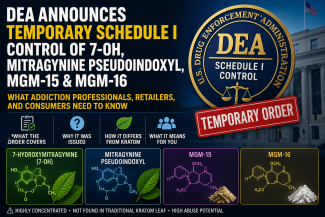
DEA Announces Temporary Schedule I Control of 7-OH, Mitragynine Pseudoindoxyl, MGM-15, and MGM-16
By Benjamin Zohar, NCACIP
Nationally Certified Advanced Clinical Intervention Professional (NCACIP)
ISSUP New York Network Moderator
NAADAC Professional Member · CCAPP Individual Member
Medically reviewed by Brandon McNally, RN
Last updated: July 2, 2026
DEA has filed Notices of Intent to temporarily place 7-OH (above a specified threshold) and three related synthetic derivatives into Schedule I of the Controlled Substances Act.
On July 1, 2026, the U.S. Drug Enforcement Administration (DEA) filed formal notices of its intent to temporarily place highly concentrated 7-hydroxymitragynine (7-OH) and three related substances — mitragynine pseudoindoxyl (MP), MGM-15, and MGM-16 — into Schedule I of the Controlled Substances Act (CSA). The action follows growing concern that enhanced, concentrated, and synthetic kratom-derived opioid products are being sold in tablets, gummies, drink shots, dissolvable strips, powders, and other consumer-friendly forms.
New to this topic? Start with the comprehensive overview: What Is 7-OH? The Emerging Opioid Threat Addiction Professionals Need to Understand in 2026. This article expands on that foundation by focusing on the DEA’s federal scheduling action, exactly what it does and does not cover, how it differs from traditional botanical kratom, and what addiction professionals, retailers, consumers, and families should know.
Table of Contents
- Key Takeaways
- What Did the DEA Announce?
- Timeline of Federal and State Events (2025–2026)
- Which Compounds Are Covered?
- Relationship Between the Compounds
- Does This Apply to Traditional Botanical Kratom?
- Why Was the DEA Action Issued?
- Scientific Background
- What This Means for Addiction Professionals
- What This Means for Retailers
- What This Means for Consumers and Families
- Florida vs. Federal: How the Two Actions Compare
- Clinical Recognition and Treatment Considerations
- Frequently Asked Questions
- Explore the 7-OH Clinical Knowledge Base
- References
Key Takeaways
- On July 1, 2026, the DEA filed two Notices of Intent (NOIs) to temporarily schedule 7-OH above a specified threshold and three related synthetic or chemically modified kratom-derived compounds.
- The named related substances are mitragynine pseudoindoxyl (MP), dihydro-7-hydroxymitragynine (MGM-15), and 9-fluoro-7-hydroxymitragynine (MGM-16).
- These are Notices of Intent, not yet final orders. The notices are set for Federal Register publication on July 6, 2026, and the temporary scheduling orders are expected to take effect roughly 30 days after publication (early August 2026).
- The action targets enhanced, concentrated, synthetic, and semi-synthetic 7-OH products — not ordinary botanical kratom leaf that contains only naturally occurring trace amounts of 7-OH below the specified threshold.
- The U.S. Department of Health and Human Services (HHS) confirmed that synthetic 7-OH and the three related substances have no currently accepted medical use and a high potential for abuse.
- Addiction professionals should ask patients specific questions about product type, dose, route of use, packaging, withdrawal symptoms, and co-use with alcohol, benzodiazepines, opioids, or other sedatives.
What Did the DEA Announce?
On July 1, 2026, the U.S. Drug Enforcement Administration (DEA) filed its intent to temporarily place 7-hydroxymitragynine (7-OH) and three related substances into Schedule I of the Controlled Substances Act (CSA). Before the DEA issued the notices, the U.S. Department of Health and Human Services (HHS) confirmed that synthetic 7-OH and the three related substances have no accepted medical use and a high potential for abuse.
The action was issued as two separate Notices of Intent (NOIs) sent to the Federal Register:
- Notice 1 — 7-OH above a specified threshold: concentrated or enhanced 7-hydroxymitragynine products, rather than ordinary kratom leaf containing only trace natural levels.
- Notice 2 — three related substances: mitragynine pseudoindoxyl, MGM-15, and MGM-16.
This distinction matters. The federal action is not best understood as a simple “kratom ban.” It is a targeted response to enhanced, concentrated, synthetic, and semi-synthetic opioid-active products that differ substantially from traditional botanical kratom. Once the temporary scheduling orders take effect, the manufacture, distribution, sale, and possession of covered 7-OH substances will become subject to the criminal, civil, and administrative provisions of the CSA.
Important status note: As of this writing, these are Notices of Intent beginning the temporary scheduling process — not final orders in effect. The public comment window on the HHS/DEA docket runs through July 31, 2026, and the temporary orders are expected to take effect approximately 30 days after Federal Register publication. Professionals and retailers should confirm the current effective status before making legal or clinical decisions.
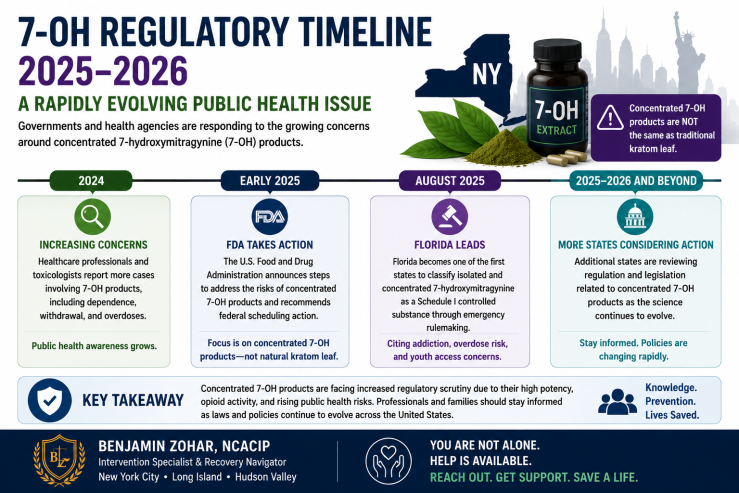
Timeline of Federal and State Events (2025–2026)
The DEA action did not happen in isolation. It follows more than a year of escalating federal and state attention to concentrated and synthetic 7-OH products.
- July 29, 2025 — FDA: The U.S. Food and Drug Administration formally recommended that the DEA classify concentrated 7-OH products as Schedule I controlled substances, emphasizing concentrated tablets, gummies, drink mixes, and shots rather than whole-leaf kratom.
- 2025 — Florida (initial rule): Florida acted at the state level to restrict 7-OH concentrates, initially limiting products above a low concentration threshold.
- June 22, 2026 — Florida (expanded emergency rule): Florida Attorney General James Uthmeier signed an emergency rule — effective immediately — expanding Schedule I to cover additional 7-OH–related compounds after new products emerged that skirted the earlier restriction.
- July 1, 2026 — HHS: HHS confirmed that synthetic 7-OH and the three related substances have no accepted medical use and a high potential for abuse, supporting DEA action.
- July 1, 2026 — DEA: DEA filed two Notices of Intent to temporarily schedule 7-OH (above a specified threshold) and mitragynine pseudoindoxyl, MGM-15, and MGM-16.
- July 6, 2026 — Federal Register: Scheduled formal publication of the notices, opening the pathway for the temporary orders to take effect approximately 30 days later.
- July 31, 2026 — Comment deadline: Public comment window on the HHS/DEA docket closes.
Which Compounds Are Covered?
The federal action focuses on four kratom-related substances or categories. MP, MGM-15, and MGM-16 do not occur naturally in the kratom plant: MP is a chemical rearrangement product of 7-OH, while MGM-15 and MGM-16 are synthetic derivatives of 7-OH.
| Substance | Also known as | Naturally in kratom? | Regulatory status (July 2026) | Learn more |
|---|---|---|---|---|
| 7-Hydroxymitragynine | 7-OH | Yes, but only in trace amounts (typically under ~2% of total leaf alkaloids); concentrated or enhanced in many commercial products. | Federal NOI filed for 7-OH above a specified threshold (pending, ~Aug 2026); Schedule I in Florida. | What Is 7-OH? The Emerging Opioid Threat Addiction Professionals Need to Understand in 2026 |
| Mitragynine pseudoindoxyl | MP, pseudoindoxyl | No — a chemical rearrangement product of 7-OH. | Federal NOI filed (pending, ~Aug 2026); Schedule I in Florida. | What Is Mitragynine Pseudoindoxyl? The Kratom-Derived Opioid Compound Explained |
| Dihydro-7-hydroxymitragynine | MGM-15 | No — a synthetic / semi-synthetic derivative of 7-OH. | Federal NOI filed (pending, ~Aug 2026); Schedule I in Florida. | MGM-16, MGM-15, and 7-OH: Understanding the New Generation of Semi-Synthetic Kratom Opioids |
| 9-Fluoro-7-hydroxymitragynine | MGM-16 | No — a synthetic fluorinated derivative of 7-OH. | Federal NOI filed (pending, ~Aug 2026); Schedule I in Florida. | MGM-16, MGM-15, and 7-OH: Understanding the New Generation of Semi-Synthetic Kratom Opioids |
DEA’s notice also targets related forms of the covered substances — such as isomers, esters, ethers, salts, and follow-on products — which is a common approach used to prevent minor chemical modifications from evading control.
Relationship Between the Compounds
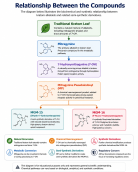
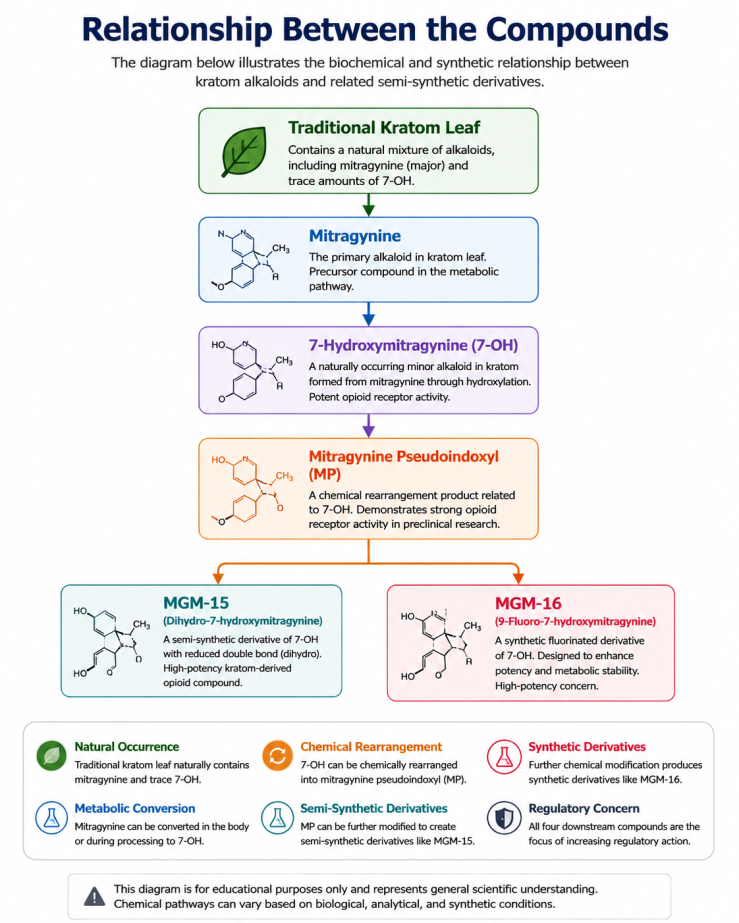
The compounds covered by the DEA action sit along a chemical progression that begins with the natural kratom leaf and moves toward increasingly concentrated, rearranged, and synthetic opioid-active molecules. The diagram below shows that progression.
How the covered compounds relate: from natural leaf alkaloids to concentrated, rearranged, and synthetic derivatives.
Traditional Kratom Leaf
Natural mixture of alkaloids, including mitragynine (major) and trace 7-OH.
▼
Mitragynine
The primary alkaloid in kratom leaf; precursor in the metabolic pathway.
▼
7-Hydroxymitragynine (7-OH)
A naturally occurring minor alkaloid formed from mitragynine; potent opioid-receptor activity. Concentrated or enhanced in many commercial products.
▼
Mitragynine Pseudoindoxyl (MP)
A chemical rearrangement product of 7-OH; strong opioid-receptor activity in preclinical research. Not naturally present in the leaf.
▼
MGM-15
Dihydro-7-hydroxymitragynine. A semi-synthetic derivative of 7-OH; high-potency kratom-derived opioid concern.
MGM-16
9-Fluoro-7-hydroxymitragynine. A synthetic fluorinated derivative of 7-OH; high-potency concern.
Educational summary only; chemical pathways vary based on biological, analytical, and synthetic conditions. For the underlying chemistry, see MGM-16, MGM-15, and 7-OH: Understanding the New Generation of Semi-Synthetic Kratom Opioids and What Is Mitragynine Pseudoindoxyl? The Kratom-Derived Opioid Compound Explained.
Does This Apply to Traditional Botanical Kratom?
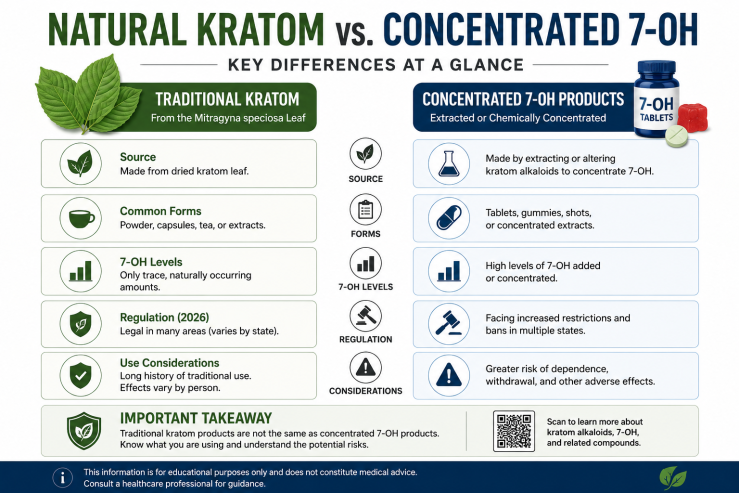
The DEA, HHS, and FDA materials draw an important distinction between traditional botanical kratom leaf and enhanced or concentrated 7-OH products.
Traditional kratom leaf contains a mixture of naturally occurring alkaloids, including mitragynine and trace amounts of 7-OH. By contrast, enhanced 7-OH products may contain elevated levels of opioid-active compounds and are sometimes sold in forms that resemble candy, supplements, or convenience-store wellness products.
According to the federal materials, this temporary scheduling action does not apply to botanical kratom products that contain naturally occurring 7-OH below the specified threshold; it targets synthesized products and those containing elevated concentrations of 7-OH. MP, MGM-15, and MGM-16 are not naturally occurring kratom leaf alkaloids in the way traditional kratom consumers understand botanical kratom.
. Suggested alt: "Comparison of traditional botanical kratom leaf versus enhanced concentrated 7-OH products" -->
Why Was the DEA Action Issued?
The DEA action was issued because federal health and law enforcement agencies identified enhanced 7-OH products and related synthetic derivatives as an emerging public-health concern. DEA laboratory findings indicate that commercial products often contain higher amounts of 7-OH than what is found naturally in the leaf, and the agency has described these products as posing an imminent threat given their highly unpredictable effects.
Regulators have cited several concerns:
- Opioid-like pharmacology: 7-OH and related substances interact with opioid receptors and may produce opioid-like effects; regulators have compared the pharmacological profile to that of Schedule II opioids.
- Dependence and withdrawal: Regular use may lead to tolerance, physical dependence, cravings, and withdrawal symptoms.
- Overdose risk: High-dose products, and combinations with alcohol, benzodiazepines, opioids, sleep medications, or other depressants, may increase respiratory-depression risk.
- Consumer confusion: Products may be marketed as “kratom,” “alkaloids,” “7-OH,” “plant-based,” or “natural,” even when they contain concentrated or chemically modified opioid-active compounds.
- Youth-appealing formats: Some products are sold as gummies, tablets, drink shots, dissolvable strips, or candy-like items with bright packaging.
- Retail availability: Products have appeared online and in smoke shops, vape stores, convenience stores, and gas stations.
Federal agencies have also noted previous FDA actions against companies marketing 7-OH products as dietary supplements, foods, or unapproved drugs.
Scientific Background
7-OH is a minor alkaloid that makes up only a small fraction of the total alkaloid content in natural kratom leaves, yet it is substantially more potent at the mu-opioid receptor than mitragynine, the leaf’s major alkaloid. Concentrated and semi-synthetic 7-OH products on the market can be many times more potent than whole-leaf kratom, which is central to the regulatory concern.
The peer-reviewed literature helps explain both the pharmacology and the ongoing scientific debate:
- Kratom pharmacology and toxicology. Reviews of Mitragyna speciosa describe mitragynine and 7-OH as the principal active alkaloids, acting through opioid and monoaminergic mechanisms with dose-dependent stimulant and depressant effects (Warner, Kaufman & Grundmann, 2016).
- Mitragynine pseudoindoxyl. MP is an oxidative rearrangement product of mitragynine that acts as a potent mu-opioid agonist / delta-opioid antagonist in preclinical models — foundational chemistry now relevant to the synthetic derivatives being scheduled (Váradi et al., 2016).
- Abuse-potential debate. A published eight-factor analysis argued that whole-leaf kratom’s abuse potential falls within the range of many uncontrolled substances and cautioned against broad Schedule I listing of natural kratom — a useful counterpoint that reinforces why regulators are distinguishing concentrated/synthetic 7-OH from botanical leaf (Henningfield, Wang & Huestis, 2022).
An important caveat: much of what is known about MP, MGM-15, and MGM-16 comes from preclinical (laboratory and animal) research. Human clinical evidence on these specific derivatives remains limited, and readers should treat claims about their effects as emerging rather than settled.
What This Means for Addiction Professionals
For addiction professionals, the most important takeaway is that “kratom use” can no longer be assessed as a single category.
A patient may be using:
- Traditional kratom leaf powder
- Kratom capsules
- Kratom extract shots
- Concentrated 7-OH tablets
- 7-OH gummies or candy-like products
- 7-OH powders or dissolvable strips
- Products containing MGM-15, MP, or other related compounds
- Products with incomplete or inaccurate labeling
These products may carry very different clinical risks. Concentrated 7-OH and related synthetic or semi-synthetic products may require a more opioid-focused assessment, including screening for dependence, withdrawal, overdose risk, relapse risk, and co-occurring opioid use disorder.
What This Means for Retailers
Retailers should treat this federal action as a serious compliance issue. Once the temporary orders take effect, products containing enhanced or concentrated 7-OH, mitragynine pseudoindoxyl, MGM-15, MGM-16, or related forms may carry significant legal risk depending on the final scheduling order, product composition, threshold levels, and applicable state law.
Because the federal action currently consists of Notices of Intent with a defined comment period and a delayed effective date, retailers should not assume either that nothing has changed or that everything is already prohibited. The prudent course is to track the effective date closely and obtain qualified legal counsel.
Retailers should not assume products are lawful simply because they are labeled “kratom,” “plant alkaloid,” “extract,” or “natural.” Labels, certificates of analysis, supplier claims, and marketing language should be reviewed carefully. Retailers should also recognize that some states, including Florida, have taken separate and in some respects broader action under state controlled-substance law.
What This Means for Consumers and Families
Consumers and families should understand that enhanced 7-OH products are not the same as traditional kratom leaf. A product sold in a gas station, smoke shop, vape store, or online marketplace may contain concentrated opioid-active alkaloids that produce stronger effects, faster tolerance, and more severe withdrawal than expected.
Warning signs of possible dependence may include:
- Using 7-OH products daily or multiple times per day
- Needing higher doses to feel the same effect
- Feeling sick, anxious, restless, or unable to sleep without the product
- Using despite health, family, work, legal, or financial consequences
- Combining 7-OH with alcohol, benzodiazepines, opioids, or sleep medications
- Repeated failed attempts to stop
If overdose is suspected, call 911 immediately and administer naloxone if available. Suspected 7-OH toxicity should be treated as an opioid-related emergency.
For family-focused guidance, see What New York Families Should Know About 7-Hydroxymitragynine (7-OH) and Mitragynine Pseudoindoxyl (MP).
Florida vs. Federal: How the Two Actions Compare
Florida acted shortly before the federal announcement. On June 22, 2026, Florida Attorney General James Uthmeier signed an emergency rule — effective immediately — placing highly concentrated 7-OH and related compounds into Schedule I under state law, expanding on an earlier 2025 rule.
Florida’s expanded rule named several substances, including:
- 7-hydroxymitragynine
- Mitragynine pseudoindoxyl
- 7-acetoxymitragynine
- 9-hydroxycorynantheidine
- 10-hydroxycorynantheidine
- MGM-15
- MGM-16
Florida’s rule also took a concentration-based approach: it limited the covered chemicals to no more than 1 milligram per gram (solids or pills) or per milliliter (liquids), and required that any product containing these compounds also contain at least 100 times more ordinary mitragynine by mass — a design intended to block super-concentrated or chemically altered formulas.
The key differences and similarities:
- Legal authority: Florida’s rule is state law and took effect immediately; the DEA action is federal and currently proceeds through Notices of Intent with a delayed effective date.
- Scope: Florida’s list is broader in some respects, naming additional corynantheidine-related compounds (such as 9- and 10-hydroxycorynantheidine) not enumerated in the federal notices.
- Direction: Both actions point the same way — regulators are increasingly distinguishing traditional botanical kratom from enhanced, concentrated, synthetic, and semi-synthetic kratom-derived opioid products.
Clinical Recognition and Treatment Considerations
Clinicians should ask targeted questions when assessing possible 7-OH or kratom-derived opioid use. Useful assessment questions include:
- What exact product name or brand are you using?
- Is it leaf powder, capsules, liquid extract, tablets, gummies, drink shots, dissolvable strips, or powder?
- Does the label mention 7-OH, 7-hydroxy, alkaloids, MGM-15, MP, or “enhanced” kratom?
- How many times per day are you using it?
- Do you feel withdrawal between doses?
- Have you tried to stop and been unable to?
- Are you using alcohol, benzodiazepines, opioids, gabapentin, pregabalin, or sleep medications?
- Do you have a history of opioid use disorder or kratom dependence?
Treatment may include medical evaluation, withdrawal management, medication assessment, outpatient treatment, intensive outpatient programming, residential care, relapse prevention, family support, and ongoing monitoring. Buprenorphine-based treatment may be considered in some kratom or 7-OH withdrawal cases, but it should only be managed by qualified medical professionals.
For treatment-specific discussion, see 7-OH Withdrawal: Symptoms, Timeline, and Treatment Considerations and Does Suboxone Help Kratom / 7-OH Withdrawal?.
Frequently Asked Questions
Does the DEA action ban traditional kratom leaf?
No. The temporary federal action targets concentrated or enhanced 7-hydroxymitragynine (7-OH) above a specified threshold and three synthetic or semi-synthetic derivatives. Traditional botanical kratom leaf containing naturally occurring trace levels of 7-OH is not the focus of the DEA action.
Is natural kratom now Schedule I?
No. The DEA notices distinguish between traditional botanical kratom and enhanced products containing elevated concentrations of 7-OH or related synthetic compounds. The action is aimed at the latter.
Is 7-OH a Schedule I controlled substance right now?
Not yet, at the federal level. On July 1, 2026, the DEA filed Notices of Intent to temporarily schedule concentrated 7-OH and related derivatives. Those notices are set to publish in the Federal Register on July 6, 2026, with the temporary orders expected to take effect roughly 30 days later. Separately, Florida has already scheduled 7-OH and multiple related compounds under state law through emergency rulemaking.
What products are affected?
Products marketed as 7-OH tablets, gummies, drink shots, extracts, powders, dissolvable strips, and other concentrated alkaloid products may fall within scope depending on composition and concentration. Ordinary whole-leaf kratom below the specified 7-OH threshold is not the target.
Does this affect smoke shops and convenience stores?
Yes. Once the temporary orders take effect, retailers selling products containing covered compounds may face significant legal obligations under both federal and applicable state law. Retailers should track the effective date and consult qualified legal counsel.
Does Florida law match the DEA action?
They are closely aligned but are separate legal authorities. Florida’s emergency rule took effect immediately and is broader in some respects, specifically naming additional compounds — 7-hydroxymitragynine, mitragynine pseudoindoxyl, 7-acetoxymitragynine, 9-hydroxycorynantheidine, 10-hydroxycorynantheidine, MGM-15, and MGM-16. The federal notices enumerate 7-OH (above a threshold), mitragynine pseudoindoxyl, MGM-15, and MGM-16.
Is MGM-16 naturally found in kratom?
No. Current evidence indicates MGM-16 (9-fluoro-7-hydroxymitragynine) is a synthetic fluorinated derivative produced through chemical modification and is not a naturally occurring kratom alkaloid. The same applies to MGM-15 (a semi-synthetic derivative) and MP (a chemical rearrangement product of 7-OH).
Should clinicians ask specifically about 7-OH instead of simply asking about kratom?
Yes. Patients frequently refer to these products simply as “kratom,” even when they are using concentrated 7-OH tablets or enhanced extracts. Asking about specific product names, formulations, packaging, and dosing improves assessment and treatment planning.
Explore the 7-OH Clinical Knowledge Base
Continue exploring the science, clinical management, public-health implications, and regulatory developments surrounding concentrated 7-hydroxymitragynine (7-OH), mitragynine pseudoindoxyl (MP), and emerging semi-synthetic kratom-derived opioids.
Understanding 7-OH and Related Compounds
- What Is 7-OH? The Emerging Opioid Threat Addiction Professionals Need to Understand in 2026
- What Is Mitragynine Pseudoindoxyl? The Kratom-Derived Opioid Compound Explained
- MGM-16, MGM-15, and 7-OH: Understanding the New Generation of Semi-Synthetic Kratom Opioids
Withdrawal & Treatment
- 7-OH Withdrawal: Symptoms, Timeline, and Treatment Considerations
- 7-Hydroxymitragynine (7-OH) and Kratom Withdrawal: Clinical Insights and Buprenorphine-Based Management
- Does Suboxone Help Kratom / 7-OH Withdrawal?
Consumer Safety
- Is 7Tabz Safe? FDA Warnings on Concentrated 7-OH
- Buy 7-OH Online? Risks of Concentrated 7-Hydroxymitragynine
Families & Community Resources
- What New York Families Should Know About 7-Hydroxymitragynine (7-OH) and Mitragynine Pseudoindoxyl (MP)
- Kratom Addiction on Long Island: Understanding 7-Hydroxymitragynine (7-OH)
- Kratom Detox on Long Island (Nassau & Suffolk)
Federal & Regulatory Updates
References
- U.S. Drug Enforcement Administration. “DEA to Temporarily Schedule 7-OH and Related Substances to Protect Public Safety.” July 1, 2026. dea.gov
- U.S. Department of Health and Human Services. “HHS, FDA Commend DEA Action Against Dangerous Enhanced 7-OH Products.” July 1, 2026. hhs.gov
- U.S. Department of Health and Human Services / DEA. “Temporary Placement of 7-Hydroxymitragynine Above a Specified Threshold and Related Substances into Schedule I.” Federal Register public inspection document (Docket No. HHS-OASH-2026-0232); comments due July 31, 2026.
- U.S. Food and Drug Administration. “FDA Takes Steps to Restrict 7-OH Opioid Products Threatening American Consumers.” July 29, 2025.
- Florida Office of the Attorney General. “Attorney General James Uthmeier Signs Emergency Rule Immediately Scheduling Dangerous 7-OH and Related Compounds as Schedule I Controlled Substances.” June 22, 2026. myfloridalegal.com
- Warner ML, Kaufman NC, Grundmann O. “The pharmacology and toxicology of kratom: from traditional herb to drug of abuse.” Int J Legal Med. 2016;130(1):127–138. doi:10.1007/s00414-015-1279-y
- Váradi A, Marrone GF, Palmer TC, et al. “Mitragynine/Corynantheidine Pseudoindoxyls As Opioid Analgesics with Mu Agonism and Delta Antagonism, Which Do Not Recruit β-Arrestin-2.” J Med Chem. 2016;59(18):8381–8397. doi:10.1021/acs.jmedchem.6b00748
- Henningfield JE, Wang DW, Huestis MA. “Kratom Abuse Potential 2021: An Updated Eight Factor Analysis.” Front Pharmacol. 2022;12:775073. doi:10.3389/fphar.2021.775073
- National Institute on Drug Abuse. “Kratom DrugFacts.” National Institutes of Health.
Peer-reviewed references (6–8) were identified via PubMed.
About the Author
Benjamin Zohar, NCACIP is a Nationally Certified Advanced Clinical Intervention Professional, ISSUP New York Network Moderator, NAADAC Professional Member, and CCAPP Individual Member. He publishes educational resources on emerging psychoactive substances, addiction treatment navigation, intervention strategy, and public health, with a focus on helping professionals and families understand fast-moving developments in the drug landscape.
This article is for educational and informational purposes only and does not constitute medical, legal, or emergency advice. Regulatory status is evolving; confirm current federal and state law before making decisions. If someone may be overdosing, call 911 immediately and administer naloxone if available. Individuals concerned about 7-OH, kratom-derived products, withdrawal, or substance use disorders should consult qualified medical and addiction professionals.