
What Is Lean (Dirty Sprite)? Risks, Slang & Treatment
The Integrated Recovery & Intervention Education Network (IRIEN) is a professional hub moderated by Benjamin Zohar for sharing evidence-based insights, experiences, and resources across the continuum of addiction care. Back to Integrated Recovery & Intervention Education Network (IRIEN) main page
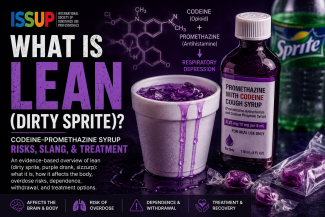
Lean — also called "dirty sprite," "purple drank," or "sizzurp" — is an illicit drink made by mixing prescription cough syrup containing codeine (an opioid) and promethazine (a sedating antihistamine) with soda and candy. The combination of two central nervous system depressants can slow or stop breathing, and regular use produces opioid dependence and withdrawal.
Key Takeaways
- Lean combines codeine, an opioid, with promethazine, a sedating phenothiazine antihistamine — two central nervous system depressants whose respiratory-depressant effects are intensified when taken together.
- "Dirty sprite," "purple drank," "sizzurp," "drank," "barre," and "Texas tea" all refer to the same codeine-promethazine mixture.
- Codeine-promethazine cough syrup is a federal Schedule V controlled substance; possessing or distributing it without a valid prescription is illegal.
- Since 2018, the FDA has restricted codeine cough medicines to adults 18 and older — yet national survey data show lean use is most prevalent among ages 13–21.
- The sweet soda-and-candy flavor masks the medicine taste, leading users to consume dangerous amounts before effects fully appear.
- Street-sold "syrup" is frequently counterfeit and may contain unknown opioids or other substances, adding an unpredictable overdose risk.
- Codeine dependence produces a classic opioid withdrawal syndrome; medically supervised treatment, including buprenorphine-based options, is effective.
Table of Contents
- Quick Answer: What Is Lean?
- Lean at a Glance
- Dirty Sprite, Purple Drank, Sizzurp: Street Names Explained
- What Is Actually in Lean?
- How Codeine and Promethazine Interact
- What Lean Does to the Body
- Can You Overdose on Lean?
- Counterfeit Syrup and Unknown Ingredients
- Lean Dependence and Addiction Risk
- Lean and Codeine Withdrawal
- Is Lean Illegal?
- Origin and Cultural Presence
- "Dirty Sprite" the Drink vs. Other Uses of the Term
- Myth vs. Fact
- When to Seek Help
- Frequently Asked Questions
- Related Clinical Resources
- References
Quick Answer: What Is Lean?
Lean is a recreational drink made from prescription-strength cough syrup containing codeine and promethazine, mixed with a soft drink — classically Sprite, which is where the slang "dirty sprite" comes from — and often hard candy for flavor and color. Because codeine is an opioid and promethazine intensifies its sedative effects, lean carries risks of respiratory depression, overdose, dependence, and withdrawal that are far greater than most users assume from a "soda drink."
Lean at a Glance
| Active drugs | Codeine (opioid antitussive) + promethazine (phenothiazine antihistamine) |
| Drug classes | Opioid + first-generation antihistamine — both CNS depressants |
| Common street names | Lean, dirty sprite, purple drank, sizzurp, drank, barre, Texas tea, purple tonic |
| Legitimate medical use | Short-term cough/upper-respiratory relief in adults 18+ when alternatives are inadequate |
| Controlled-substance status | Schedule V (United States, cough preparations ≤200 mg codeine per 100 mL) |
| Primary acute risk | Respiratory depression, especially combined with alcohol, benzodiazepines, or other sedatives |
| Chronic risks | Opioid dependence, withdrawal, dental damage, constipation, weight gain, seizure risk at high doses |
| Highest-use demographic | Teenagers and young adults (ages 13–21 accounted for roughly two-thirds of users in national survey data) |
Dirty Sprite, Purple Drank, Sizzurp: Street Names Explained
All of the common street names describe the same codeine-promethazine mixture; each name has its own etymology.
- Lean — from the drink's intense sedation: users slouch or "lean" because they cannot stand up straight. The most widespread term.
- Dirty sprite — the clear soda turns cloudy, or "dirty," when the cough syrup is poured in; popularized further by rapper Future's mixtape Dirty Sprite (2011) and album DS2 (2015).
- Purple drank / purple tonic — "purple" from the deep purple color of the prescription promethazine-codeine syrup itself, which persists after clear soda and candy are added; "drank" is a Southern-vernacular variation of "drink" from the mixture's Houston origins.
- Sizzurp / syrup / drank — slang adaptations of "syrup," dating to the Houston scene that formed around DJ Screw in the 1990s.
- Barre / Texas tea — regional Gulf Coast variants; "Texas tea" nods to the drink's origin in the American South.
Clinicians and school professionals should treat any of these terms — including emoji shorthand such as the purple heart, baby bottle, or double-cup imagery on social media — as referring to codeine-promethazine misuse until established otherwise. For a companion discussion of how drug slang is coded online, see the IRIEN slang resource on what the snowflake emoji means in drug slang.
What Is Actually in Lean?
The base ingredient is prescription oral solution containing codeine phosphate and promethazine hydrochloride, dispensed legally only for cough and upper-respiratory symptoms in adults. The syrup is combined with lemon-lime soda and frequently hard candy. Some versions substitute other codeine-containing preparations, and street versions may substitute entirely different sedatives when genuine syrup is unavailable.
Two points matter clinically:
- There is no standard dose. The drink is homemade, concentrations vary wildly, and the sweet flavor conceals how much active drug is being consumed.
- The "soda drink" framing lowers perceived risk. Adolescents in particular rate lean as safer than pills or powders because the delivery vehicle is familiar — a perception directly contradicted by its pharmacology.
How Codeine and Promethazine Interact
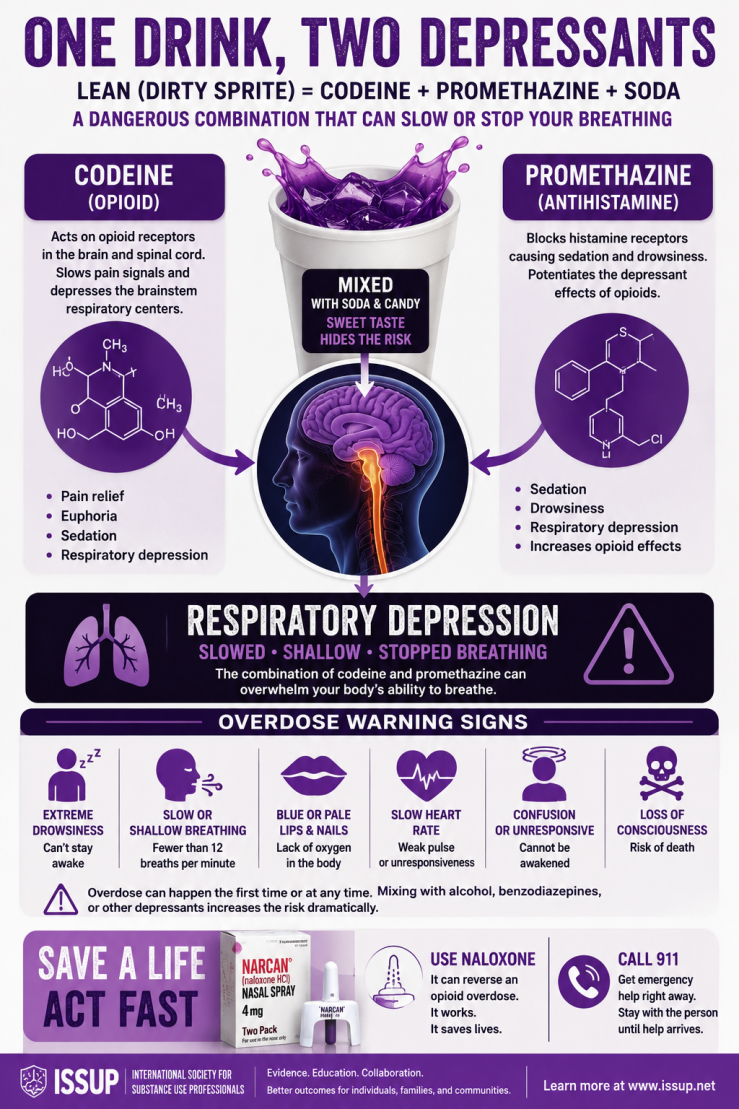
Codeine and promethazine depress the central nervous system through different mechanisms that compound each other — which is precisely what makes the combination more dangerous than either drug alone.
| Feature | Codeine | Promethazine |
|---|---|---|
| Drug class | Opioid (natural opiate) | Phenothiazine antihistamine |
| Primary action | Prodrug metabolized by CYP2D6 to morphine; acts on mu-opioid receptors | H1-receptor blockade with strong anticholinergic and sedative effects |
| Contribution to lean | Euphoria, analgesia, respiratory depression, dependence | Heavy sedation; intensifies codeine's respiratory depression |
| Notable risks | Ultra-rapid CYP2D6 metabolizers convert codeine to morphine unusually fast, raising overdose risk unpredictably | Dystonic reactions; evidence of neuroleptic malignant syndrome (NMS) in rare cases; boxed warning for respiratory depression in young children |
| Dependence liability | High with repeated use (opioid) | Not a classic dependence drug, but reinforces the sedative experience |
FDA labeling for promethazine-codeine products carries a boxed warning that concomitant use of opioids with benzodiazepines, alcohol, or other CNS depressants may result in profound sedation, respiratory depression, coma, and death. In practice, lean is very often consumed with alcohol, cannabis, or benzodiazepines — exactly the combinations the labeling warns against. The same combination logic covered in the IRIEN benzodiazepine resource Xanax vs Valium vs Ativan vs Klonopin: Key Differences applies here: stacking CNS depressants multiplies rather than adds risk.
Clinical Pearl: Codeine is a prodrug — it must be converted to morphine by CYP2D6 to produce most of its opioid effect. Patients who are ultra-rapid metabolizers (a genotype more common in some populations) can experience morphine-level effects from "ordinary" codeine amounts, while poor metabolizers may feel little effect and escalate their intake. This genetic variability is one reason lean overdoses appear so unpredictable across users drinking the "same" mixture.
What Lean Does to the Body
Lean's sought-after effects are euphoria, relaxation, and a dissociated, "swaying" sedation — the origin of the name. Adverse effects scale with amount consumed and co-used substances:
- Extreme drowsiness, slurred speech, impaired coordination and motor control
- Slowed heart rate and blood pressure changes
- Nausea, vomiting, and severe constipation with regular use
- Confusion, memory impairment, and blackouts
- Dental decay ("syrup mouth") from chronic sugar-plus-xerostomia exposure
- Seizure risk and, rarely, neuroleptic malignant syndrome linked to the promethazine component
- Respiratory depression — the mechanism behind lean-related deaths
Can You Overdose on Lean?
Yes. Because codeine is an opioid, lean overdose is opioid overdose, and it is treated the same way. Warning signs include:
- Extreme sleepiness or inability to wake
- Slow, shallow, or stopped breathing
- Blue or gray lips and fingertips
- Gurgling or choking sounds
- Pinpoint pupils
- Loss of consciousness
If any of these appear: call 911, place the person on their side, and administer naloxone (Narcan) if available. Naloxone reverses codeine's respiratory depression, though it does not reverse promethazine's sedation — which is why emergency evaluation is still required even when someone appears to recover. In New York, naloxone is available free through OASAS-registered Opioid Overdose Prevention Programs, and SAMHSA's National Helpline (1-800-662-4357) provides confidential, 24/7 treatment referral nationwide.
Counterfeit Syrup and Unknown Ingredients
Genuine promethazine-codeine syrup is tightly controlled, several brand products have been discontinued, and legitimate supply has contracted — while street demand persists. The predictable result is a counterfeit market: "syrup" sold on social media or in person may be diluted, dyed, mixed with other sedatives, or contain different opioids entirely, including fentanyl in reported cases. As with counterfeit pressed pills, appearance is no guarantee of content, and the overdose profile of a fake bottle is unknowable. The counterfeit dynamics documented in the IRIEN resource on Xanax Bars: Types, Colors, Slang, Risks & Treatment apply to syrup with equal force.
Lean Dependence and Addiction Risk
Regular lean use produces opioid dependence: the nervous system adapts to codeine, and tolerance drives escalating consumption. National survey research analyzing NSDUH data found lean use concentrated among teenagers and young adults — ages 13 to 21 accounted for roughly two-thirds of identified users — despite FDA labeling restricting these products to adults 18 and older since 2018. Early-onset opioid exposure is a well-established risk factor for later opioid use disorder, which is what makes the adolescent skew of lean use a genuine public-health concern rather than a cultural curiosity.
Dependence becomes a use disorder when behavioral patterns emerge: drinking lean daily, escalating amounts, using it to cope, combining it with alcohol or benzodiazepines, buying syrup from nonmedical sources, or continuing despite consequences. The distinction between physical dependence and addiction is covered in the IRIEN glossary entry Abstinence — Definition, Meaning in Addiction Recovery, and Why the Term Is Contested.
Lean and Codeine Withdrawal
Stopping after sustained use produces a classic opioid withdrawal syndrome: anxiety, restlessness, muscle aches, sweating, gastrointestinal distress, insomnia, and intense cravings. Codeine withdrawal is rarely medically dangerous in the way benzodiazepine or alcohol withdrawal can be, but it is a major relapse driver, and medically supervised management — including buprenorphine-based approaches where indicated — substantially improves outcomes. For the symptom-by-symptom picture, see the companion IRIEN article Codeine Withdrawal: Symptoms, Timeline, and Treatment Considerations, and for the parallel clinical logic applied to another opioid-active substance, 7-OH Withdrawal: Symptoms, Timeline, and Treatment Considerations.
Medication-assisted pathways relevant to codeine dependence mirror those used for other opioids; the IRIEN MAT resources, including Signs Your Suboxone Dose Is Too Low (Cravings, Withdrawal & What to Do), cover the practical considerations clinicians and families ask about most.
Is Lean Illegal?
The prescription syrup itself is a federal Schedule V controlled substance — the DEA schedule covering cough preparations containing not more than 200 milligrams of codeine per 100 milliliters. It is legal only when prescribed to and used by the patient it was prescribed for. Possessing it without a prescription, sharing it, selling it, or distributing it is illegal and can carry criminal charges. State scheduling can be stricter, and prescribers face heightened scrutiny of codeine-promethazine prescribing after years of documented diversion cases.
Origin and Cultural Presence
The mixture originated in Houston, Texas, and gained wide visibility through the 1990s hip-hop scene associated with DJ Screw, whose "chopped and screwed" sound became culturally intertwined with syrup use. The widely reported deaths of DJ Screw (2000) and Pimp C (2007), both linked to codeine-promethazine, did little to slow the drink's spread through music and, later, social media — where it remains persistently glamorized. For prevention professionals, the cultural packaging is the point: lean reaches adolescents through aspirational imagery, not street-corner marketing, which is why school- and family-facing education must address the imagery directly rather than only the pharmacology.
"Dirty Sprite" the Drink vs. Other Uses of the Term
Searchers encounter two unrelated meanings. In drug slang, "dirty sprite" is the codeine-promethazine drink described in this article. Separately, "Dirty Sprite" is used as a cannabis strain name by some commercial breeders, and DS2 (Dirty Sprite 2) is a 2015 studio album by the rapper Future. Context usually resolves the ambiguity quickly — but professionals reviewing a young person's messages should be aware that the strain name and the drink share a search footprint.
Myth vs. Fact
| Myth | Fact |
|---|---|
| "Lean is just cough syrup — it can't be that dangerous." | Lean contains an opioid plus a sedative that intensifies it. Respiratory depression from the combination has caused deaths, including high-profile ones. |
| "You can't get addicted to a drink." | Codeine is an opioid. Regular use produces tolerance, dependence, and a recognized opioid withdrawal syndrome regardless of the delivery vehicle. |
| "It's safer than pills because you can pace yourself." | The sweet flavor masks potency, homemade mixtures have no standard dose, and delayed onset encourages re-dosing before the first amount peaks. |
| "Real syrup from a bottle is always what it says it is." | Street-sold syrup is frequently counterfeit and may contain unknown sedatives or other opioids, including fentanyl in reported cases. |
| "Mixing it with alcohol just makes it stronger, not riskier." | Alcohol is a third CNS depressant; FDA boxed warnings identify exactly this combination as a cause of profound sedation, respiratory failure, and death. |
When to Seek Help
Professional evaluation is warranted if someone cannot stop or reduce lean use, experiences withdrawal symptoms between uses, needs increasing amounts, combines lean with alcohol or benzodiazepines, buys syrup from nonmedical sources, or shows escalating sedation, blackouts, or declining functioning. Families searching for local options in New York can start with lean addiction treatment on Long Island. For a detailed community-level guide, see Lean on Long Island: Dirty Sprite, Fake Syrup Risks, Withdrawal & Treatment Options. Nationally, SAMHSA's helpline and treatment locator remain the front door.
Frequently Asked Questions
What is dirty sprite?
"Dirty sprite" is street slang for lean: prescription cough syrup containing codeine and promethazine mixed into Sprite or another soft drink, usually with hard candy. It is the same substance as "purple drank" and "sizzurp." The name references Sprite "dirtied" with the syrup.
Is dirty sprite the same as lean?
Yes. Dirty sprite, lean, purple drank, sizzurp, drank, barre, and Texas tea all refer to the same codeine-promethazine drink. The terms vary by region and era, not by ingredients.
What does lean do to you?
Lean produces euphoria, heavy sedation, and impaired coordination. Because it combines an opioid with a sedating antihistamine, it can slow breathing to dangerous levels — especially when combined with alcohol, benzodiazepines, or other sedatives — and regular use leads to opioid dependence.
Can you overdose on lean?
Yes. Lean overdose is opioid overdose: extreme sleepiness, slow or stopped breathing, blue lips, pinpoint pupils, and unresponsiveness. Call 911 and give naloxone (Narcan) if available — it reverses the codeine component and will not harm someone who has not taken opioids.
Is lean illegal?
The codeine-promethazine syrup used to make lean is a Schedule V controlled substance in the United States. It is legal only with a valid prescription for the person using it; possessing, sharing, or selling it otherwise is illegal.
Why is it called purple drank?
"Purple" refers to the deep purple color of the prescription promethazine-codeine syrup, which persists after clear soda and hard candy are mixed in. "Drank" is a Southern-vernacular variation of "drink," rooted in Houston, Texas, where the mixture originated and first became culturally prominent in the 1990s.
Does lean show up on a drug test?
Yes. Codeine is an opiate and is detected by standard opiate panels; it also metabolizes partly to morphine, which tests detect as well. Detection windows depend on dose, frequency, metabolism, and test type.
Is lean addictive?
Yes. Codeine is an opioid, and regular lean use produces tolerance, physical dependence, and opioid withdrawal on stopping. Adolescent use is a particular concern because early opioid exposure raises the risk of later opioid use disorder.
Is "dirty sprite" a weed strain?
The term is used both ways. In drug slang it means the codeine-promethazine drink; separately, some cannabis breeders market a strain under the same name, and DS2 is a Future album. Context determines the meaning — but the drink is the meaning relevant to opioid risk.
Related Clinical Resources
- Codeine Withdrawal: Symptoms, Timeline, and Treatment Considerations — the companion withdrawal guide for this article.
- Xanax Bars: Types, Colors, Slang, Risks & Treatment — counterfeit-pill dynamics and CNS-depressant combination risks.
- What Does ❄️ Mean in Drug Slang? Snowflake Emoji and Cocaine — decoding coded drug language online.
- What Is 7-OH? The Emerging Opioid Threat Addiction Professionals Need to Understand in 2026 — another opioid-active substance marketed as low-risk.
- 7-OH Withdrawal: Symptoms, Timeline, and Treatment Considerations — parallel opioid-withdrawal clinical framework.
- Does Suboxone Help With Kratom Dependence? — buprenorphine-based management questions families ask.
- Abstinence — Definition, Meaning in Addiction Recovery, and Why the Term Is Contested — glossary context for recovery terminology.
Last updated: July 5, 2026
References
- U.S. Drug Enforcement Administration (DEA). "Controlled Substance Schedules." Schedule V cough preparations containing not more than 200 mg codeine per 100 mL. https://www.deadiversion.usdoj.gov/schedules/schedules.html
- U.S. Food and Drug Administration (FDA). "FDA Drug Safety Communication: FDA requires labeling changes for prescription opioid cough and cold medicines to limit their use to adults 18 years and older." 2018. https://www.fda.gov/drugs/drug-safety-and-availability
- U.S. Food and Drug Administration (FDA). Promethazine Hydrochloride and Codeine Phosphate Oral Solution — Prescribing Information (boxed warnings: respiratory depression; concomitant CNS depressants). https://www.accessdata.fda.gov/drugsatfda_docs/label/2017/008306s033lbl.pdf
- National Institute on Drug Abuse (NIDA). "Benzodiazepines and Opioids." https://nida.nih.gov/research-topics/opioids/benzodiazepines-opioids
- Substance Abuse and Mental Health Services Administration (SAMHSA). National Helpline and treatment locator. https://www.samhsa.gov/find-help/national-helpline
- "Codeine and promethazine: Exploratory study on 'lean' or 'sizzurp' using national survey data and an online forum." PLOS ONE, 2024. https://pmc.ncbi.nlm.nih.gov/articles/PMC10962845/
- New York State Office of Addiction Services and Supports (OASAS). Opioid Overdose Prevention Programs (free naloxone). https://oasas.ny.gov
About the author: Benjamin Zohar is a Nationally Certified Advanced Clinical Intervention Professional (NCACIP), the ISSUP New York Network Moderator, a NAADAC Professional Member, and a CCAPP Individual Member. He has worked in addiction treatment navigation, crisis intervention, and recovery support for over a decade across New York State
Medical review: Brandon McNally, RN — Registered Nurse specializing in addiction medicine.
This article is for educational and informational purposes only and does not constitute medical advice or a diagnosis. If someone may be overdosing, call 911 immediately and administer naloxone if available. If you or a loved one may be struggling with substance use, consult a qualified professional.