

The range of medical, psychological, and social services designed to help individuals reduce or stop substance use and manage substance use disorders. Treatment may include assessment, counselling and behavioural therapies, medication-assisted treatment, withdrawal management, and support for co-occurring mental or physical health conditions. Effective treatment is typically person-centred and evidence-informed, and may be provided in outpatient, community, or residential settings. Treatment aims to improve health and functioning, reduce substance-related harms, and support individuals in moving toward recovery and long-term wellbeing.
Treatment
New Psychoactive Substances (NPS) Webinar Series
Various NPS have significantly changed the picture of drug use in different countries. They are now very prominent in the drug market. Indeed, many of these substances are intended to circumvent drug laws and are sold as ‘legal’...
Oxytocin as an adolescent treatment for methamphetamine addiction after early life stress in male and female rats
Abstract Early life stress (ELS) is associated with perturbed neural development and augmented vulnerability to mental health disorders, including addiction. How ELS changes the brain to increase addiction risk is poorly understood, and...
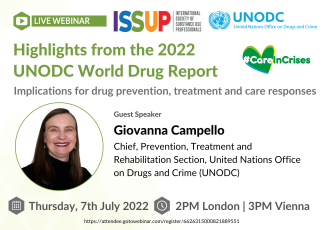
Highlights from the 2022 UNODC World Drug Report: Implications for drug prevention, treatment and care responses
ISSUP presented a webinar on Thursday, July 7, 2022, featuring Giovanna Campello, Chief of the Prevention, Treatment and Rehabilitation Section, United Nations Office on Drugs and Crime (UNODC) presenting highlights from the 2022 edition of...
Highlights from the 2022 UNODC World Drug Report: Implications for drug prevention, treatment and care responses
ISSUP presented a webinar on Thursday, July 7, 2014, featuring Giovanna Campello, Chief of the Prevention, Treatment and Rehabilitation Section, United Nations Office on Drugs and Crime (UNODC) presenting highlights from the 2022 edition of the UNODC World Drug Report. The presentation included implications on drug prevention, treatment and rehabilitation responses during times of crisis.
Involvement of the ghrelin system in the maintenance and reinstatement of cocaine-motivated behaviors: a role of adrenergic action at peripheral β1 receptors
Abstract Cocaine addiction is a significant medical and public concern. Despite decades of research effort, development of pharmacotherapy for cocaine use disorder remains largely unsuccessful. This may be partially due to insufficient...
Addiction Severity Index (ASI) Assessment Interview Part IV
Addiction Severity Index (ASI) Assessment Interview Part IV This video is intended as a learning tool for practicing assessment interview skills by using ASI adapted from UTC on course 5: Intake, Screening Assessment, Treatment Plan, and...
The prevalence of comorbid serious mental illnesses and substance use disorders in prison populations: a systematic review and meta-analysis
Comorbid mental illnesses and substance use disorders are associated with adverse criminal, social, and health outcomes. Yet, their burden is not reliably known among prison populations. We therefore aimed to estimate the prevalence of comorbid serious mental illnesses and substance use disorders (dual disorders) among people in prison worldwide.
Introducing Training of Trainers (ToT) on Universal Treatment Curriculum (UTC) Advance course 9-15 in Pakistan
The country office Pakistan of “United Nation Office on Drug & Crime” (UNODC) is happy to offer the Training of Trainers (ToT) on Universal Treatment Curriculum (UTC) Advance course 9-15. We are inviting the application for ToT on following...
Jamaica to update national drug policy
National Security Minister, Dr Horace Chang, says the Government is taking the necessary steps to implement an updated National Policy and Plan of Action for Drug Control
Training on UTC 01 - Sri Lanka
At the start of may 2022 the Preventive Education and Training Unit of the National Dangerous Drugs Control Board has conducted training on Universal Treatment Curriculum, Course 01 (UTC - 01) for 32 staff members in NDDCB. The training...