
The Dangers of 7-OH and New York’s Proposed Ban on High-7-OH Products
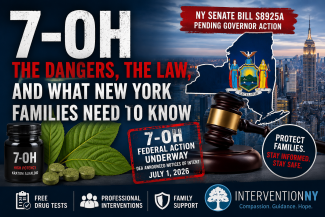
The Dangers of 7-OH and Why Accessibility in New York Matters
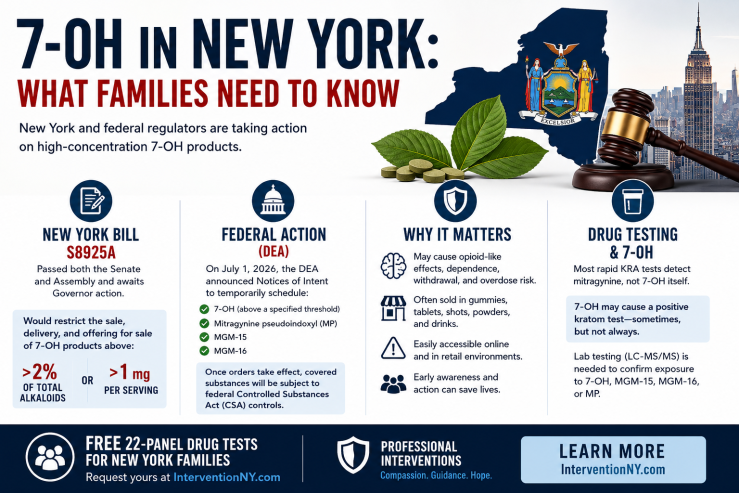
New York is moving closer to restricting retail access to high-concentration 7-hydroxymitragynine (7-OH) products. Senate Bill S8925A has passed both the Senate and Assembly and is awaiting action by the Governor. If signed, the bill would prohibit businesses from knowingly selling, offering for sale, or delivering products containing 7-OH above specific concentration limits.
This matters because concentrated 7-OH products are different from traditional kratom leaf. While kratom is often marketed as a “natural” supplement, high-7-OH products may produce strong opioid-like effects and have been linked to concerns about dependence, withdrawal, and overdose risk.
Key Summary
- New York Senate Bill S8925A has passed both chambers and is awaiting Governor action.
- The bill targets products containing 7-OH above 2% of total alkaloids or more than 1 milligram per serving.
- The bill focuses on sale, delivery, and offering for sale, not simple consumer possession.
- The DEA announced Notices of Intent on July 1, 2026 to temporarily schedule high-7-OH products and related substances including mitragynine pseudoindoxyl, MGM-15, and MGM-16.
- Once DEA temporary scheduling orders take effect, covered substances will be subject to federal Controlled Substances Act controls.
- Most rapid KRA drug tests detect mitragynine, not 7-OH itself.
Is 7-OH Banned in New York?
As of July 2026, 7-OH is not yet fully banned under New York law. However, New York Senate Bill S8925A has passed both chambers of the Legislature and is awaiting action by the Governor. If signed, the law would restrict the retail sale, delivery, and offering for sale of products containing 7-hydroxymitragynine above the bill’s thresholds: more than 2% of total alkaloids or more than 1 milligram per serving.
The bill is aimed at high-concentration 7-OH products, not ordinary natural kratom leaf products that remain below those thresholds. New York lawmakers have described the legislation as targeting highly concentrated and synthetic 7-OH products that far exceed the naturally occurring levels found in kratom leaves.
Is 7-OH Federally Scheduled?
On July 1, 2026, the DEA announced Notices of Intent to temporarily schedule certain 7-OH products and related substances. One notice addresses 7-OH above a specified threshold. A second notice addresses three related substances: mitragynine pseudoindoxyl (MP), MGM-15, and MGM-16.
This is an important federal development, but it should be described accurately. The DEA announcement is a move toward temporary Schedule I control. According to the DEA, once the temporary scheduling orders take effect, the manufacture, distribution, sale, and possession of covered 7-OH substances will become subject to federal criminal, civil, and administrative provisions of the Controlled Substances Act.
What New York Senate Bill S8925A Would Do
Senate Bill S8925A would amend New York’s General Business Law to prohibit the sale of certain high-7-OH products. The bill applies to businesses, online platforms, firms, corporations, partnerships, and other business entities that knowingly sell, offer for sale, or deliver prohibited 7-OH products in New York.
| Provision | What S8925A Says | Why It Matters |
|---|---|---|
| Product threshold | More than 2% of total alkaloids or more than 1 mg of 7-OH per serving | Targets concentrated products rather than ordinary low-7-OH kratom leaf. |
| Restricted conduct | Sale, offering for sale, or delivery of prohibited 7-OH products | Focuses on retail and online access rather than simple possession language. |
| First violation | Civil penalty of up to $500 | Creates enforcement consequences for businesses that knowingly sell covered products. |
| Later violations | Civil penalty of up to $1,000 for each subsequent violation | Increases penalties for repeat violations. |
| Use of penalty funds | Deposited into the New York State Drug Treatment and Public Education Fund | Directs penalty money toward treatment and public education. |
| Effective date | 90 days after the bill becomes law | Gives businesses and regulators time before enforcement begins. |
New York Senate Bill S8925A Legislative Timeline
The bill moved through the New York Legislature during the 2026 session. The table below summarizes key legislative milestones.
| Date | Legislative Action | What It Means |
|---|---|---|
| January 16, 2026 | Referred to the Senate Consumer Protection Committee | The bill was introduced and assigned to committee review. |
| May 11, 2026 | Amended and recommitted to Consumer Protection | Lawmakers revised the bill and sent it back to committee. |
| May 11, 2026 | Print Number 8925A | The amended version became the official S8925A text. |
| May 20, 2026 | Passed Senate Consumer Protection Committee | The committee advanced the bill to the Senate floor. |
| June 2, 2026 | Passed the New York Senate | The Senate approved the bill. |
| June 5, 2026 | Passed the New York State Assembly and returned to the Senate | The bill passed both chambers and moved toward the Governor’s desk. |
| Current status | Awaiting Governor action | If signed, the law would take effect 90 days later. |
What Are MGM-15, MGM-16, and Mitragynine Pseudoindoxyl?
The DEA and federal health agencies have also focused on 7-OH-related substances, including mitragynine pseudoindoxyl (MP), MGM-15, and MGM-16. HHS and FDA state that MP, MGM-15, and MGM-16 do not occur naturally in the kratom plant. MP is described as a chemical rearrangement product of 7-OH, while MGM-15 and MGM-16 are synthetic derivatives of 7-OH. :contentReference[oaicite:1]{index=1}
For a deeper clinical explanation of these emerging compounds, see MGM-16, MGM-15, and 7-OH: Understanding the New Generation of Semi-Synthetic Kratom Opioids and What Is Mitragynine Pseudoindoxyl? The Kratom-Derived Opioid Compound Explained.
Is Possession of 7-OH a Crime in New York?
S8925A is written as a sale, delivery, and offering-for-sale restriction. It does not appear to create a simple-possession offense for consumers under New York law. The proposed penalties are civil penalties directed at businesses or online platforms that knowingly sell or deliver covered 7-OH products.
That said, the legal status of 7-OH is changing quickly. At the federal level, the DEA announced Notices of Intent to temporarily schedule certain 7-OH products and related substances under Schedule I of the Controlled Substances Act. Once temporary scheduling orders take effect, covered substances would become federally controlled.
In practical terms, New York is moving toward a retail ban on high-7-OH products, while the DEA is moving toward temporary federal Schedule I control of covered 7-OH substances. Consumers, retailers, and families should avoid assuming that all kratom products are treated the same under the law.
Why Accessibility Is a Public Health Issue
Accessibility matters because high-potency 7-OH products are often sold in consumer-friendly forms, including tablets, gummies, beverages, and other products that may appear less risky than traditional opioids. These products have been described in public reporting as “gas station heroin,” reflecting concern that they are being sold in ordinary retail environments despite opioid-like effects.
Federal health agencies have also raised concerns. HHS and FDA stated that DEA issued Notices of Intent to begin the temporary scheduling process for certain kratom-related substances, including enhanced 7-OH products.
Will 7-OH Cause a Positive Kratom Test?
Sometimes, but not always. Most rapid urine drug tests labeled KRA or kratom are designed to detect mitragynine, the primary alkaloid naturally found in kratom, rather than 7-hydroxymitragynine (7-OH) itself.
Many commercially available 7-OH products still contain measurable amounts of mitragynine because they are manufactured from kratom extracts. In these cases, a standard KRA urine test may produce a positive result.
However, highly purified or synthetic 7-OH products may contain little or no mitragynine. Because most rapid immunoassay drug tests have not been validated to specifically detect 7-OH, these products may not trigger a positive KRA result. Cross-reactivity varies depending on the manufacturer and design of the urine test.
If confirmation of exposure to concentrated 7-OH, MGM-15, MGM-16, or mitragynine pseudoindoxyl is required, specialized laboratory testing—such as liquid chromatography-tandem mass spectrometry (LC-MS/MS)—may be necessary. Standard point-of-care urine cups generally cannot distinguish traditional kratom use from concentrated or semi-synthetic kratom-derived products.
A Community-Driven Prevention Response
At InterventionNY.com, we believe awareness, early identification, and family education are important parts of prevention. To support families, schools, and community organizations across New York, we are distributing free 22-panel drug tests that can detect kratom along with a broad range of other substances.
Drug testing should not replace communication, clinical assessment, or professional help. However, when families are worried about kratom, 7-OH, or other substance use, access to accurate testing can help start an informed conversation and guide the next step.
The Role of Professional Intervention Services
When families suspect kratom or 7-OH use, professional intervention services can provide a structured, compassionate pathway toward help. A trained interventionist can help families move from fear and confusion into a clear plan of action.
Professional interventionists may help by:
- Assessing the situation: Reviewing substance use patterns, mental health concerns, medical history, safety risks, and family dynamics.
- Educating the family: Helping loved ones communicate clearly, set boundaries, and avoid reactive or enabling patterns.
- Facilitating the intervention: Leading a structured conversation focused on treatment, safety, and immediate next steps.
- Coordinating placement: Helping connect individuals with detox, residential treatment, outpatient care, or mental health services when appropriate.
- Supporting aftercare: Encouraging continued therapy, recovery support, family involvement, and relapse-prevention planning.
Why Certified Professionals Matter
Certified intervention professionals bring training, ethical accountability, and experience with complex family systems. Credentials such as NCACIP reflect advanced intervention training and a commitment to professional standards.
For families in New York, local knowledge also matters. A qualified interventionist should understand the treatment landscape, including detox options, mental health resources, insurance barriers, outpatient programs, and regional provider networks.
Related Clinical Resources
Continue exploring clinical, regulatory, family, and testing information about concentrated 7-OH, mitragynine pseudoindoxyl, MGM-15, MGM-16, kratom withdrawal, and treatment options.
- What Is 7-OH? The Emerging Opioid Threat Addiction Professionals Need to Understand in 2026
- DEA Announces Temporary Schedule I Control of 7-OH, Mitragynine Pseudoindoxyl, MGM-15, and MGM-16
- MGM-16, MGM-15, and 7-OH: Understanding the New Generation of Semi-Synthetic Kratom Opioids
- What Is Mitragynine Pseudoindoxyl? The Kratom-Derived Opioid Compound Explained
- 7-OH Withdrawal: Symptoms, Timeline, and Treatment Considerations
- Does Suboxone Help With Kratom Dependence?
- Is 7Tabz Safe? FDA Warnings on Concentrated 7-OH
- Buy 7-OH Online? Risks of Concentrated 7-Hydroxymitragynine
- What New York Families Should Know About 7-OH and Mitragynine Pseudoindoxyl
Frequently Asked Questions
Is 7-OH banned in New York?
Not fully yet. As of July 2026, New York Senate Bill S8925A has passed both the Senate and Assembly and is awaiting Governor action. If signed, it would restrict the sale, delivery, and offering for sale of products containing 7-OH above the bill’s thresholds.
Does S8925A ban all kratom?
No. The bill is aimed at high-7-OH products above specific thresholds. It does not appear to ban ordinary natural kratom leaf products that remain below those 7-OH limits.
Is possession of 7-OH a crime in New York?
S8925A focuses on businesses, online platforms, sale, delivery, and offering for sale. It does not appear to create a simple consumer possession offense under New York law. However, federal scheduling actions and state laws can change quickly.
Is 7-OH federally Schedule I?
The DEA announced Notices of Intent on July 1, 2026 to temporarily place covered 7-OH products and related substances into Schedule I. The DEA states that once the temporary scheduling orders take effect, covered substances will be subject to federal Controlled Substances Act controls.
What substances are included in the DEA action?
The DEA announcement addresses 7-OH above a specified threshold and related substances including mitragynine pseudoindoxyl, MGM-15, and MGM-16.
Will 7-OH show up on a drug test?
Sometimes, but not always. Most rapid KRA drug tests detect mitragynine rather than 7-OH itself. Some 7-OH products may trigger a KRA-positive result if they contain mitragynine, but purified or synthetic 7-OH may not be detected by standard kratom cups.
What type of test can confirm 7-OH, MGM-15, MGM-16, or mitragynine pseudoindoxyl?
Specialized laboratory testing such as LC-MS/MS is generally needed. Standard rapid urine cups are not designed to distinguish traditional kratom from concentrated 7-OH or semi-synthetic kratom-derived opioids.
Take Action Today
If you or someone you love may be struggling with kratom, 7-OH, or another substance, do not wait for the situation to become a crisis. Visit InterventionNY.com to request free drug tests and learn more about certified intervention services in New York.
Through education, prevention, professional intervention, and community support, families can respond earlier and more effectively to the risks associated with concentrated kratom products.
This article is for educational purposes only and does not provide legal or medical advice. Laws can change quickly. For legal questions about possession, sale, or distribution of 7-OH, speak with a qualified attorney in your state.